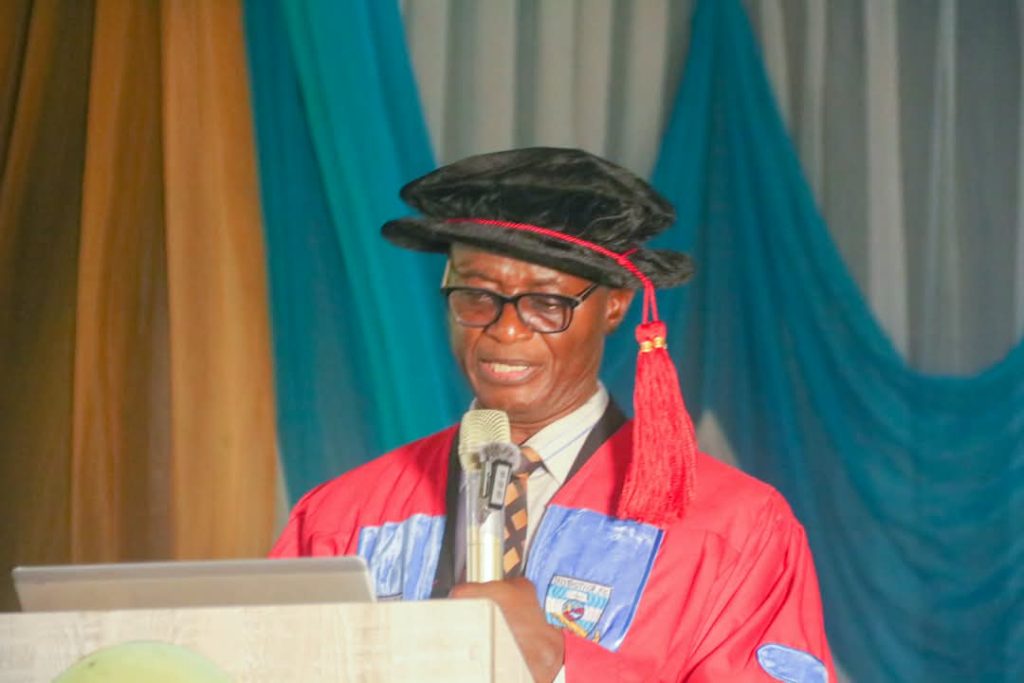
Professor Yusuf Mustapha
A professor of Research, Measurement and Evaluation at the University of Jos (UNIJOS), Yusuf A. Mustapha, has called on the Federal Government, in collaboration with the National Universities Commission (NUC), to introduce undergraduate degree programmes in educational tests and measurement.
Mustapha made the call on Tuesday in Jos while delivering the 130th inaugural lecture of the University of Jos, titled: _“Managing joys and curbing sorrows of educational tests and assessment: Preventing an apocalypse in the educational system.”_
He said the proposed programme would provide primary and secondary schools with qualified professionals who could handle examination and assessment processes.
The don said Nigeria currently has postgraduate programmes in the field but lacks an undergraduate programme specifically designed to train experts in educational tests and measurement.
“I am recommending that the Federal Ministry of Education, in collaboration with NUC, should come up with an undergraduate program in educational tests and measurement.
“What we have right now is only a master degree and PhD. We don’t have undergraduates” He stated.
According to him, producing graduates specifically trained in testing and measurement would help schools recruit qualified examination officers and improve the quality of assessment in the education system.
He said, “Why am I saying that if we have them undergraduate BSCN test and measurement, at least our secondary schools and primary schools will be able to recruit qualified examination officers.”
Mustapha also drew a comparison with guidance and counselling, arguing that schools should similarly have professionals specifically trained to handle educational testing and measurement.
“For what is happening now, anybody can be a town officer. They just look at you and they are looking back. Just like we have guidance and counseling in our schools, we can also have those that are qualified test and measurement experts”
The professor stressed that educational assessment could not be eliminated because it provides evidence needed to determine learning outcomes and make decisions within the education system.
He, however, called for reforms to address the negative consequences associated with poorly managed assessment, including anxiety, inequality and examination malpractice.
“Educational assessment cannot be abolished. If you are going to remove assessment, then we stop education. Not education, but we must have to reform. There must be reform,” he said.
According to him, assessment should be designed and administered in ways that promote fairness, human dignity and continuous learning rather than merely serving as a mechanism for accountability.
He said effective assessment should be valid, reliable, fair, objective and inclusive, adding that proper management could help prevent what he described as an “apocalypse” in the educational system.
The don also advocated a shift from punishment to prevention in dealing with examination malpractice and other assessment-related challenges.
He identified early detection, counselling, quality assessment and ethical practices among the measures required to address the problems confronting educational assessment.
Mustapha said there were several measures that could be adopted to reform assessment practices, noting that he had outlined up to 28 of them in his inaugural lecture book.
He urged stakeholders in the education sector to ensure that assessment serves learners and supports meaningful educational development.