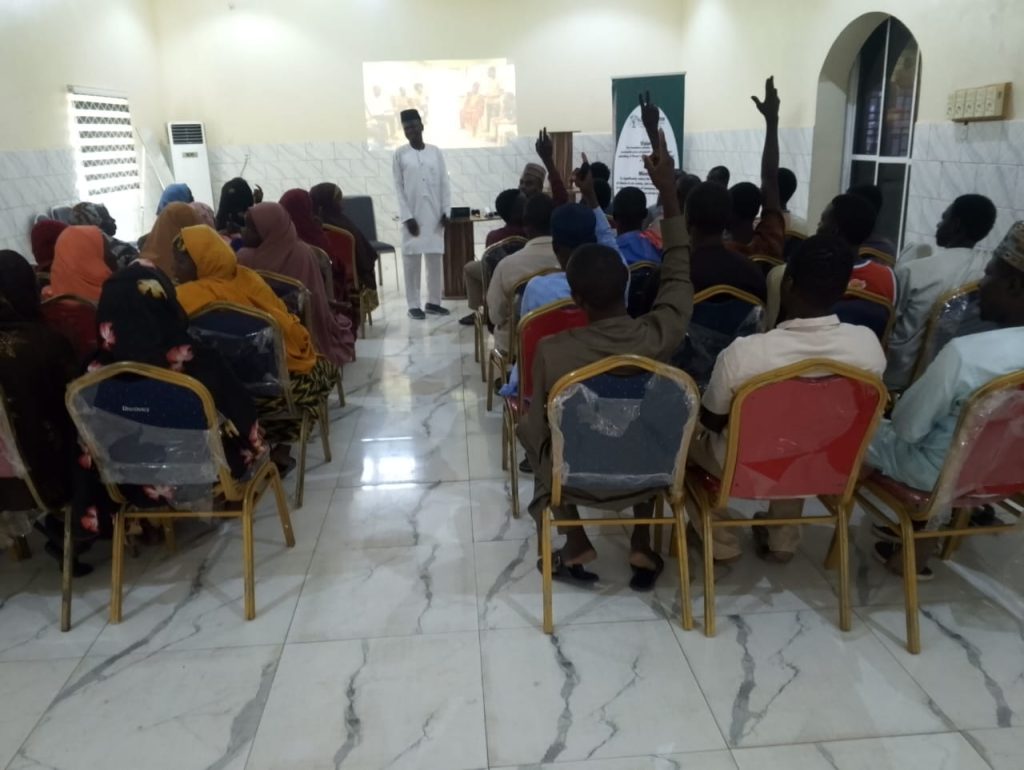
The Allamin Foundation for Peace and Development (ALFOPED) has trained 40 selected leaders of the Jire Dole Network on community outreach and human rights advocacy in Maiduguri, Borno State.
The one-day seminar, titled: _“Community Outreach and Advocacy for Human Rights”,_ was organised under the Support Activities of the Victims’ Network (Jire Dole) project. It was held on Tuesday at the Town Grill Pizza Banquet Hall in Maiduguri.
Speaking at the seminar, the resource person and consultant to ALFOPED, Dr. Muhammad Abdullahi of the University of Maiduguri, said the project was designed to advance a victim-centred approach to justice and accountability for victims of human rights violations and international crimes committed in North-East Nigeria.
He said the project is funded by Amnesty International and implemented by the Allamin Foundation for Peace and Development.
According to him, the programme aims to “enhance participants’ understanding of community outreach and advocacy concepts within the human rights context.”
Dr. Abdullahi added that the training was also organised to improve participants’ understanding of effective and context-appropriate outreach strategies based on the realities in Borno State.
He said the workshop would equip participants with practical skills to identify and prioritise key human rights issues in their communities and take appropriate action.
The consultant explained that another objective of the training was to “build participants’ skills to develop clear, simple and context-specific advocacy plans and messages” and prepare them to design and implement advocacy activities using documented cases of human rights violations as evidence.
He further stated that the seminar was organised to “strengthen participants’ ability to plan and conduct community outreach activities effectively” and provide an opportunity for members of the network to meet, exchange ideas, brainstorm and improve their advocacy methods.
According to him, the workshop will equip participants with the knowledge needed to promote peaceful coexistence, social cohesion and stronger interaction among individuals and groups while encouraging better compliance with human rights standards.
Dr. Abdullahi also said the training would expose participants to effective ways of engaging relevant authorities and organisations working on human rights and transitional justice.
He noted that participants would gain a better understanding of behavioural and attitudinal change, social interaction and the proper procedures for carrying out advocacy responsibilities within their communities.
The consultant also took participants through the fundamentals of planning advocacy campaigns, including where, when and how to conduct advocacy activities to achieve positive results.
He further highlighted the importance of dialogue with relevant groups, making meaningful contributions, promoting justice, speaking for the oppressed and using facts to drive positive change in society.
The participants are expected to use the knowledge gained during the seminar to strengthen community engagement and promote human rights awareness across their communities.