By TOM CHIAHEMEN, Abuja
Where are West Africa’s health workers trained, how many can its institutions produce, and where are the gaps? A three-day workshop that ended in Abuja on Saturday brought the region closer to answering those questions, as health and education officials compiled data for a regional inventory of training institutions and their programmes.
The West African Health Organisation (WAHO) will consolidate and validate the information gathered under its Training Institutions Service Availability Mapping (TISAM) initiative. The planned online inventory will organise information by country, institution and programme, giving prospective students a single place to explore training opportunities and helping governments identify where more investment is needed.
At the close of the workshop, Senegalese President Bassirou Diomaye Faye, represented by Professor Awa Seck, commended the quality of the discussions and the cooperation among health ministries, training institutions and other stakeholders. Seck said the exercise had given member states a clearer picture of the region’s training capacity. She urged them to put the findings to work and keep the information current.
“We must ensure that the achievements of this workshop are sustained and translated into practical improvements in health professional education,” she said.
Keeping the inventory up to date
Professor Cyriaque Debe, who represented the deans of faculties of health sciences in West Africa, said the mapping could help governments and institutions identify training gaps, guide investment and anticipate future workforce needs.
He called for regular updates to the data, concrete commitments from participating institutions and closer cooperation among countries through shared expertise, pooled resources and partnerships between universities and health training institutions. He also pledged the deans’ support in implementing the workshop’s recommendations.
Professor Yao Tettey, representing the West African Postgraduate Medical and Professional Colleges, urged each college to list its accredited institutions and programmes on its website so students, professionals and regulators could readily consult them. He said colleges should update those listings as programmes and institutions gain accreditation, while regulatory bodies should relay changes to WAHO to keep the regional inventory current.
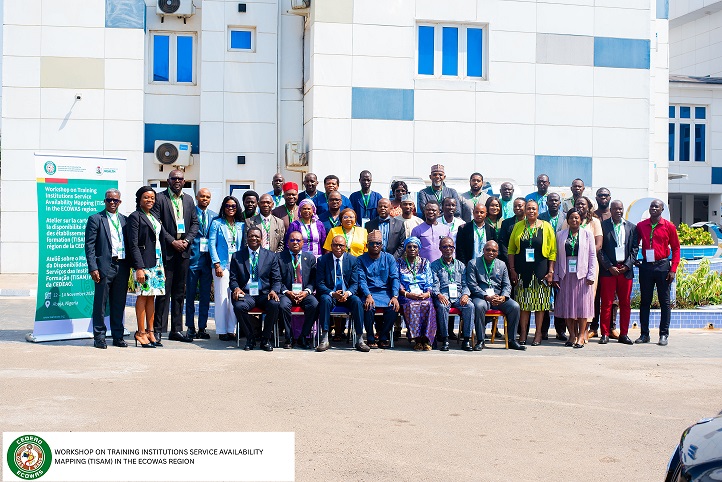
- A group photograph by participants at a three-day regional workshop on TISAM organised by WAHO in Abuja in Nigeria’s capital, Abuja
Professor John Mulbah, president-elect of the Regional Council for the Training of Health Professionals in the ECOWAS Region, said the mapping could help bring training standards and curricula into closer alignment with the needs of West Africa’s health systems.
“A strong, equitable and responsive health workforce begins with accurate data, harmonised standards and strategic alignment between what our institutions teach and what our health systems urgently need,” he said.
WAHO plans a public online inventory
WAHO Director-General Professor Palokinam T. Pitche, represented by Professor Joseph Olorunda, said the immediate priority was to consolidate the workshop data into a comprehensive regional inventory. WAHO may call on participants again to help validate the information before it is made available online.
Pitche said the platform would allow a prospective student in Guinea-Bissau, for instance, to look up training institutions and programmes in Senegal, Nigeria and Ghana in one place. Policymakers and academic institutions could use the same information as they work on common curricula, specialised training programmes and ways to retain health workers.
He also called for countries to share expertise more widely, including by engaging retired professionals as consultants, facilitators and resource persons who could train and mentor colleagues across the region.
From training data to better care
Declaring the workshop closed, Nigeria’s Coordinating Minister of Health and Social Welfare, Professor Muhammad Ali Pate, said West Africa had long grappled with the migration of doctors, nurses and midwives, shortages of health professionals in rural communities and concerns about the quality of training.
Pate, who was represented by Dr Datum Longji, said the mapping would help governments see where training institutions are concentrated, how many students they admit and graduate, and where shortages of teaching staff, clinical training facilities, laboratories and equipment limit their capacity.
“Over the past three days, you have done much more than attend a workshop. You have helped build a mirror for our region,” he said.
The minister said harmonised standards could help qualifications earned in one ECOWAS country gain recognition in another. He also called for better working conditions and career opportunities to retain health professionals and encourage japada, which he described as “the return of our skilled professionals”.
Pate said the administration of President Bola Ahmed Tinubu was taking steps to strengthen Nigeria’s health workforce by doubling training quotas, recruiting more than 30,000 health workers and strengthening quality assurance.
He urged member states to use the findings to shape national policy and direct investment. For communities that have long struggled to attract and retain health workers, the most tangible measure of progress will be whether more qualified professionals are available where patients need them.