Federal Government’s ₦50,000 relief grant for poor and vulnerable Nigerians is a welcome intervention at a time when rising living costs continue to put pressure on household incomes. However, the programme also presents an opportunity for fraudsters to exploit the desperation of citizens struggling to make ends meet.
Concerned economic and cybersecurity experts have warned prospective beneficiaries against registering through unfamiliar websites, paying agents or sharing sensitive banking details with individuals promising to secure their inclusion in the National Emergency Relief and Stabilisation Intervention (NERSI).
According to the Federal Ministry of Humanitarian Affairs and Poverty Reduction, the programme has no public registration portal or application process. Beneficiaries are selected from existing government records, including the National Social Register and verified national identity databases.
This means Nigerians cannot secure the grant by filling out online forms or paying anyone to facilitate their selection. The ministry has also made it clear that politicians, public officials and financial agents cannot influence the selection process.
Unfortunately, the search for government assistance often makes vulnerable citizens easy targets for fraudulent schemes. Individuals who create fake registration links, demand processing fees or promise faster payment are taking advantage of people’s economic difficulties.
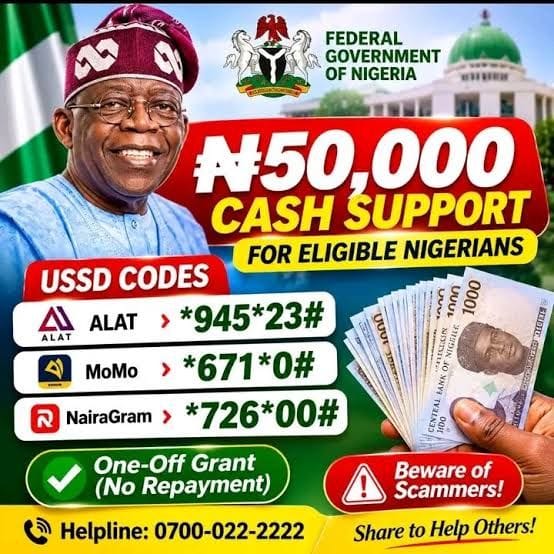
The government agency says genuine beneficiaries will be contacted through SMS by authorised financial service providers, including ALAT by Wema Bank, MoMo Payment Service Bank, NairaGram, OPay and Moniepoint. The messages will contain instructions on how to accept the grant and receive the money through a mobile wallet linked to their registered phone numbers.
Importantly, the ₦50,000 is a grant, not a loan, and beneficiaries are not expected to repay it or pay any fee before receiving the money.
Nigerians must therefore exercise caution when responding to messages or calls claiming to offer access to the programme. Personal Identification Numbers, Bank Verification Numbers and One-Time Passwords should never be disclosed to strangers under the guise of facilitating payment.
The ministry has provided 0700-022-2222 as the official helpline for enquiries and complaints.
While the warning is necessary, the government has responsibility to ensure that information about the programme reaches vulnerable households, particularly those in the rural communities with limited access to digital platforms.
The major concern is that fraudsters will exploit the Federal Government’s ₦50,000 NERSI relief programme to prey on unsuspecting villagers, particularly poor households with limited access to digital information and little knowledge of the official selection process.
Government must not allow a programme designed to alleviate poverty become another avenue for exploiting the very people it is intended to help.
For many rural dwellers, ₦50,000 is a significant amount of money. The desperation to benefit may make them susceptible to false promises, especially when scammers disguise themselves as government representatives.
Beyond announcing relief programmes, the government has a responsibility to make their implementation transparent, accessible and accountable. Clear and consistent public communication will help prevent fraud and ensure that eligible citizens are not left behind and also help protect against fraud.
It is worthy to also note that a ₦50,000 grant may provide temporary relief, but it cannot address the deeper economic challenges confronting millions of Nigerians.
Ultimately, the success of NERSI should not be measured only by the amount disbursed but by whether the assistance reaches the people it is intended for without exposing them to further exploitation.