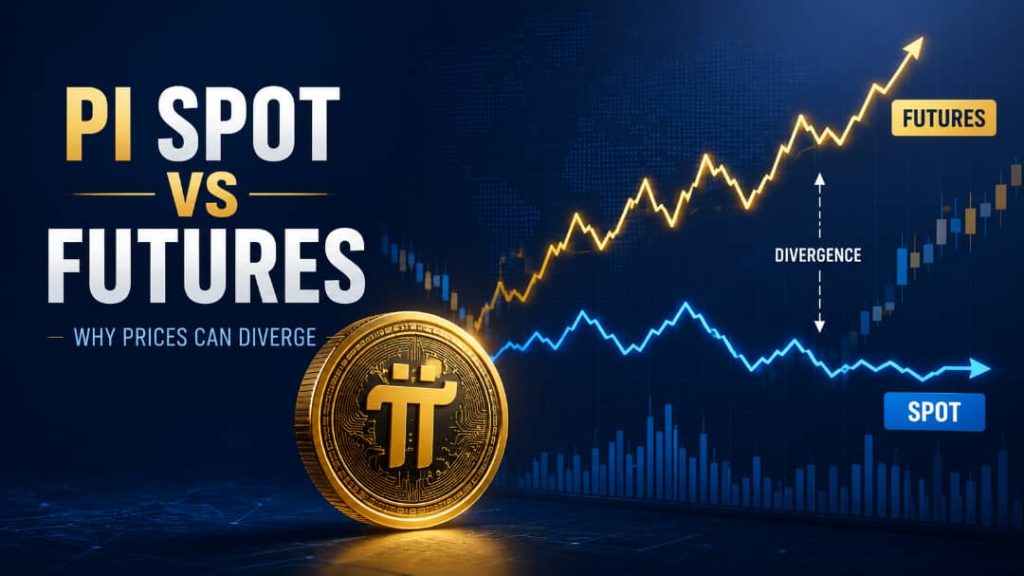
Quick Answer
Pi Network spot vs futures compares two different markets, not two versions of one price. Spot is what traders pay to buy or sell actual PI. PIUSDT perpetual futures are leveraged derivative contracts tied to an underlying spot index through funding, but they aren’t required to trade at an identical price at every moment.
The two usually stay close because funding creates an incentive for convergence, but they can still diverge temporarily due to leverage, positioning, liquidity, and liquidations. A futures premium or discount is a market condition worth investigating, not an automatic bullish or bearish signal.
Key Takeaways
● PI spot involves owning actual tokens; PIUSDT perpetual futures involve derivative exposure without ownership.
● Perpetuals have no expiry, so funding, not a settlement date, keeps them tethered to spot.
● Divergence can come from leveraged positioning, liquidations, thin liquidity, or PI-specific news hitting one market first.
● A basis needs confirmation from funding, spot volume, and a real catalyst before it’s treated as meaningful sentiment.
● Neither spot nor futures alone predicts where PI trades next.
Pi Network Spot vs Futures: What Exactly Are You Comparing?
PI spot involves buying or selling the underlying PI token. PIUSDT perpetual futures provide derivative exposure to PI’s price without requiring the trader to hold any actual PI.
This distinction matters for PI specifically because of its history: Pi Network’s Open Network launched on February 20, 2025, connecting its Mainnet to external networks and services, the milestone that made real, transferable Mainnet PI distinct from purely speculative derivative exposure.
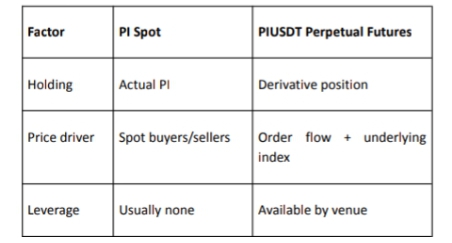
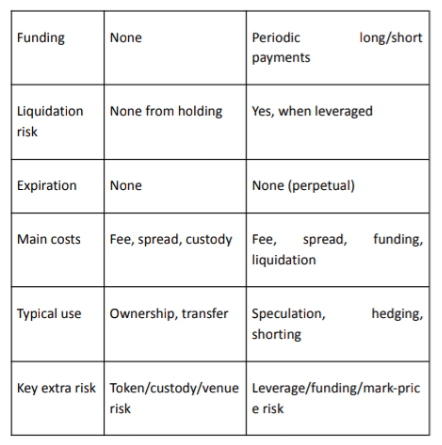
Funding pulls the perpetual price back toward spot over time, it reduces persistent divergence but doesn’t guarantee identical prices at every instant.
Why Can Pi Network Spot and Futures Prices Diverge?
Spot and futures diverge when buying and selling pressure in derivatives moves faster than arbitrage and funding can bring the two back into line. A few structural factors explain why.
Leveraged positioning moves faster than spot
Traders can open large futures positions without buying equivalent PI. A wave of leveraged long demand can push the perpetual to a premium; heavy shorting can push it to a discount. Liquidations amplify these swings, since forced closures add more market orders in the same direction.
Funding is the economic counterweight
Positive funding means longs pay shorts; negative funding means shorts pay longs. One-sided positioning makes funding costlier, nudging traders back toward balance, it’s evidence about crowding and carry, not a forecast on its own.
Spot and futures liquidity are separate order books
Depth, spreads, and participant mix differ, and thinner books react more sharply to large orders. Exchanges also often calculate an index price and a mark/fair price separately from the futures contract’s last trade.
PI-specific news can hit one market first
Relevant categories include Mainnet migration, token supply changes, ecosystem or protocol releases, and exchange-liquidity changes. Pi Network continued migration work and announced further protocol updates through 2026, so project developments, not just futures sentiment, remain legitimate variables to watch.
What Does a PI Futures Premium or Discount Actually Mean?
A simple basis calculation frames the gap in percentage terms rather than raw dollars:
Basis % = (Futures price − Spot/reference price) ÷ Spot/reference price × 100
The size and persistence of that basis, combined with other signals, determines how much weight it deserves.
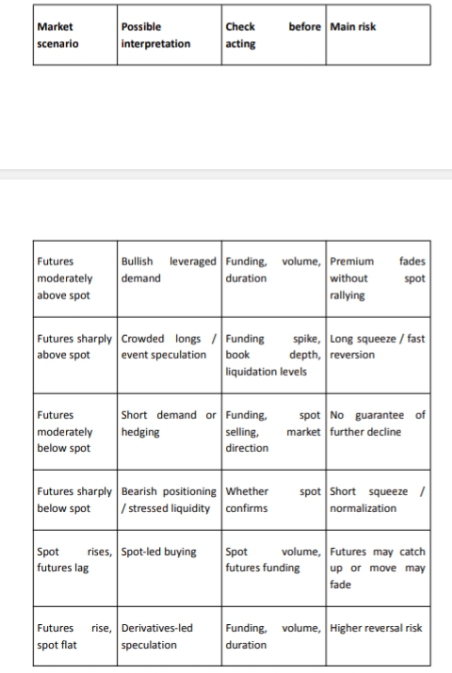
*Editorial rule*: treat a basis as bullish or bearish only after at least two independent signals, such as funding direction, spot volume, or a verifiable catalyst, point the same way.
Do PI Futures Predict the Future Spot Price?
Not reliably. A PI perpetual futures price can contain information about trader expectations, but it shouldn’t be read the way a conventional, fixed-expiry futures contract is read.
Perpetual contracts have no settlement date forcing convergence to a predetermined future spot price. Funding continuously nudges the contract toward the underlying market instead, so today’s premium may reflect leverage demand, hedging flows, or short-term order-book pressure, not a consensus target for where PI trades next month.
“Futures expectations” describes information embedded in positioning and basis. It isn’t the same thing as a literal price prediction.
How Should Traders Interpret a PI Spot–Futures Divergence?
A five-step process turns a raw price gap into something actionable.
1. Identify which prices you’re comparing — spot last price, futures last price, index price, and mark/fair price can differ slightly, and the mark price typically drives liquidation, not just the futures contract’s last trade.
2. Calculate the basis as a percentage, not a raw dollar gap, to see whether futures sit at a premium, near parity, or a discount.
3. Check funding — is it positive or negative, unusually large versus its recent range, and has it held across multiple periods?
4. Check whether spot confirms the move via spot volume, order-book depth, and whether the price action shows up across other exchanges.
5. Look for a catalyst in Pi Network’s protocol, Mainnet migration/supply, exchange changes, or broader crypto volatility.
Decision rule: the interpretation is strongest when basis, funding, spot activity, and a catalyst all point the same way. If they conflict, treat the market as noisy rather than as sending a clear signal.
When Does Spot or Futures Make More Sense for PI Exposure?
Spot may suit traders who want to own PI outright, don’t need short exposure or leverage, and are comfortable accepting custody, exchange, and token-price risk instead of funding and liquidation risk.
Futures may suit traders who need short exposure or hedging, want capital-efficient leverage, are managing short-term positions, and understand funding and liquidation mechanics well enough to monitor them regularly.
Traders who trade PIUSDT futures may encounter pricing shaped by leverage, funding, and short-term expectations that differ from the spot market at any given moment.
What Are the Biggest Risks When Trading a PI Spot–Futures Gap?
Five risks are worth weighing before trading a basis:
● Basis risk: the gap can widen before it eventually narrows.
● Liquidation risk: leverage can force a position closed before the thesis plays out.
● Funding risk: repeated payments can turn a seemingly profitable position into an expensive one.
● Liquidity/slippage risk: entry and exit prices can differ from displayed quotes during volatility.
● Event and supply risk: migration or protocol developments can shift expectations quickly; Pi Network’s continued 2026 activity keeps this relevant.
Even an apparent arbitrage isn’t risk-free once execution costs, funding, fees, and liquidation constraints are factored in.
Conclusion: Treat the Gap as a Signal, Not a Forecast
PI spot measures actual token-market demand. PI futures add leverage, funding, and derivatives positioning on top of that. A premium can point to stronger futures demand, and a discount to stronger short or hedging pressure, but neither alone predicts PI’s next move.
The practical path is to read basis, funding, spot confirmation, liquidity, and any real catalyst together, rather than reacting to a single number. The more extreme the divergence, the more it matters to understand why the gap exists, not to assume the futures market “knows” where PI is headed next.
FAQ
Why is PI futures price different from PI spot price?
They trade in separate markets with different participants, liquidity, and leverage. Funding pulls the two toward each other over time but doesn’t force identical prices at every moment.
Does a PI futures premium mean the price will go up?
Not by itself. It shows stronger leveraged long demand and needs confirmation from funding, spot volume, and a real catalyst before it’s reasonably called bullish.
What is the difference between PI spot price and PI perpetual futures price?
Spot reflects actual token buying and selling. Perpetual futures price reflects derivative positioning, leverage, and funding on top of an underlying index, with no expiry forcing convergence.
Is trading PI futures riskier than trading PI spot?
Generally yes, when leverage is involved — futures add funding costs and liquidation risk that don’t exist when simply holding unleveraged spot PI.
Can I use the basis between PI spot and futures to predict price direction?
It’s one input, not a forecast. It’s most informative alongside funding direction, spot confirmation, and an identifiable catalyst.