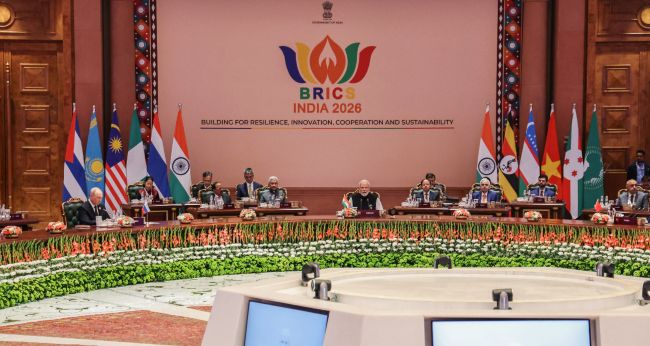
In this pool photograph distributed by the Russian state agency Sputnik, India’s Prime Minister Narendra Modi (C) speaks as Russia’s President Vladimir Putin (L) listens during the BRICS Summit in New Delhi on September 12, 2026. (Photo by Alexander KAZAKOV / POOL / AFP)
Members of the BRICS bloc have jointly called for “maximum restraint” in the Middle East, overcoming earlier disagreements to issue a unified position during their summit in New Delhi, India.
The 11-member grouping, which includes China, Russia, India, Iran, Saudi Arabia, the United Arab Emirates, Brazil, South Africa, Egypt, Ethiopia and Indonesia, expressed concern over the worsening conflict in the region.
Chinese President Xi Jinping, speaking alongside Russian President Vladimir Putin, Iranian President Masoud Pezeshkian, Indian Prime Minister Narendra Modi and other leaders, said the ongoing Middle East conflict “does not serve the common interests of the international community.”
The leaders, in a joint communiqué released on Saturday after extensive negotiations, stated: “We express deep concern over the continued escalation of tensions in Middle East/West Asia,” adding that member countries “call for exercising maximum restraint, as well as avoiding actions that could further aggravate the situation.”
The consensus marks a significant breakthrough after BRICS foreign ministers failed to reach a common position during their meeting in New Delhi in May due to differing views among Iran, Saudi Arabia and the United Arab Emirates over the conflict that followed the US-Israeli strikes of February 28.
Opening the two-day summit, Prime Minister Modi said BRICS was becoming an increasingly influential voice in global affairs. He urged members to work together to reshape international cooperation.
“We have to transform this pyramid of privilege into a platform of partnership,” Modi said.
He also highlighted the bloc’s growing economic influence, noting that BRICS nations “represent 50 percent of the world’s population, 40 percent of global GDP and more than 25 percent of global trade.”
India has maintained diplomatic ties with both Iran and US ally Israel while carefully balancing its strategic relationship with Washington. The country has also relied more heavily on Russian energy supplies amid the disruption caused by the US-Iran conflict.
Iranian President Pezeshkian attended the summit shortly after declaring that the Middle East does not need the United States to act as a “regional policeman.” He also held talks with Abu Dhabi Crown Prince Khaled bin Mohamed bin Zayed Al Nahyan on the sidelines of the meeting.
President Putin, one of India’s closest strategic partners, met with Modi during the summit. The Russian leader’s participation came months after his December 2025 visit to India, underscoring the close ties between both countries.
Xi Jinping’s visit attracted particular attention as it marked his first trip to India since 2019, signalling continued efforts to improve relations between the two Asian powers despite their long-running border dispute.
During his meeting with Modi, Xi stressed the importance of deeper cooperation, saying: “Although our two countries are different in many respects, they are fully capable of complementing each other’s strengths, supporting one another, achieving mutual success and advancing together.”
India’s foreign ministry later said both leaders reaffirmed their commitment to “a fair, reasonable, and mutually acceptable resolution of the boundary question,” while Modi emphasized the need for both countries to honour existing border agreements.
Xi also urged stronger economic collaboration, saying: “Both sides should… work hand-in-hand to promote high-quality major financial cooperation, advocate an equal and sustainable global order, and foster an economic globalisation that is open and inclusive.”
Despite signs of improving diplomatic engagement, longstanding disputes over their Himalayan border, trade imbalance and broader strategic competition continue to shape relations between the world’s two most populous nations. Meanwhile, dozens of Tibetan exiles staged protests in New Delhi ahead of Xi’s visit, opposing China’s policies in Tibet.