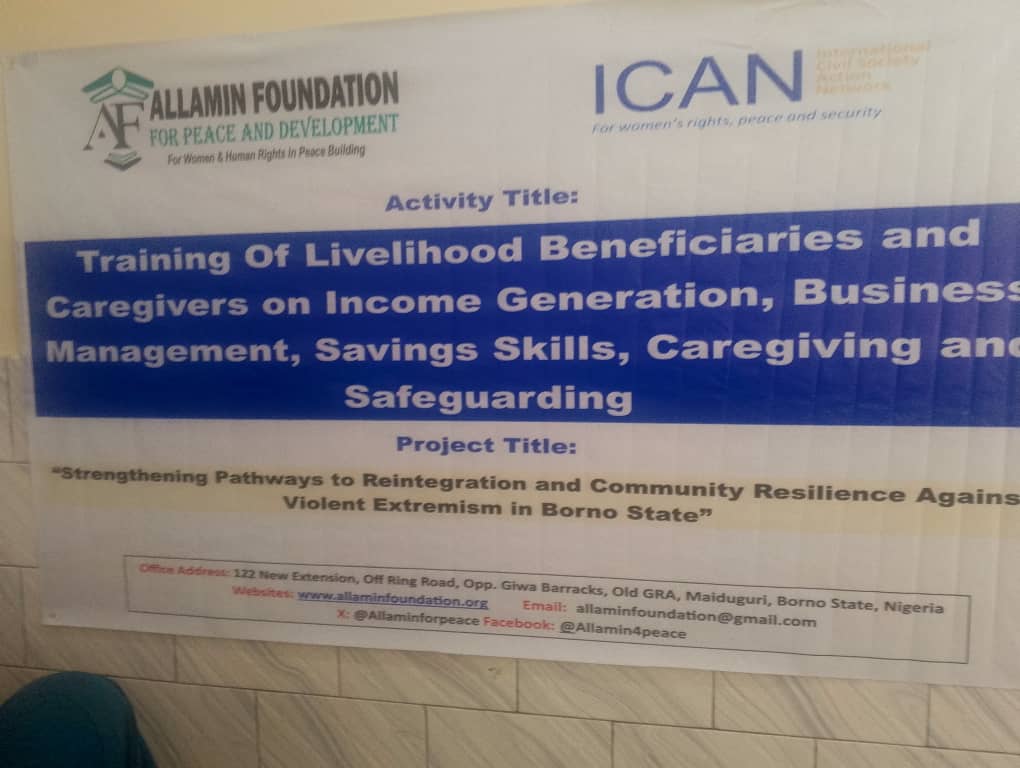
Allamin Foundation for Peace and Development, in partnership with the International Civil Society Action Network (ICAN), has trained 60 victims of armed conflict and their caregivers in Maiduguri, Borno State, on livelihood and entrepreneurship skills aimed at promoting sustainable reintegration and economic self-reliance.
The three-day capacity-building programme was conducted under the project, “Strengthening Pathways to Reintegration and Community Resilience Against Violent Extremism in Borno State,” which seeks to strengthen economic resilience and improve the welfare of individuals and families affected by insurgency.
A total of 60 participants, made up of 20 conflict victims and 40 caregivers, received practical training on entrepreneurship, income generation, business management, savings culture, financial discipline, record-keeping, caregiving and safeguarding.
Speaking during the exercise, the Monitoring and Evaluation Officer of the Allamin Foundation, Mallam Hamza Maigari, said the initiative was designed to equip beneficiaries with practical skills needed to build sustainable livelihoods and improve their economic wellbeing.
According to him, the programme focused on critical areas such as business management, savings, income generation and financial record-keeping to enable participants make sound financial decisions and effectively manage available resources.
He noted that empowering victims of conflict and their caregivers economically remains a vital step towards successful reintegration, adding that self-reliance reduces vulnerability and strengthens resilience within affected communities.
«”When individuals and families are economically empowered, they are better positioned to rebuild their lives and contribute meaningfully to their communities,” Maigari said.»
Resource person, Dr. Mohammed Abdullahi, led participants through sessions on entrepreneurship and business development, highlighting the importance of identifying profitable business opportunities, assessing market demand, preparing business plans and determining appropriate start-up capital.
He urged participants to conduct proper market surveys before starting any business, stressing that understanding customers’ needs and maintaining sound financial discipline are essential for long-term business success.
Dr. Abdullahi also emphasized accurate record-keeping, proper planning and prudent financial management, noting that even small enterprises can thrive when managed efficiently.
Beyond entrepreneurship, participants were introduced to savings strategies and income-generation techniques, with facilitators encouraging them to separate personal and business finances, monitor cash flow and reinvest profits to expand their businesses.
The programme also featured sessions on caregiving and safeguarding, providing caregivers with practical knowledge on supporting and protecting individuals affected by armed conflict.
Organizers said combining livelihood development with caregiving skills was intended to address both the economic and social challenges confronting conflict-affected households while promoting dignity, family stability and stronger community support systems.
Some beneficiaries, Hajja Gana Mamman and Falta Bukar Shettima, commended the Allamin Foundation and ICAN for the initiative, describing it as timely in view of the prevailing economic difficulties facing many families displaced or affected by conflict.
They expressed confidence that the knowledge gained on business planning, savings and financial management would help them improve their businesses, increase household income and better support those under their care.
The beneficiaries also pledged to apply the lessons learned and called for similar programmes to be extended to more conflict-affected communities across Borno State.
The Allamin Foundation and ICAN reaffirmed their commitment to supporting the economic empowerment and capacity development of conflict-affected populations, describing sustainable livelihoods as a critical pathway to long-term peace, resilience and reintegration in Borno State.