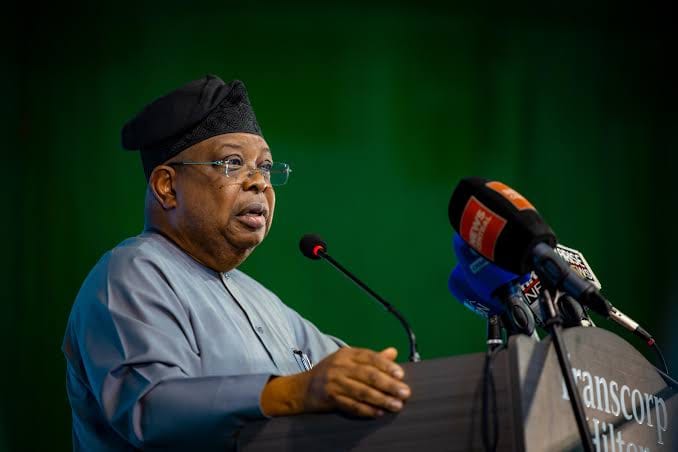
Minister of Power Joseph Tegbe
Federal Government has launched the Renewable Asset Management Company (RAMCO), a new initiative designed to improve the management and sustainability of publicly financed renewable energy assets and mobilise about N3 trillion in fresh investment into the sector.
Minister of Power, Joseph Tegbe, unveiled RAMCO at a stakeholders’ event in Abuja on Wednesday August 26, saying the company was established to address the longstanding gap between infrastructure construction and effective asset management.
Tegbe said Nigeria had historically focused on building public infrastructure without giving adequate attention to maintenance, resulting in the deterioration of assets and repeated government spending on replacements.
He said RAMCO would introduce professional management, stronger governance structures, maintenance discipline and measurable performance standards to the management of renewable energy infrastructure.
“RAMCO, therefore, provides the opportunity for us to protect what we build, optimise what we already own, and ensure that every naira invested in energy infrastructure produces sustained service,” the minister said.
Tegbe said renewable energy was becoming an increasingly important part of Nigeria’s electricity strategy, alongside grid power, embedded generation, interconnected and isolated mini-grids, distributed renewable systems and energy storage.
He added that the Federal Ministry of Power would support RAMCO as part of broader efforts to improve grid stability, address liquidity challenges in the power sector, optimise existing assets and attract private investment into power infrastructure.
The minister, however, said the success of RAMCO would ultimately be determined not by the volume of assets transferred to it but by its ability to keep the assets operational and productive over their economic lives.
At the event, other initiatives were also unveiled, including the One-Humanitarian-One Poverty Response System (OHOPRS), the Emergency Cash Transfer Programme, the Federal Ministry of Humanitarian Affairs and Poverty Reduction Ministerial Blueprint, and the Humanity First Magazine.
The First Lady, Oluremi Tinubu, said the initiatives were designed to improve the wellbeing of Nigerians, particularly people facing economic and social vulnerabilities.
She said the programmes were important amid the economic reforms being implemented by the administration of President Bola Ahmed Tinubu to strengthen the economy and establish the foundation for sustainable growth and shared prosperity.
According to her, despite the ongoing reforms, many Nigerian families continue to face economic challenges and require government and stakeholder support.
Tinubu described the HOPE-SP intervention as an important mechanism for identifying vulnerable households, understanding their specific needs and providing appropriate assistance.
She said the programme would go beyond temporary relief by combining immediate stabilisation support with interventions aimed at helping vulnerable households recover and achieve economic independence.
Minister of Budget and Economic Planning, Atiku Bagudu, said effective social protection required a coordinated approach involving the federal, state and local governments, as well as other stakeholders.
Bagudu said the administration’s ambition to build a $1 trillion economy by 2030 must be matched with deliberate efforts to ensure that economic opportunities and prosperity reach Nigerians at the grassroots.