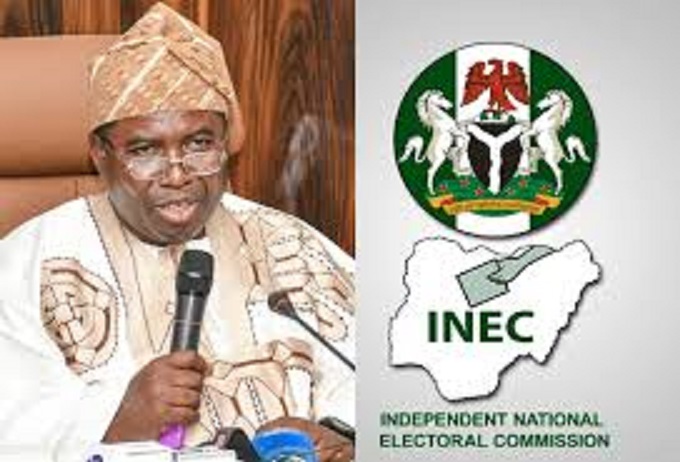
INEC Chairman Prof Joash Amupitan
The Independent National Electoral Commission (INEC) has said it is yet to receive the court judgment on the African Democratic Congress (ADC) and will not act on reports of it circulating on social media until it has received and studied the judgment.
The Chairman of the Commission, Prof. Joash Amupitan, said this on Monday 9th November, 2026, while responding to questions at a press conference at the Commission’s headquarters in Abuja. He also announced a ban on web cameras in voter registration and the Commission’s approval of an Artificial Intelligence (AI) governance framework.
“We don’t just act on the basis of what is on the social media,” he said.
Prof. Amupitan said judgments of this kind first come to the Chairman, who asks the relevant department for expert advice before the matter goes to the Commission.
“Normally when we receive judgment like that, it comes to the Commission, it comes first to the chairman who asks for the expertise advice from the relevant department before it’s taken to the commission,” he said.
He said the Commission would examine the circumstances of the case. “In this case, we are yet to receive the judgment. So the judgment is to be received and studied. I know I’m also a lawyer,” he said, adding that he would personally go through the processes filed.
The Chairman recalled an earlier instance in which a purported Supreme Court judgment was posted on social media and trended. “The Supreme Court disowned itself from it, and even some people have been investigated,” he said.
On AI-generated pictures found in the voter register, the Chairman said INEC had traced the access points used.
“We have found the number that were used through AI to infiltrate. You see, it takes just one person to compromise the password,” he said.
He added that some of the access had been granted by authorised persons. “Some of those things are given in authority, and when that is done, you know what AI can do,” he said.
Prof. Amupitan said the Director of Information and Communication Technology (ICT) had been directed to stop the use of web cameras and adopt an app-based camera.
“We have just directed the director of ICT now that our IVFs, this web camera, should not be allowed again. Instead, we should have an app camera. It is what is on the app that will take picture,” he said.
He said the change would stop pictures from being imported from outside the system. “Don’t go and use any URL and begin to import pictures here and there,” he said. “When things happen like that, you don’t want to fall into the same error.”
The Chairman said the Commission had investigated the matter thoroughly and cleared many of the complaints received at its boards, online and on social media.
“Most of the complaints were thoroughly investigated, just to ensure fairness and justice, and to show that there is no hidden agenda,” he said.
On additional safeguards, Prof. Amupitan said the Commission had an AI policy approved in 2025, before he became Chairman. The fast-changing nature of AI, he said, led it to develop a fuller framework.
“We decided as a commission to have a comprehensive, well-laid out AI governance framework that will govern responsible deployment of AI,” he said.
He said the framework was developed jointly with the International Foundation for Electoral Systems (IFES) and the UK High Commission. It was sent for peer review and has since been returned, and the Commission also considered the ECOWAS protocol on the subject.
“Just today, the commission also approved the AI governance framework that will improve on what we used to have,” he said. He added that the guidelines contain guarantees that will ensure AI is “deployed for proper purpose and for proper use.”
On people involved in double registration, the Chairman said the matter had drawn wide concern, including from security agencies.
“Everyone is concerned, including the security agencies. So the security agencies are also making their own investigations,” he said.
He said INEC staff found to have been involved would face administrative or internal disciplinary action. Where a crime had been committed, he said, they would also be referred to the appropriate law enforcement agencies for prosecution.
Asked about staff involvement, he said he had the list. “They are all staff of INEC, and we are taking some steps. We are not covering anything. What I told you today is the truth,” he said.
Prof. Amupitan said that whenever INEC saw issues raised on social media, it flagged them and checked them against the register. He said some of the cases circulating, such as one person’s name appearing with a different person’s picture, dated from earlier exercises and not from the current one.
“Those that happen currently, that were able to have a digital log, digital evidence, must proceed against them,” he said.
Asked what guarantee existed against loopholes in the register, the Chairman pointed to Section 19 of the Electoral Act.
“The law recognizes that there could be some form of imperfections. Mind you, we are managing over 100 million registered voters. So that is why there is this gap for complaint, objections, and claims,” he said.
He said the process was meant to bring such problems to light. “This process is supposed to expose some of the things we are seeing now,” he said.
Prof. Amupitan said the Commission had reviewed its ICT infrastructure and cybersecurity arrangements at Monday’s meeting as part of preparations for the general election.
He described the recent incidents as an early warning. “Sometimes when you see like this happen, you take it in good faith, because it’s an early warning for you to be on your guard,” he said.
He said the Commission was taking important measures, “some of which we cannot begin to mention here.”
On early voting for journalists and others on election duty, including INEC officials, the Chairman acknowledged the desire to vote. “Everybody would like to vote, you want to exercise your franchise,” he said.
He said INEC had proposed early voting during the amendment of the Electoral Act, but it did not get the support of the National Assembly. “This is still not known to our law, but it’s going to still be a process of advocacy to ensure that this is done,” he said.
He said he had taken up the matter after his appointment. “Hopefully it will be addressed one day,” he said.