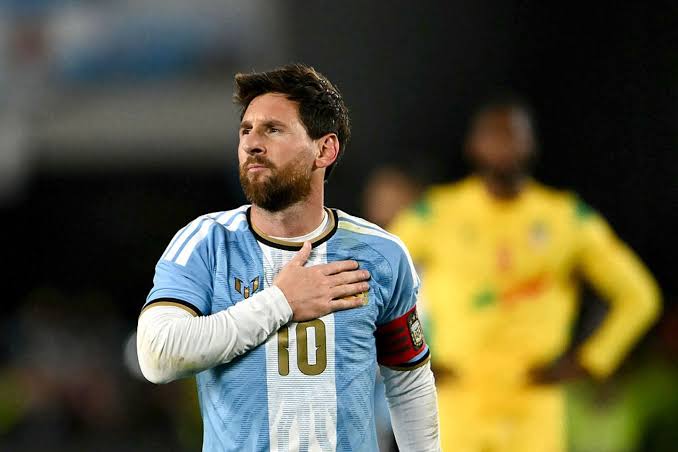
Lionel Messi
Lionel Messi’s 21-year international career has come to an end, with Argentina’s greatest footballer signing off with a goal, two assists and a 3-0 victory over Benin at the Estadio Monumental on Tuesday night.
In front of more than 85,000 fans, Messi made his record 208th and final appearance for Argentina, closing one of the most remarkable chapters in international football history in typically decisive fashion.
The occasion was less about the friendly itself than the end of an era.
For more than two decades, Argentina’s national team had Messi at the centre of almost everything. He was the player teammates looked for when games became difficult, the figure opponents planned around and the man who carried a nation’s expectations through triumphs and painful disappointments.
Even before kick-off, the Monumental was prepared for his final bow. Messi wore a special-edition Argentina shirt, while the stadium erupted in the 10th minute as the match was briefly stopped for a standing ovation for the No. 10.
Benin refused to simply play the role of farewell guests, however, and arguably had the better chances in a goalless first half, with Aiyegun Tosin and Junior Olaitan testing Emiliano Martinez.
Messi also went close from a free-kick and saw another effort drift wide as Argentina struggled to find their rhythm.
Three minutes after the restart, the night finally turned into the farewell the home crowd had been waiting for.
Messi’s corner found Nicolás Otamendi, who finished to put Argentina ahead in the 48th minute.
Thirteen minutes later, Messi turned provider again, picking out Nico Paz shortly after the youngster came off the bench. Paz curled the ball home for Argentina’s second.
Then came Messi’s final goal for his country.
Agustín Giay was fouled inside the box and Messi stepped up in the 70th minute, sending the resulting penalty into the top corner to make it 3-0.
It took his Argentina tally to 126 goals and gave him two assists on his final night.
For a player whose career with Argentina began with a red card on his debut against Hungary in 2005, the ending could hardly have been more fitting.
Messi leaves as Argentina’s most-capped player, record goalscorer and leading assist provider, with 208 appearances, 126 goals and 70 assists.
More importantly, he leaves behind a national team that he helped transform from perennial underachievers into champions of the world.
The journey included three consecutive major final defeats between 2014 and 2016, a brief international retirement and years of criticism before Messi finally got his hands on the Copa America in 2021.
That victory opened the door to a remarkable three-year run in which Argentina also won the 2022 Finalissima, the 2022 World Cup and the 2024 Copa América.
Tuesday’s farewell therefore marked more than the retirement of a superstar. It marked the end of the player around whom Argentina built its modern football identity.
The challenge now belongs to Lionel Scaloni.
Argentina must find a way to remain one of the world’s leading national teams without the player who has spent 21 years being their creative outlet, their goalscorer and, at times, their safety net.
Nico Paz’s goal offered a glimpse of what that future could look like. The 20-year-old’s finish came from Messi’s final creative contribution for Argentina, turning a simple assist into a symbolic passing of the torch.
Messi leaves with the World Cup, two Copa América titles, a Finalissima, eight Ballon d’Or awards and a legacy that may be impossible to reproduce.
But on a night when Argentina came to say goodbye, he gave them one final reminder of why replacing him will be so difficult.
A goal. Two assists. A victory.
And one last “Olé, olé, Messi” ringing around the Monumental.