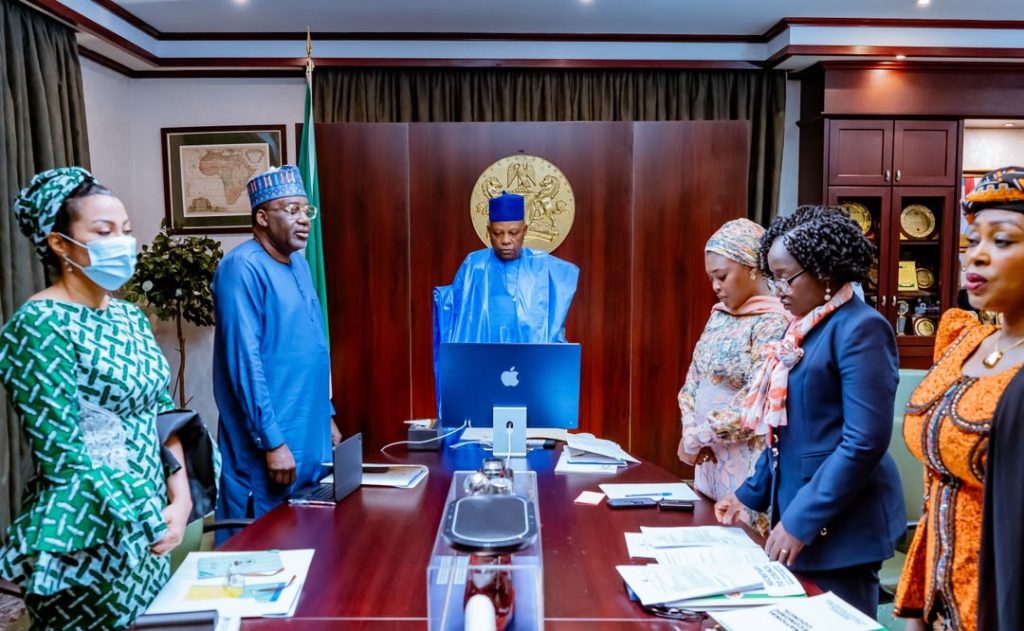
National Economic Council (NEC) has reviewed Nigeria’s response to the reported Ebola outbreak in the Federal Capital Territory (FCT), assuring Nigerians that the country has the capacity to contain the disease while directing states yet to update their preparedness plans to act without delay.
The Minister of Health and Social Welfare, Prof. Muhammad Ali Pate, briefed the council on the government’s response, assuring members that there was no cause for panic as Nigeria has the institutional capacity to manage the situation effectively.
Pate said the Federal Ministry of Health, working with relevant stakeholders, had activated a robust national response system to prevent the spread of the disease.
He identified strong coordination, surveillance at points of entry, laboratory testing, adequate supply of protective equipment and emergency kits, as well as effective public communication as key pillars of the response.
The minister disclosed that 21 states had already updated their Ebola preparedness plans and urged the remaining 15 states to immediately strengthen their response mechanisms.
On polio eradication, the council received the report of the NEC Ad Hoc Committee on Polio Eradication chaired by Gombe State Governor, Muhammadu Inuwa Yahaya.
NEC directed states to carry out post-immunisation reviews, especially in areas where children were missed during vaccination campaigns and communities affected by insecurity.
The council also stressed the need for the timely release of counterpart funds, stronger routine immunisation programmes, improved collaboration with security agencies and better coordination among states.
It further emphasised that the commitment of governors, traditional rulers and security agencies remains vital to achieving the complete eradication of polio in Nigeria.
On livestock development, NEC considered the report of the committee chaired by Kebbi State Governor, Nasir Idris, and acknowledged the sector’s huge potential to boost economic growth, create jobs and improve livelihoods.
The council noted that all states had expressed willingness to support the Federal Government’s livestock development programme and resolved to deepen collaboration to unlock the sector’s full economic potential.
NEC also considered a presentation on the National Affordable Compressed Natural Gas (CNG) Transit Programme by the Chairman of the Presidential Initiative on CNG and Electric Vehicles, Barrister Ismaeel Ahmed.
The council approved the establishment of a joint financing framework between the Federal and State Governments to speed up the deployment of CNG and electric vehicles across Nigeria.
It directed that the programme must reduce transportation costs for Nigerians and instructed relevant authorities to engage transport unions and operators to ensure savings from the initiative translate into lower fares for commuters.
To implement the decision, NEC agreed to set up a committee to coordinate the financing framework, engage key stakeholders and develop practical measures that will make affordable, accessible and sustainable transportation a reality for Nigerians.