
By VICTOR CHIAHEMEN, Abuja –
Nigeria has called for a reliable regional database of health training institutions across West Africa, saying accurate information on their locations, programmes and capacity is essential to addressing workforce shortages and ensuring health professionals are trained where they are most needed.
The Coordinating Minister of Health and Social Welfare, Professor Muhammad Ali Pate, made the call in an address delivered on his behalf by Dr Dakum Longji, Country Liaison Officer, at the opening of a three-day workshop on Training Institution Services Availability Mapping (TISAM) in the ECOWAS region in Abuja on Thursday.
Pate said the absence of reliable information about health training institutions made it difficult for governments to identify gaps, plan investments and ensure a fair distribution of training opportunities across the region.
“Some institutions are well known while others are invisible. Some regions are well served while others are underserved. Without mapping, we cannot plan fairly, and we cannot invest wisely,” he said.
He stressed that the exercise was not simply about compiling the names and locations of institutions, but about building an evidence base that would help governments understand existing training capacity, identify areas requiring expansion and make better decisions about the health workforce.
According to him, the initiative is expected to produce a regional map of accredited health training institutions, provide evidence to guide investment and institutional development, and support the harmonisation of training standards and professional mobility across West Africa.
He added that the exercise aligned with the Federal Government’s Renewed Hope Agenda and ongoing efforts to strengthen Nigeria’s health system.
Pate urged participants to ensure that the workshop produced practical outcomes that would help countries make informed decisions about training capacity and workforce development. He subsequently declared the workshop open.
Earlier, the Director-General of the West African Health Organisation (WAHO), Professor Stanley Okolo, in an address delivered on his behalf by Professor Joseph Olorunda, said TISAM was designed to provide a comprehensive picture of institutions responsible for training health professionals across the region.
He explained that the mapping process involved collecting, coding and analysing information, alongside cartographic and geospatial reporting, to establish where training institutions were located and assess their available infrastructure, equipment, programmes and funding.
Okolo said the ultimate objective was to increase the production of well-trained, motivated and equitably distributed health professionals to meet the needs of West African populations.
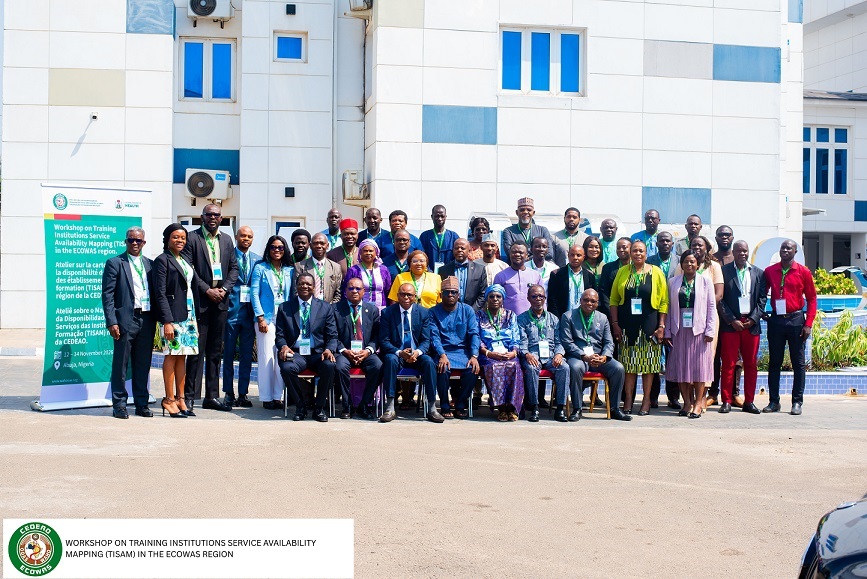
- Group photograph of participants at the workshop
He warned that without dependable information on training institutions, governments would struggle to plan effectively, address workforce imbalances and respond to challenges relating to recruitment, migration and staff retention.
The WAHO chief recalled that the organisation had conducted a situational analysis covering 2010 to 2015, which helped establish the foundation for the regional mapping initiative. He also acknowledged the contribution of former WAHO Director-General, Professor Placido Cardoso, whose initial funding support helped set the process in motion.
On progress, he said mapping had earlier been completed in Burkina Faso, Ghana, Benin and Sierra Leone, while data collection was ongoing in Nigeria, Togo, The Gambia and Liberia.
He said the exercise was expected to continue through 2026 and 2027, with country-level validation scheduled for the first quarter of 2027, followed by stakeholder validation, evaluation, publication and dissemination of the regional inventory.
In his remarks, a representative of the Deans of Faculties of Health Sciences drew attention to persistent shortages of health professionals, uneven geographical distribution and gaps in specialist training across the region.
He said mapping would help governments move beyond general estimates and understand the actual capacity of institutions, the quality of their programmes and the areas where additional investment was required.
He identified five priorities for the exercise, including establishing the training capacity of institutions, improving quality and harmonisation, understanding student attrition, projecting workforce requirements over the next 15 years and strengthening cooperation among universities.
He urged participants to ensure that the exercise resulted in practical recommendations and commitments that could be monitored beyond the workshop.
Also speaking, a representative of the West African postgraduate colleges said stronger regional cooperation and harmonised training standards would improve professional development and make it easier for qualified health workers to pursue further training across member states.
He noted that professionals could miss opportunities available in other West African countries simply because information about training programmes and institutions was not readily accessible.
He stressed the importance of national and regional accreditation, as well as common standards that would build confidence in qualifications and support professional mobility.
Representing Senegal and the ECOWAS Chairmanship, Professor Awa Seck said the mapping exercise would help countries understand not only how many health professionals they could train, but whether their training systems were producing the skills their populations needed.
She called for reliable and regularly updated data to support evidence-based planning, adding that regional cooperation was particularly important given the linguistic diversity of West Africa.
Seck said the region’s Francophone, Anglophone and Lusophone countries should see their differences as an opportunity to strengthen cooperation and improve health workforce development.
The President-elect of the Regional Council for Health Professional Education, Professor John Mulbah, also emphasised the need for accurate information, saying the success of the exercise would depend on the honesty and quality of data supplied by participating institutions and countries.
He said a credible database would help identify gaps in health service delivery, guide decisions by training institutions and strengthen the region’s capacity to produce the professionals required by its health systems.
The workshop brings together health education stakeholders and representatives of member states to examine the availability and capacity of health training institutions, with the aim of building a regional evidence base for better workforce planning.
Its wider significance lies in helping governments identify where training capacity is concentrated, where shortages persist and what investments are needed to ensure that the region produces the right mix of health professionals to serve its people.