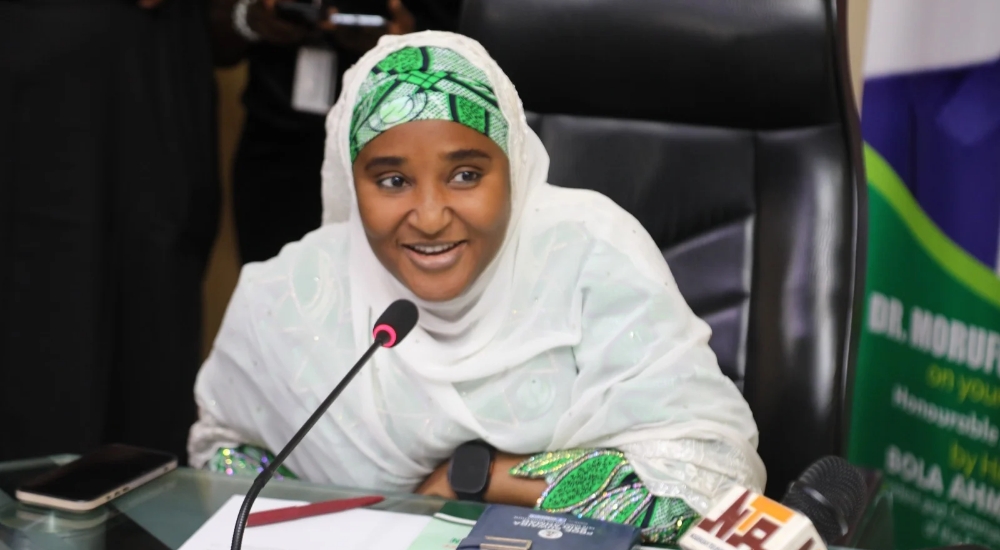
Minister of State for Education, Professor Suwaiba Sa’id Ahmad
The Minister of State for Education, Professor Suwaiba Ahmad, has urged teachers to develop digital competence to effectively equip students with the knowledge and skills required in today’s technology-driven world.
Ahmad made the call on Monday at the National Trainers’ Workshop on Safe Learning Environment, Gender-Responsive Technology and ICT Skills for Educators in Teacher Training Institutions in Nigeria, held in Abuja.
She stressed that digital literacy has become an essential requirement for teachers rather than an option.
“A teacher has to be digitally sound and enabled to be able to impact adequate knowledge to students in a digital era,” she said, urging educators to embrace technology as a vital tool for effective teaching and learning
The workshop, organised with the support of UNESCO and the Government of Japan, brought together 45 master trainers from 15 colleges of education across Nigeria to strengthen their capacity in safe learning environments, gender-responsive pedagogy, digital teaching and the prevention of school-related gender-based violence.
Ahmad said the training aligns with the Federal Government’s Education Sector Renewal Initiative, which focuses on expanding access to education, improving teaching quality, promoting school safety and integrating technology into learning.
She also highlighted the implementation of the National Policy on Anti-Bullying in Nigerian Schools, noting that its success depends on teachers’ ability to identify bullying, support affected learners and respond appropriately.
The minister said millions of Nigerian children remain disadvantaged despite being enrolled in school, citing a 2024 UNICEF report which found that 74 per cent of children aged seven to 14 lack basic reading and mathematics skills.
She said every child deserves not only access to education but also a safe, inclusive and supportive learning environment in which they can thrive.
According to her, the workshop will equip the 45 master trainers with advanced knowledge that they will transfer to about 500 teacher educators, significantly expanding the programme’s impact across the country.
Ahmad commended the Government of Japan, UNESCO, the UNESCO Abuja Office, the African Union International Centre for the Education of Girls and Women in Africa, the Nigerian National Commission for UNESCO and the participating colleges of education for supporting the initiative.
She described the digital equipment donated to the colleges as a practical investment in the future of teacher education, urging participants to make full use of projectors, smartboards, tablets and other ICT tools during and after the training.
The minister encouraged teacher educators to demonstrate practical classroom applications of technology by developing inclusive lesson plans, adapting digital learning materials and effectively using ICT tools, including in areas with limited internet connectivity.
She further urged the master trainers to return to their institutions and ensure that the knowledge gained becomes part of regular teacher training rather than remaining a one-off workshop.
Ahmad concluded by calling on educators to create classrooms where every child feels safe, valued and heard, stressing that properly trained teachers can make the difference between a child remaining engaged in school and quietly falling behind.