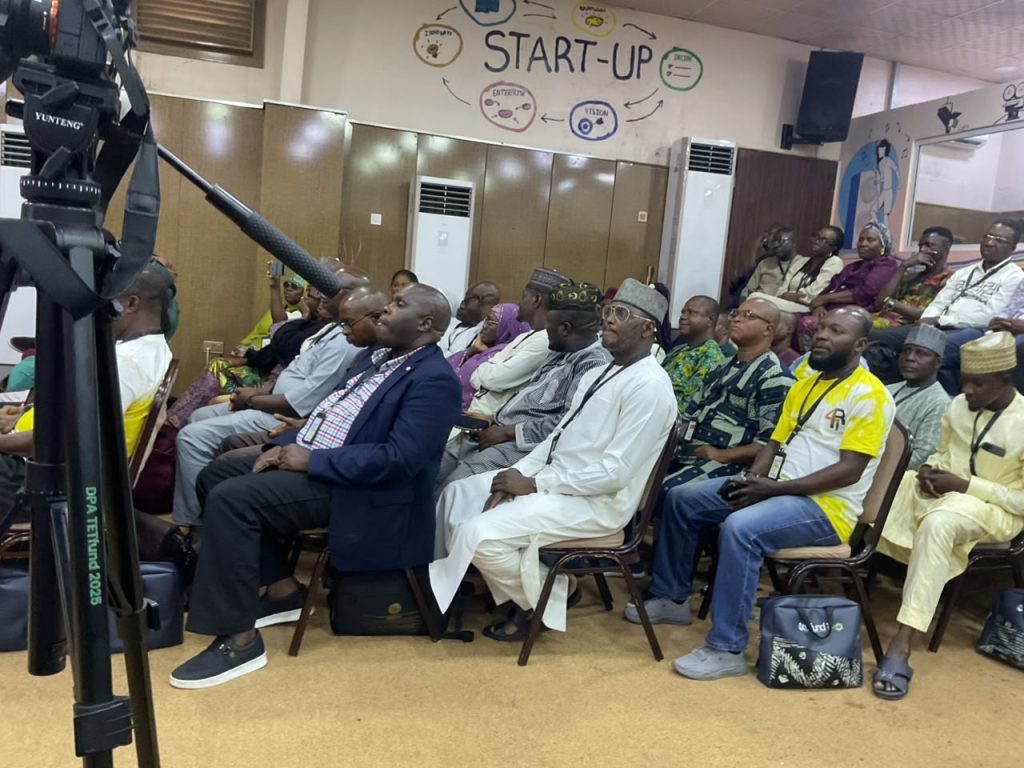
Tertiary Education Trust Fund (TETFund) has urged Nigerian academics and researchers to move beyond publishing scholarly papers and focus on developing practical innovations that address societal challenges, create jobs and generate economic opportunities.
The Executive Secretary of TETFund, Dr Sonny Echono, made the call in Abuja on Friday through the Assistant Director, Research and Development, Dr Hadiza Ismail, at the closing ceremony of the 35th cohort of the Research for Impact Initiative (R4i).
Echono said the initiative, implemented in partnership with Innov8 Hub, was part of the Fund’s efforts to institutionalise research and development (R&D) in public tertiary institutions and strengthen collaboration between academia, industry and government.
He said Nigeria must empower researchers to develop home-grown solutions to local problems rather than remain dependent on foreign technologies.
“We must empower our scholars to create local solutions for our societal problems. This is why a commitment to education is a commitment to our nation’s future, ensuring that our people are not just consumers of foreign technology, but innovators who can drive sustainable growth,” he said.
According to him, technological advancement has become a major driver of economic transformation, making investment in quality education, research and innovation essential for sustainable development.
Echono said TETFund was refocusing its intervention programmes to strengthen research capacity, promote institutional research and development, and improve linkages between research institutions and industry.
He explained that the R4i programme was designed to reposition public tertiary institutions as drivers of a knowledge-based economy through innovative practices and solution-oriented research.
The executive secretary commended Innov8 Hub for providing technical expertise and mentorship to participating academics, urging the graduates to apply the skills acquired during the intensive training to develop solutions for their institutions and communities.
TETFund and Innov8 Hub was strengthening the connection between academic knowledge and practical innovation through closer cooperation among government, academia, industry and society.
One of the participants, Farida Adamu Mohammed of the Federal Polytechnic, Damaturu, said the programme had changed her perception of research by shifting her focus from academic publications to solutions with commercial potential.
Mohammed said the 10-day intensive training equipped participants with skills in identifying real-world problems, selecting viable ideas, understanding users’ needs and developing prototypes.
She said the training also covered the responsible use of artificial intelligence, the Business Model Canvas, user co-creation and effective communication for pitching ideas to potential funders and collaborators.
“Indeed, R4i has completely changed my perspective on research, shifting my focus from research for publication to research that creates impact, drives commercialisation, and generates profit,” she said.
Similarly, Engr. Austine Omoraka of the Federal Polytechnic, Orogun, Delta State, said the programme had strengthened his resolve to apply engineering research to practical challenges in Nigeria, particularly in his state.
Omoraka said the combination of research, prototyping, market validation and business planning had provided him with a more structured approach to developing ideas into potentially marketable solutions.
“The training has encouraged me to view research not merely as an academic exercise but as a pathway to innovation and societal transformation,” he said