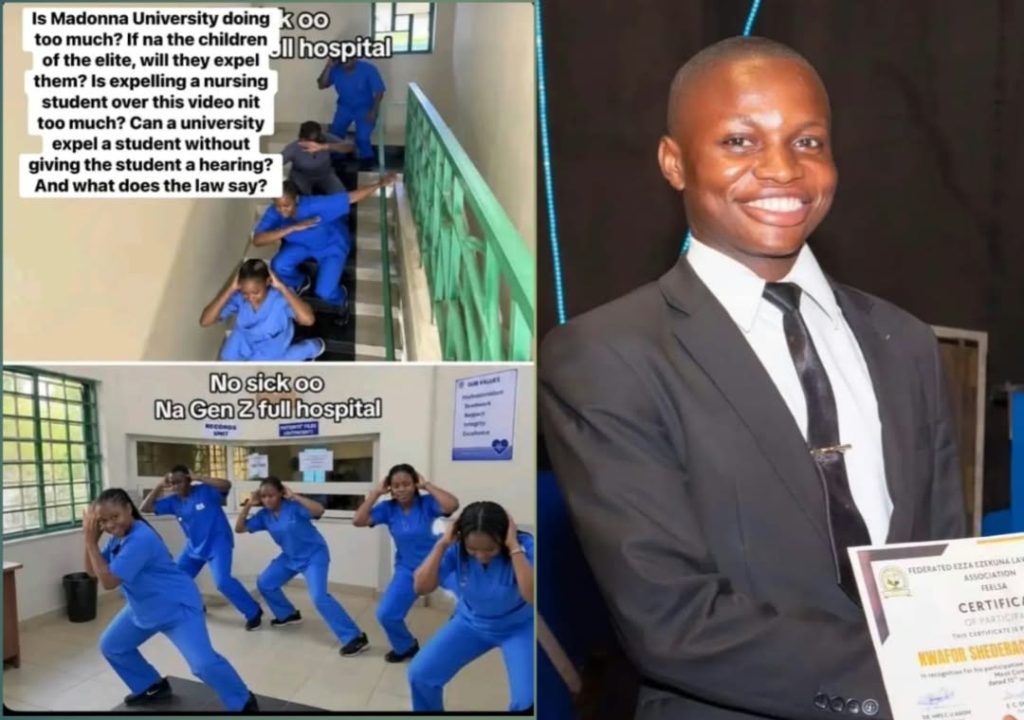
The news broke like wildfire, fanned by the November and December harmattan: 500-level Nursing students of Madonna University had been expelled and suspended over a TikTok video captioned, “No Sick Ooo, Na Gen Z Full Hospital.”
The decision has since generated serious public concern, with lawyers, law students, and civil society actors divided over whether the University complied with constitutional requirements and the fundamental principles of natural justice.
While the conduct of the students was, to say the least, condemnable and unprofessional, some fundamental questions must nevertheless be asked—and they demand honest and legally sound answers.
Were the affected students afforded a fair hearing?
Did the Disciplinary Committee of Madonna University comply with the principles of natural justice?
And was the sanction of expulsion and suspension excessively harsh and disproportionate in the circumstances?
Every institution, including a private university, has the inherent authority to make rules, enforce standards, and discipline its students.
However, the exercise of that disciplinary power is not absolute. It must be exercised in accordance with the law and the principles of natural justice.
The constitutional foundation of the right to fair hearing is found in Section 36(1) of the Constitution of the Federal Republic of Nigeria, 1999, as amended, which provides that:
“In the determination of his civil rights and obligations, including any question or determination by or against any government or authority, a person shall be entitled to a fair hearing within a reasonable time by a court or other tribunal established by law and constituted in such manner as to secure its independence and impartiality.”
This provision embodies the twin pillars of natural justice: nemo judex in causa sua, meaning that no one should be a judge in his own cause, and audi alteram partem, meaning that the other side must be heard.
Nigerian courts have repeatedly affirmed the importance of these principles. In the celebrated case of Garba v. University of Maiduguri (1986) 1 NWLR (Pt. 18) 550, the Supreme Court recognised that students facing disciplinary proceedings are entitled to the elementary requirements of natural justice. The Court famously emphasised the need to hear both sides before reaching a decision.
This position was further affirmed in Esiaga v. University of Calabar (2004) All NLR 187, where the Supreme Court recognised the disciplinary authority of educational institutions while making it clear that such authority cannot be exercised arbitrarily. Similarly, in Chijioke Edeh v. University of Nigeria, Nsukka, the court intervened where disciplinary action resulting in expulsion was taken without the requisite fair hearing.
The implication is clear: however inappropriate, offensive, or unprofessional the students’ conduct may have been, they were still entitled to the elementary requirements of fair hearing. They ought to have been informed clearly of the allegations against them, given adequate notice and opportunity to respond, and afforded a genuine opportunity to defend themselves before an impartial disciplinary body, in accordance with the applicable university regulations and the law.
Therefore, if the Disciplinary Committee of Madonna University expelled or suspended the students without observing these requirements, such disciplinary action may be vulnerable to judicial challenge. Nigerian jurisprudence contains numerous instances in which disciplinary decisions taken in breach of fair-hearing requirements have been set aside.
The Question of Proportionalilty
Beyond fair hearing lies another important question: was the punishment proportionate to the misconduct?
Reports indicate that fourteen students were suspended while one was expelled.
With respect, disciplinary measures ought not merely to punish; they should also serve legitimate corrective and educational purposes.
Where lesser sanctions are capable of achieving those objectives, the imposition of the most severe penalty demands careful justification.
Expulsion carries profound consequences, particularly for a final-year nursing student who has spent years undergoing professional training. It can disrupt an academic career, impose significant financial and emotional costs, and potentially affect the student’s future professional prospects.
That is not to say that students should be insulated from serious consequences for serious misconduct. Far from it. Universities must be able to protect their reputation, uphold professional standards, and maintain discipline. But punishment must remain connected to the nature and circumstances of the misconduct and must be imposed through a lawful and fair process.
If the allegations arose from a single ill-advised social-media video, and if the students had no intention of causing harm, then the question of whether expulsion was the appropriate and proportionate response deserves serious consideration. Suspension, a formal reprimand, counselling, remedial training, or other corrective measures might, depending on the circumstances and the applicable regulations, have achieved the disciplinary objective without permanently terminating a student’s education.
It is therefore encouraging that the National Association of Nigerian Students has intervened with a view to finding a resolution and ensuring that justice is tempered with mercy.
A Sober Lesson for GEN Z
But this unfortunate episode must also serve as a sober lesson to Generation Z: not everything is content, and not every moment is a cruise.
The students may not have intended to cause harm. They may have viewed the video as nothing more than a joke. But it was an expensive joke.
These are not merely undergraduates. They are 500-level nursing students—professionals-in-training whose eventual responsibility will be to care for people at some of the most vulnerable moments of their lives.
To joke, even casually, that sick people should not come to the hospital raises a troubling question: where else should the sick go?
After spending years studying nursing, should caring for the sick ever be portrayed as an inconvenience? Would your parents be proud to see such a video associated with your name? Would you encourage other Nigerians to entrust their lives to professionals who appear to mock or trivialise their suffering?
The answers should be obvious.
Professionalism does not begin after graduation. It begins during training.
Students preparing for professions governed by strict ethical obligations must understand that their conduct outside the classroom can affect how the public perceives their fitness to practise. Social media has blurred the line between the private individual and the professional identity. A video intended as a joke can quickly become a permanent digital record, stripped of its original context and viewed by thousands—or millions—of people.
The internet does not forget.
And for a nursing student, the white uniform demands more than academic competence. It demands empathy, dignity, responsibility, and respect for human life—both online and offline.
Conclusion
The Madonna University controversy presents two important lessons that must be held together.
First, students must be held accountable for their conduct. Freedom of expression is not a licence for professional misconduct, and virality is not a defence against accountability. Students, particularly those preparing to enter professions built on trust and human dignity, must understand the consequences of what they post online.
Second, institutions must also be held to the standards of legality and fairness. The fact that a student may have behaved badly does not suspend the Constitution. Disciplinary authority must still be exercised within the bounds of due process, fair hearing, applicable university regulations, and proportionality.
Madonna University must therefore demonstrate that the disciplinary process complied with the requirements of law and natural justice. At the same time, the affected students—and indeed the wider Gen Z community—must learn that social-media fame is not a substitute for wisdom, and that virality is not a virtue when it diminishes the very profession one seeks to represent.
Justice must be done. But justice is not merely about punishment.
Justice is also about process, fairness, proportionality, and mercy.