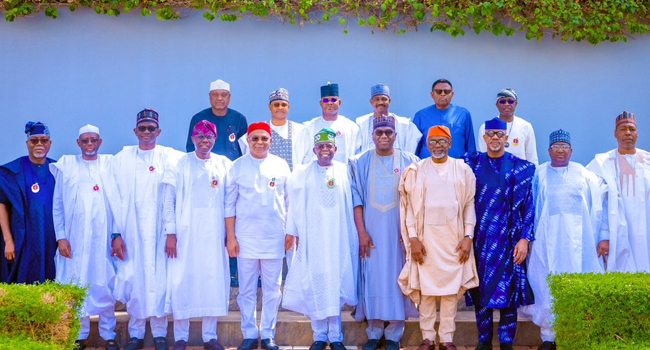
APC governors after a meeting with President Bola Tinubu (PHOTO: X@Mr_JAGs)
As Nigeria gradually approaches the 2027 general elections, an interesting phenomenon is emerging in the country’s presidential campaign politics: the competition among governors, political party organisations and support groups to promise millions of votes for President Bola Ahmed Tinubu. What began as individual political declarations is increasingly becoming a campaign ritual, with political actors mounting public platforms to announce the number of votes they intend to deliver to the President. The declarations are becoming more ambitious, the figures more spectacular, and the political implications more consequential.
The emerging trend raises fundamental questions about the character of Nigeria’s democracy, the relationship between political leaders and voters, and the credibility of electoral mobilisation in a country where voter turnout has consistently declined. More importantly, it raises a troubling democratic question: do governors and political leaders genuinely possess the capacity to deliver millions of votes, or are these declarations merely instruments of political signaling, propaganda, and the demonstration of loyalty to the President?
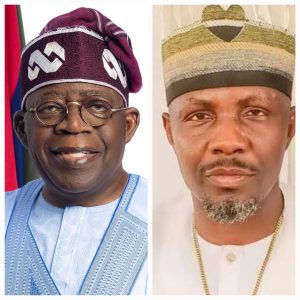
Consider the figures. The City Boys and associated national supports have reportedly declared that they will deliver 10 million votes. Governor Monday Okpebholo of Edo State has promised 2.5 million votes for Tinubu. Governor Mohammed Umaru Bago of Niger State has announced a target of two million votes, while the APC organisation in Kaduna State has also declared a two-million-vote target. In Ekiti State, Governor Biodun Oyebanji has challenged his campaign organisation to secure 90 percent of registered voters for the President. In Sokoto State, Yusuf Dingyadi, an aide to the APC National Chairman, has projected that Tinubu will secure at least 80 percent of votes cast.
These declarations represent different forms of electoral commitments. Some are fixed numerical targets, while others are percentages of registered voters or votes eventually cast. Nevertheless, the four fixed numerical commitments alone amount to 16.5 million votes. If Ekiti’s 90 percent target is interpreted literally against its 2023 registered electorate of approximately 988,000 voters, the figure increases by another 889,000, bringing the combined announced targets to approximately 17.4 million votes, even before considering Sokoto.
The numbers are politically significant. Tinubu secured approximately 8.79 million votes in the 2023 presidential election. Thus, the four fixed numerical promises alone represent almost twice the votes he obtained nationally in the last presidential election. The comparison becomes even more striking when one considers that some of these targets are being announced by individual states whose previous electoral performances provide little evidence of the capacity to produce such numbers.

Of course, political parties are entitled to set ambitious electoral targets. Campaigns are built around persuasion, mobilisation, organisation and the expansion of political support. There is nothing inherently undemocratic about a governor declaring an intention to mobilise two million voters for his party’s presidential candidate. The difficulty begins when political mobilisation is presented as though the votes of millions of independent citizens are already owned, controlled, or guaranteed by political officeholders.
The first test of these promises must be Nigeria’s electoral history. The country has experienced a persistent decline in presidential election turnout. Participation fell from approximately 69 percent in 2003 to 57 percent in 2007, 54 percent in 2011, 44 percent in 2015, 34 percent in 2019, and approximately 27 percent in 2023. In the last presidential election, Nigeria had 93.47 million registered voters, but only about 25.29 million were accredited. The number of valid votes was approximately 24 million. In other words, fewer than three out of every ten registered voters participated in the presidential election.
This is the electoral reality against which the promises of millions must be assessed. The central challenge is not simply whether political parties can persuade citizens to support their candidates. It is whether they can first persuade a significantly larger proportion of registered voters to participate in an electoral process from which millions have increasingly withdrawn.
The Edo State example is particularly revealing. Governor Okpebholo’s promise of 2.5 million votes is almost equivalent to the entire number of registered voters in the state in 2023, which stood at approximately 2.5 million. In that election, Tinubu secured only 144,471 presidential votes in Edo, compared with 331,163 for Peter Obi and 89,585 for Atiku Abubakar. The governor’s target therefore represents an extraordinary departure from the state’s previous presidential voting pattern.
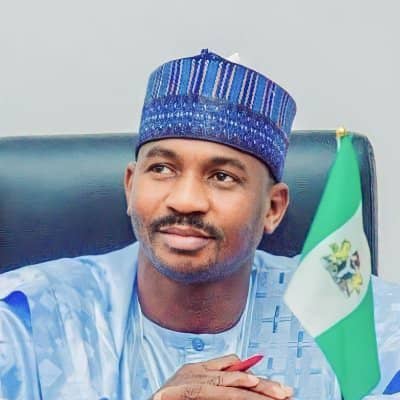
To achieve 2.5 million votes, virtually the entire registered electorate would have to participate and vote for Tinubu. Such an outcome would require an unprecedented level of voter mobilisation and an extraordinary degree of political uniformity. It would also require many previous opposition supporters and nonvoters to change their political preferences or participate for the first time. While voter preferences are not permanently fixed, such a transformation requires a demonstrable political strategy rather than a declaration at a campaign rally.
The Niger State promise of two million votes presents a similar challenge. In 2023, Niger had approximately 2.56 million registered voters, while Tinubu secured 375,183 presidential votes. The proposed target therefore represents a substantial increase over the President’s previous electoral performance in the state. Governor Bago may possess considerable political influence and an extensive grassroots network, but the existence of political structures does not automatically translate into two million presidential votes. A political organisation may boast thousands of members, but membership figures are not equivalent to independently cast ballots.
Kaduna State presents another interesting case. With approximately 4.34 million registered voters in 2023, the state has a sufficiently large electorate to make a two-million-vote target numerically conceivable. However, Tinubu secured 399,293 votes in the state in the last presidential election, while Atiku Abubakar obtained 554,360 and Peter Obi 294,494. The APC target would therefore require a major expansion of its electoral support. Kaduna’s political and geographical diversity, including the different voting patterns across its northern and southern constituencies, makes the assumption of a politically consolidated electorate particularly questionable.
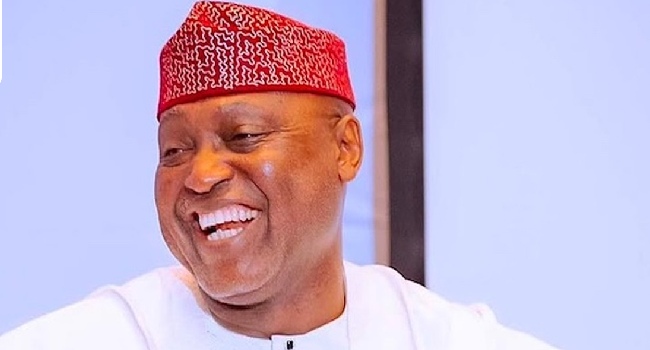
Ekiti State provides an equally instructive illustration. Governor Oyebanji’s challenge to secure 90 per cent of registered voters is remarkable, especially because it acknowledges the problem of low participation. With approximately 987,647 registered voters in 2023, the target translates into nearly 889,000 votes. Yet Tinubu obtained 201,494 presidential votes in the state. There is an important distinction between achieving 90 percent voter turnout and securing 90 percent of the votes cast for one candidate. Even if the first objective were achieved, the second would remain a separate and considerably more demanding political undertaking.
In Sokoto, the declaration of an 80 percent share of votes cast is framed differently. Tinubu received 285,444 votes in the state in 2023, narrowly behind Atiku Abubakar’s 288,679. The APC’s projected 80 percent would require a substantial change in the distribution of political support. It is not enough to mobilise more voters; the party must also persuade a significant proportion of those voters to support its candidate.
These examples expose a recurring weakness in the politics of promised millions: political declarations often begin with the desired electoral outcome without providing convincing evidence of the voter-level capacity required to achieve it. The arithmetic of electoral promises is not the same as the arithmetic of electoral possibilities.
There is also a question of the origins and evolution of this political phenomenon. Although Governor Okpebholo’s 2.5-million-vote declaration became one of the prominent early examples of the current trend, it would be inaccurate to suggest that he invented the practice of promising votes on behalf of political constituencies. Nigerian political parties have historically announced electoral targets and mobilised regional and state structures around presidential candidates. What appears to be new is the intensity, publicity, and competitive character of the declarations. Political actors are increasingly using spectacular numerical commitments to demonstrate their political relevance and proximity to the centre of power.
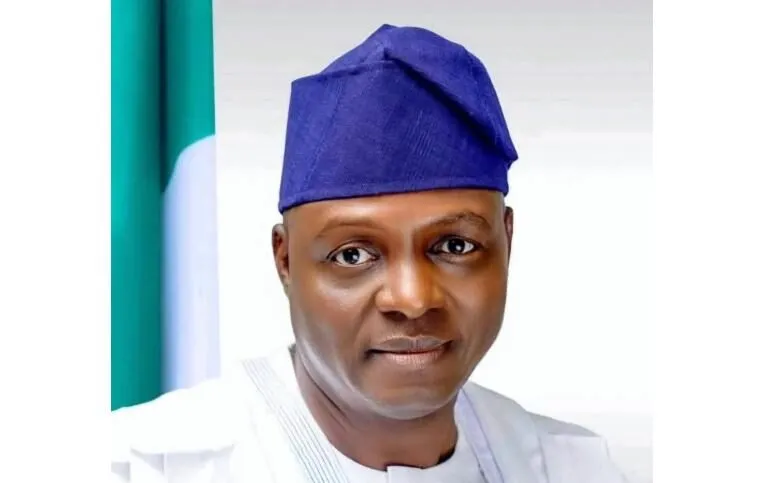
In July 2025, for instance, reports emerged of APC allies and state political organisations projecting approximately 15.2 million votes for Tinubu across several states. By October 2026, further reports had placed the combined projections of political allies at approximately 18.7 million. The pattern suggests an emerging campaign culture in which governors, party officials and support groups compete to demonstrate their electoral delivery capacity through increasingly ambitious figures.
The phenomenon can be interpreted from at least three perspectives. First, it may represent genuine political mobilisation. Governors and party organisations may sincerely believe that they can expand their support base, attract opposition voters, encourage young people to participate and bring previously inactive registered voters into the electoral process. Such efforts are legitimate and, indeed, desirable in a democracy struggling with declining voter participation.
Second, the declarations may constitute political signaling. A governor who promises two million votes may be communicating more than an electoral target. He may be signaling loyalty to the President, demonstrating control over the party structure in his state and positioning himself as an indispensable political ally. In a political system where governors exercise considerable influence over party organisation and political appointments, electoral promises can become a form of political currency. The larger the promised number, the greater the perceived political value of the individual making the declaration.
Third, the declarations may be part of a broader strategy of electoral expectation management. Political leaders may be attempting to create an impression of overwhelming national support for the incumbent before the actual election. Repeated announcements of millions of promised votes can create a perception of political inevitability, influence public discourse and reinforce the image of a ruling party with an expansive electoral machinery. However, the existence of such a communication strategy should not automatically be interpreted as evidence of an intention to manipulate election results.
This brings us to the sensitive question of whether the politics of promised millions is a ploy to rig votes. It is important to distinguish between rigorous electoral mobilisation and electoral manipulation. Mobilising registered voters, persuading citizens, organising campaigns and encouraging participation are legitimate democratic activities. Vote buying, intimidation, coercion, interference with accreditation, manipulation of results and unlawful alteration of election records are entirely different matters.
The declarations themselves do not establish that electoral malpractice is being planned. Nevertheless, the language of delivering millions of votes raises legitimate questions about the political understanding of citizenship. When a governor speaks as though he can personally deliver the votes of millions of people, the impression is that the electorate is an extension of the governor’s political machinery. That is a dangerous conception of democracy.
Votes do not belong to governors. They do not belong to traditional rulers, political godfathers, party chairmen or campaign organisations. They belong to individual citizens, whose constitutional right to vote includes the freedom to support or reject any candidate. A governor may influence political preferences through performance, persuasion and political organisation, but cannot legitimately guarantee the electoral choices of independent citizens.
There is also a potential danger in the emergence of what might be described as informal electoral performance contracts between the President and governors. Under such an arrangement, governors promise electoral results while expecting political recognition, influence and continued relevance within the governing party. This could intensify competition among governors and create pressure on local government chairmen, political appointees and grassroots party officials to demonstrate their capacity to deliver votes.
The implication is that the political performance of governors may increasingly be judged by the number of votes they promise or claim to deliver rather than the quality of governance they provide. This would represent a troubling distortion of democratic accountability. Governors should be evaluated primarily by the quality of public services, infrastructure, education, healthcare, security, employment opportunities and the general welfare of their citizens, not merely by their capacity to produce presidential votes.
Furthermore, the political dominance of the APC at the state level should not be confused with guaranteed presidential electoral dominance. Even where a party controls a state government, voters may choose a different presidential candidate. The 2023 elections demonstrated this clearly. The APC’s control of political structures did not automatically translate into presidential victories in every state. The five South-Eastern states, for example, voted for the Labour Party’s presidential candidate despite the different political configurations within the region. This illustrates an important feature of Nigeria’s evolving electoral behaviour: citizens are increasingly capable of distinguishing between state-level and national political choices. A voter may support a governor but reject the President, support the President but oppose the governor, or reject both. Political loyalty is not necessarily transferable across electoral contests
.
The economic and social environment will also matter. The cost of living, food prices, unemployment, insecurity, public confidence in government and the perceived performance of the administration will all influence electoral participation and voter preferences. Political mobilisation cannot be separated entirely from the lived experiences of citizens. A party may have an impressive organisational structure, but electoral support is also shaped by the everyday realities of the people it seeks to persuade.
What, then, would make these promises credible? Political organisations announcing such targets should provide measurable evidence of their mobilisation capacity. They should disclose the number of registered voters in their constituencies, the historical turnout patterns, the size of their active grassroots structures and the number of additional voters they intend to persuade. They should explain how they intend to address insecurity, voter apathy, transportation challenges and other obstacles to electoral participation. Above all, their targets should be understood as aspirations to persuade citizens, not guarantees of votes that have already been appropriated.
INEC also has an important responsibility. The electoral commission must ensure that the actual votes cast, rather than political targets announced at campaign rallies, determine election outcomes. Accreditation, ballot integrity, transparent counting, credible collation and public confidence in the electoral process must remain paramount. No political organisation should be allowed to turn its publicly declared electoral target into an unofficial benchmark against which electoral officials are judged.
The politics of promised millions presents Nigeria with an opportunity to reflect on the meaning of democratic representation. Political leaders should compete through ideas, policies, performance and persuasion rather than through claims of ownership over the electorate. The real measure of political strength should be the ability to earn the confidence of citizens, not the capacity to announce impressive electoral figures.
Nigeria needs more voters, not merely more promises. It needs political parties that inspire participation, not organisations that assume votes can be delivered like political merchandise. It needs governors who understand that their constitutional authority does not extend to appropriating the electoral choices of their citizens. The 2027 election should therefore be an opportunity to move beyond the politics of promised millions towards a politics of accountable governance and genuine democratic engagement.
A governor may promise two million votes. A political movement may announce ten million. A campaign organisation may project 80 or even 90 percent electoral support. But these declarations remain political aspirations until citizens independently make their choices at the polling booth. The ultimate authority does not reside in Government House, the Presidential Villa or the headquarters of any political party. It resides with the Nigerian electorate.
You may promise millions of votes at a political rally, but only the Nigerian voter can deliver a vote at the polling booth. That is the enduring principle of democracy: votes belong to citizens, not to those who govern them. Let the votes of Nigerians count!