Middle Belt Forum (MBF) has thrown its weight behind the Minister of Defence, Gen. Christopher Musa (rtd.), over his recent comments on the administration of former Kaduna State Governor, Malam Nasir El-Rufai, demanding an independent investigation into alleged killings and human rights abuses recorded in the state during his tenure.
The forum also called for the former governor to be investigated over allegations of complicity in insecurity and alleged payments to bandits or other armed groups, saying anyone found culpable should face prosecution, including before the International Criminal Court (ICC) where applicable.
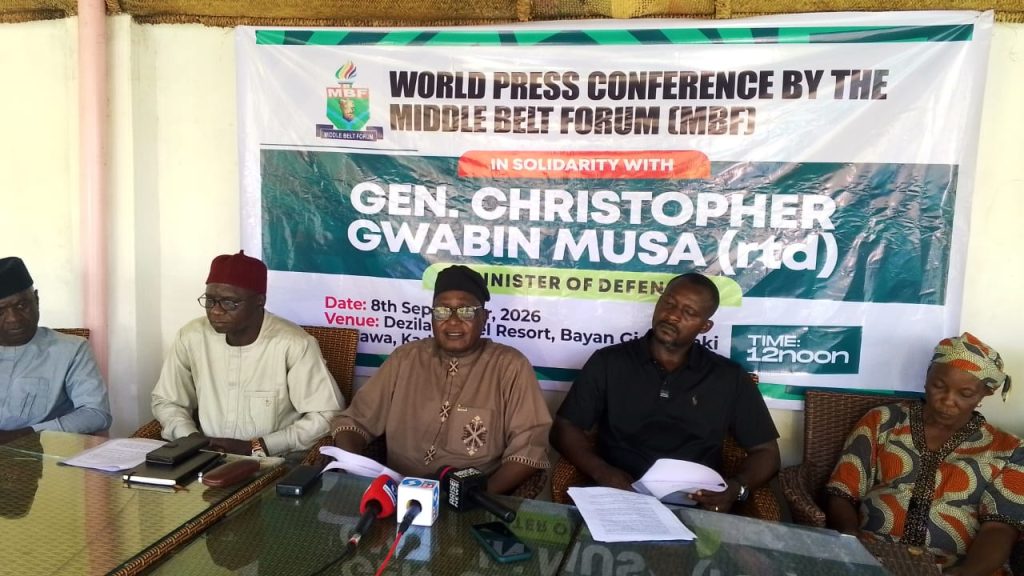
The MBF made the demands on Tuesday in Kaduna at a press conference addressed by its National Spokesman, Luka Binniyat, in solidarity with Musa following his recent remarks concerning the former governor.
Musa had, during an appearance on Channels Television’s Politics Today on September 3, said, “We can never be happy with somebody who has deliberately planned for the killing of our people,” in an apparent reference to the El-Rufai administration.
Reacting to the controversy generated by the statement, Binniyat said the minister’s comments should not be dismissed as political rhetoric, arguing that the events recorded in Kaduna between 2015 and 2023 required closer scrutiny.
“We are here to say that the historical record of Kaduna State under El-Rufai provides enough evidence to support the claims of the retired four-star General,” he said.
The forum said it was speaking not as a political ally of Musa but as a stakeholder and “witness” to events in Southern Kaduna, which it described as part of the Middle Belt.
The group acknowledged that Kaduna had experienced communal and religious conflicts before 2015, including crises in Kasuwan Magani, Zangon Kataf and the College of Education, as well as violence associated with the introduction of Sharia and the 2011 presidential election.
However, it alleged that the nature and scale of violence changed under El-Rufai, with rural communities allegedly subjected to repeated attacks, killings, destruction of homes and mass displacement.
The MBF particularly criticised what it described as the former administration’s handling of some attacks, alleging that community leaders and traditional rulers were sometimes arrested while the perpetrators of violence were not adequately pursued.
It cited the 2016 attack on Goska in Jema’a Local Government Area, alleging that several people were killed and houses destroyed, while the District Head, Moses Barde, was arrested instead of the alleged perpetrators.
The forum also mentioned the case of the B’Gwam Kurama, Dr. Ishaku Sabo Damina, whom it alleged was arrested after handing a suspected criminal over to the military. It said the traditional ruler was subsequently dethroned and died in 2021.
The group further referred to the 2021 arrests of 15 Atyap leaders, including an 82-year-old man, over allegations that they were responsible for the killing of 706 cows in one night. According to the MBF, the men were later released after spending months in detention, while at least three reportedly died within a month of their release.
On the 2019 Kajuru crisis, the forum alleged that statements attributed to the former governor contributed to tensions surrounding the violence. It recalled El-Rufai’s announcement shortly before the 2019 presidential election that 66 Fulani people had been killed in Kajuru, saying the figure was later revised upwards.
The MBF also alleged that several Adara leaders were detained following the crisis, including Awemi Dio Maisamari, then president of the Adara Development Association.
It said Maisamari and eight other leaders later secured a N900 million judgment against the Kaduna State Government in 2024 after the Federal High Court in Kaduna reportedly ruled that their detention was unlawful.
The forum further alleged that attacks continued in communities including Karamai, Ungwan Barde, Inkirimi and Dogonnoma, resulting in deaths, destruction of property and displacement.
It also raised the 2015 clash between security forces and members of the Islamic Movement in Nigeria (IMN) in Zaria, alleging that more than 1,000 Shiite Muslims were killed.
The forum accused the former governor of defending the security operation, describing the incident as another issue requiring independent investigation.
On the use of curfews during periods of communal violence, the MBF alleged that the restrictions sometimes left vulnerable communities exposed to attacks while armed groups continued to operate.
It cited attacks on Goska, Zangon Kataf and Atyap communities, alleging that women, children and elderly people were among those killed, while several villages were reportedly burnt and residents displaced.
Beyond insecurity, the forum also criticised aspects of El-Rufai’s economic and labour policies, particularly the mass dismissal of public workers and the termination of about 22,000 primary school teachers following competency tests.
The MBF said the sackings, coupled with alleged delays in the payment of entitlements, created hardship for thousands of affected workers and their dependants.
Binniyat said the allegations raised against the former governor should be subjected to a credible and independent process rather than being treated as a political confrontation.
“Gen. Christopher Musa has raised a salient point. The appropriate response is not intimidation, insults or political blackmail. The appropriate response is to investigate the issues and establish the truth,” he said.
He added that families who lost loved ones, homes, livelihoods and communities during the period deserved justice, saying an independent investigation would help establish responsibility and provide closure to victims.
The former governor has not, in the statement presented by the MBF, been given an opportunity to respond to the latest allegations.