Flamingos
Nigeria’s Flamingos have conquered the world, but their historic triumph has also brought fresh attention to a major question facing Nigerian football: who should take charge of the game’s administration?
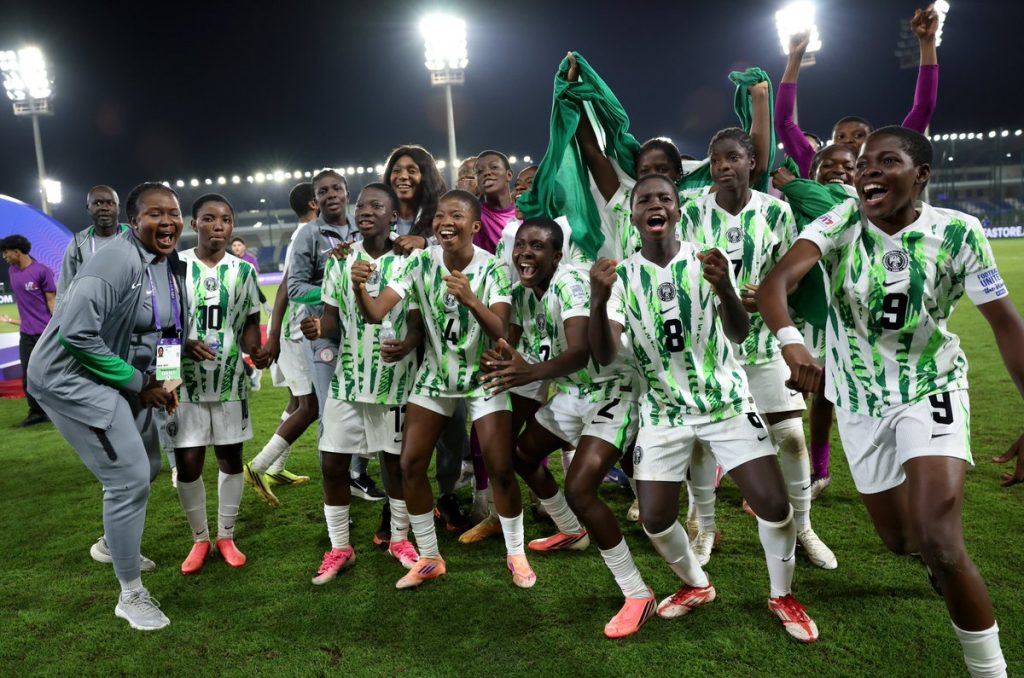
The Flamingos defeated Japan 2-1 in the final of the 2026 FIFA U-17 Women’s World Cup in Rabat, Morocco, on Saturday, November 7, becoming the first African women’s national team to win a FIFA World Cup title at any age level.
Awawu Bashiru opened the scoring in the 39th minute before Oluebube Umejiaku doubled Nigeria’s lead two minutes into the second half. Japan pulled one back through Fuki Ito in the 80th minute, but the Nigerian girls held on to secure the trophy.
Umejiaku finished the tournament with four goals and won the Golden Ball as its best player. Bashiru also made a strong contribution, scoring twice in Nigeria’s 3-1 semi-final victory over Brazil before finding the net again in the final.
The triumph was particularly remarkable given how the campaign began. Nigeria lost their opening group match 2-1 to Poland but recovered to win their remaining six games, beating Puerto Rico, defending champions Korea DPR, Mexico, Venezuela, Brazil and Japan on their way to the title.
It was a significant improvement on the team’s previous best finish, a bronze medal in 2022. The victory also added the Flamingos to Nigeria’s list of FIFA U-17 world champions, alongside the Golden Eaglets, who have won the boys’ competition five times.
President Bola Tinubu and the National Sports Commission were among those who congratulated the team, while reactions from Delta and Edo states highlighted the wider significance of the achievement.
Delta State Governor, Rt. Hon. Sheriff Oborevwori, praised the players for representing the country with distinction and singled out Onyinyechi Opara of Delta Queens FC, whose achievement he said reflected the state’s contribution to Nigerian sports.
In Edo State, Commissioner for Women Affairs and Social Development, Eugenia Abdallah, urged parents to encourage their daughters to participate in sports. She said the Flamingos had shown what girls could achieve when given the necessary support and opportunities.
The victory comes at a difficult time for Nigerian football. The Super Eagles missed out on the 2026 FIFA World Cup for a second successive edition, while the Super Falcons failed to qualify for the 2027 Women’s World Cup, ending their record of appearing at every edition since the competition began in 1991.
The leadership crisis led to the resignation of NFF President Ibrahim Gusau, General Secretary Mohammed Sanusi and members of the federation’s Executive Committee on August 27, amid pressure for changes in the administration of the game.
FIFA’s Bureau of the Council subsequently approved the establishment of a Normalisation Committee on October 22 to manage the Nigeria Football Federation pending fresh elections into its Executive Committee.
The committee’s members are to be appointed jointly by FIFA and the Confederation of African Football (CAF). FIFA said its tenure would end once it had completed its assigned tasks, but no later than May 31, 2027. Its members will also be barred from contesting positions in the forthcoming NFF elections.
Until the committee is appointed, the NFF Secretariat will continue to handle the federation’s day-to-day administration.
Jalla renews call for ex-players to led NFF
Against this background, , Chairman of the Advocacy for Nigeria Football Reform Initiative, Harrison Jalla, has renewed his call for former footballers to take a more active role in the administration of the game.
Jalla argues that no thoroughbred former international has led Nigerian football as NFF president since organised football began in the country in 1945. He, however, insists that a playing career alone should not qualify anyone for the position.
According to him, candidates must also be educated, competent, credible and capable of managing a modern football organisation.
He believes former players bring an understanding of the game that may be missing from its administration, having experienced first-hand the problems surrounding players’ welfare, unpaid entitlements and the handling of football resources.
Jalla wants an administration that places greater emphasis on merit in appointments, brings professionals into technical, marketing and sponsorship committees, protects players’ interests and ensures that entitlements are paid when due.
He also called for greater transparency in the use of football funds, particularly an end to the practice of taking personal associates and family members to international competitions at public expense.
His proposals extend to the development of indigenous coaches through regular training and exposure to international best practice, as well as greater involvement of the private sector, the media and other stakeholders in the running of the game.
As part of the campaign, Jalla announced plans to organise footballers’ conferences across the six geopolitical zones between February and March 2027 under the auspices of the Professional Footballers Association of Nigeria (PFAN).
The proposed meetings are expected to bring former and active players together to discuss football reforms, mobilise the Footballers’ Bloc and develop a common strategy ahead of the 2027 NFF elections.
The Flamingos have shown that Nigerian talent can still compete with and defeat the best in the world. But success on the pitch and effective administration are two different challenges.
As the NFF prepares for a new leadership, the question is whether former players and other football stakeholders can turn their demands for reform into a credible plan for running the game. The next administration will be judged not only by the promises it makes, but also by how it treats players, develops the game and accounts for the resources entrusted to it.