West African Health Organization (WAHO) has raised the alarm over the shortage of health professionals in the ECOWAS region, disclosing that most member states have fewer than one physician, nurse and midwife per 1,000 inhabitants.
The organisation warned that the workforce deficit, poor working conditions, inadequate funding and migration of skilled professionals were weakening healthcare delivery and threatening efforts to achieve universal health coverage by 2030.
The Director-General of WAHO, Prof. Palokinam Pitche, who spoke through the Programme Manager, Prof. Joseph Olorunda, at the Integration Meeting of Accredited West African Colleges, Training Institutions and Regulatory Bodies in the ECOWAS Region in Abuja on Monday, said the region’s health systems remained fragile despite several international and regional commitments to improve healthcare.
He identified inadequate financing, weak surveillance systems, poor public health infrastructure and insufficient human resources as major challenges confronting healthcare systems across member states.
“Several years after the Al-Maqta, Ouagadougou and Astana declarations, our health systems remain fragile,” he said.
Pitche said the situation was worsened by governments’ inability to adequately fund health training institutions while simultaneously expecting them to increase the production of qualified professionals.
He also expressed concern over employment restrictions, poor remuneration and limited career development opportunities, which he said were contributing to the migration of health workers within and outside the region.
“Inadequate motivation, economic situations with a lack of opportunity for career development and growth continue to fuel migration, both internal and external,” he said.
Citing a 2025 review by the World Health Organisation’s West African Office, the WAHO chief said most of the 15 ECOWAS member states had fewer than one physician, nurse and midwife per 1,000 inhabitants, while only two countries recorded between 1 and 2.2 health workers per 1,000 people.
He added that Africa had an average of 1.5 health workers per 1,000 population, against the minimum of 2.5 required to make a meaningful impact on reducing maternal mortality.
“This is what we call the human resources for health crisis. Without action through our cooperation, there is little chance of countries making significant progress towards achieving the Sustainable Development Goals,” he said.
The WAHO director-general identified low wages and salaries, poor working conditions, inadequate incentives and weak regulatory frameworks as major factors responsible for the growing shortage of skilled professionals, particularly in rural communities.
He further blamed political and economic crises, as well as structural adjustment policies, for staff layoffs, employment freezes and the failure of governments to recruit new health personnel.
On interventions, Pitche disclosed that WAHO had facilitated the harmonisation of 58 basic and post-basic training curricula across different health professions and provided scholarships to strengthen the capacity of 44 health professionals in critical areas.
He said the organisation had also developed harmonised training modules for community-based health workers, supported member states in implementing regional training curricula and developed an action plan to motivate and retain health professionals in difficult terrains.
According to him, WAHO had equally supported continuous training for 23 health professionals from ECOWAS countries in anti-biotherapy and vaccinology, alongside research and publication activities by regional professional colleges.
Emphasising the importance of strengthening the health workforce, he said: “Well-trained health workers save lives.”
He added that supporting and protecting health personnel, improving their efficiency throughout their professional careers, addressing inequalities and strengthening partnerships were critical to resolving the workforce crisis.
In his remarks, the Coordinating Minister of Health and Social Welfare, Prof. Muhammad Ali Pate, said harmonising health professional education across West Africa was essential to improving healthcare delivery and strengthening regional integration.
Pate, who was represented by Nigeria’s Liaison Officer to WAHO and the African Union at the Federal Ministry of Health and Social Welfare, Dr. Dakum Londji, said diseases did not respect national borders, making cooperation in health education and professional development imperative.
“As the World Health Organisation reminds us, there is no health without a workforce, and there cannot be a strong workforce without strong, harmonised education,” he said.
He observed that health training institutions across the region had operated independently, with different curricula, standards and accreditation processes, thereby limiting professional mobility and affecting the quality of training.
According to him, the meeting provided an opportunity to address the fragmentation and establish a common standard of excellence while respecting the national circumstances of member states.
Pate identified three priorities for the integration process: harmonisation of curricula and training standards, mutual recognition of professional qualifications to promote mobility, and stronger quality assurance and accountability among regulatory bodies.
He said the objective was to ensure that a doctor trained in Senegal or a midwife trained in Nigeria could practise confidently and credibly in any ECOWAS member state.
“Regional integration is not an option; it is a necessity,” he said, urging participants to conclude the meeting with clear decisions, an actionable roadmap and implementation timelines.
Also speaking, the representative of the West African Colleges, Prof. Yao Tettey, called on ECOWAS leaders to increase financial support for advanced specialist and sub-specialist training to enable the region to meet its growing healthcare needs.
Tettey said the postgraduate training system had evolved from producing general specialists to developing sub-specialists in highly specialised areas of medicine.
He explained that the development followed concerns by ECOWAS leaders that fellowship training was taking too long and that the population needed more middle-level specialists who could serve in district hospitals.
He commended WAHO for supporting the harmonisation of training programmes from basic professional education to fellowship and sub-specialty levels.
However, he warned that inadequate funding and the absence of essential medical equipment could discourage highly trained specialists from remaining in the region.
Citing Ghana as an example, he said some specialists who returned after advanced training had been forced to leave because the facilities required to practise their skills were unavailable.
He urged ECOWAS leaders to provide sustained financial support for specialised healthcare services, noting that the ultimate objective was to reduce the region’s dependence on foreign countries for advanced medical treatment.
“We have to make sure that these programmes we are looking at, the sub-specialty programmes, will meet the needs of the population,” he said.
He added that the region should work towards a future where patients would no longer need to travel to Europe or America to access specialised medical care.
“So that in a few years, we don’t have to send anybody from the ECOWAS region outside to the UK, America or France for treatment, but be able to practise it all here,” he said.
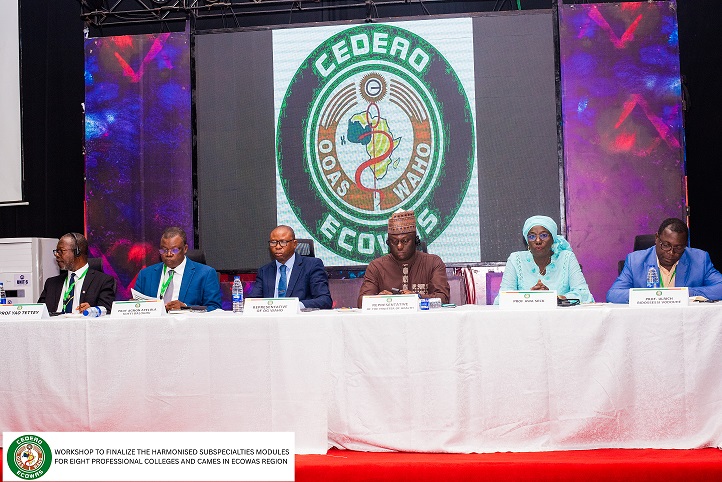
The three-day meeting is expected to strengthen collaboration among accredited health training institutions, professional colleges and regulatory bodies, and advance the harmonisation of health professional education and accreditation standards across the ECOWAS region.