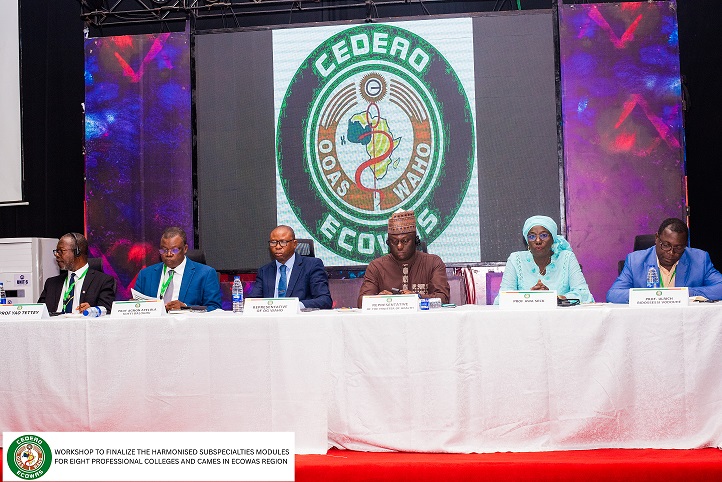
Health officials, professional colleges, universities, training institutions and regulatory bodies from across West Africa have opened a three-day workshop to finalise harmonised subspecialty training modules for eight professional colleges and the African and Malagasy Council for Higher Education (CAMES).
The workshop, which began in Abuja on Monday, November 9, is being organised with the support of the West African Health Organisation (WAHO) and is focused on establishing common standards and normative frameworks for specialised and subspecialised health professional training across ECOWAS member states.
Opening the meeting on behalf of Nigeria’s Coordinating Minister of Health and Social Welfare, Prof. Muhammad Ali Pate, Dr Dakum Longji said harmonising training standards was essential to improving healthcare quality, strengthening professional mobility and building a competent health workforce across the region.
He said differences in curricula, accreditation procedures and professional standards had limited the movement of qualified health workers across national borders and created inconsistencies in training quality.
“Regional integration does not necessarily mean imposing uniformity. Rather, it requires the establishment of common standards of excellence while respecting the specific circumstances and priorities of individual Member States,” Pate said.
The minister identified harmonised training standards, mutual recognition of qualifications and stronger quality assurance as key priorities for regional cooperation.
He said qualified professionals trained in one ECOWAS country should have their competencies recognised across the region, regardless of where they seek to practise.
Pate, however, challenged participants to ensure that the meeting produced practical outcomes rather than additional policy documents.
“The success of this workshop will not be measured by the number of documents produced or declarations adopted. It will be measured by the improvements experienced by our students, health professionals and, ultimately, our patients,” he said.
He urged participants to conclude the workshop with clear decisions, an agreed implementation roadmap and realistic timelines.
Professor Ulrich Vodouhe, representing the Faculty of Health Sciences, said the meeting marked another important step in efforts to strengthen health professional education in West Africa.
He said common standards for specialist and subspecialist training would improve professional practice, build patient confidence and promote safer, higher-quality healthcare across the region.
“Harmonisation is essential to improving professional practice, strengthening patient confidence and ensuring that individuals receive safe, high-quality healthcare regardless of where they seek treatment within the region,” Vodouhe said.
Professor Yao Tettey, representing the West African postgraduate medical and professional colleges, said the growing demand for specialised healthcare had made it necessary to expand training beyond general specialist qualifications.
He explained that professional colleges had reviewed their traditional postgraduate training and certification arrangements to increase the availability of qualified specialists while maintaining professional competence.
Tettey noted that many countries in the region continued to refer patients outside West Africa for highly specialised treatment, adding that subspecialty programmes could help build regional capacity and reduce dependence on overseas medical referrals.
He, however, warned that training programmes would not be sustainable without corresponding investment in hospitals, equipment and other infrastructure.
According to him, some specialists who returned home after advanced training had been compelled to leave again because the facilities needed to practise their skills were unavailable.
“Some professionals who have returned to their home countries after advanced training have subsequently been compelled to leave because the necessary facilities and equipment were unavailable,” he said.
He called on governments, regional authorities and development partners to support advanced specialist training and centres of excellence in the region, including institutions providing services such as interventional cardiology and transplantation.
Tettey said the ultimate objective should be to build sufficient regional capacity so that fewer patients would need to travel outside West Africa for specialised medical treatment.
Representing the chairperson of the ECOWAS Authority of Heads of State and Government, Professor Awa Seck said harmonised standards would improve the recognition of qualifications and strengthen health systems across the region.
Senegal currently holds the chairmanship of the ECOWAS Authority. Seck commended WAHO, professional colleges and CAMES for their work in aligning training pathways and urged participants to exchange experiences and develop practical solutions to challenges facing health professional education.
Professor Koffi Balogou, chairperson of the Regional Council for the Training of Health Professionals, said 58 training curricula had already been harmonised, but cautioned that the adoption of common curricula alone would not guarantee uniform implementation or automatic recognition of professional practice rights.
“The adoption of a harmonised curriculum does not automatically guarantee uniform implementation across training institutions. Similarly, comparable academic qualifications do not necessarily translate into the automatic recognition of professional practice rights,” Balogou said.
He said effective harmonisation required strong training institutions, accreditation mechanisms, regulatory frameworks, clinical learning environments and reliable assessment systems.
Balogou proposed that participants focus on three areas: establishing clear and verifiable quality requirements; clarifying the relationship between university training, professional college certification and national regulatory systems; and developing a practical roadmap with responsibilities, milestones and monitoring mechanisms.
He said the time had come to translate the achievements recorded in harmonisation into practical improvements in training and healthcare delivery.
“The time has now come for these documents to move more decisively into classrooms, clinical training centres and healthcare facilities,” he said.
In an address delivered on behalf of WAHO Director-General, Professor Palokinam T. Pitche, Professor Joseph Olorunda said weaknesses in health workforce planning, recruitment, distribution and retention continued to undermine health systems in West Africa.
He cited inadequate financing, limited infrastructure, difficult working conditions, insufficient professional development and the migration of skilled health workers as major challenges, noting that rural and underserved communities were particularly affected.
Olorunda said poor remuneration, limited career progression and inadequate incentives had contributed to the migration of qualified professionals, creating significant disparities in the distribution of health workers across the region.
He said WAHO had supported the harmonisation of 58 basic and advanced training curricula, the development of training materials for trainers, specialist training-needs mapping and capacity-building initiatives in priority disciplines.
The organisation had also supported centres of excellence and training institutions, continuous professional development activities and a regional action plan aimed at improving the retention of health professionals, particularly in underserved and hard-to-reach areas.
“Health workers save lives, and their contribution must be recognised and supported throughout their professional careers,” Olorunda said.
He reaffirmed WAHO’s commitment to working with ECOWAS member states, professional institutions and development partners to strengthen health workforce development and improve the quality and availability of healthcare services.
The workshop is expected to review and finalise subspecialty training documents for implementation across the region. Participants will also examine the functioning of professional colleges, review training modules in group sessions and present conclusions during plenary discussions.
The broader objective is to establish a common foundation for quality, professional recognition and mobility while strengthening West Africa’s capacity to provide advanced healthcare within the region.