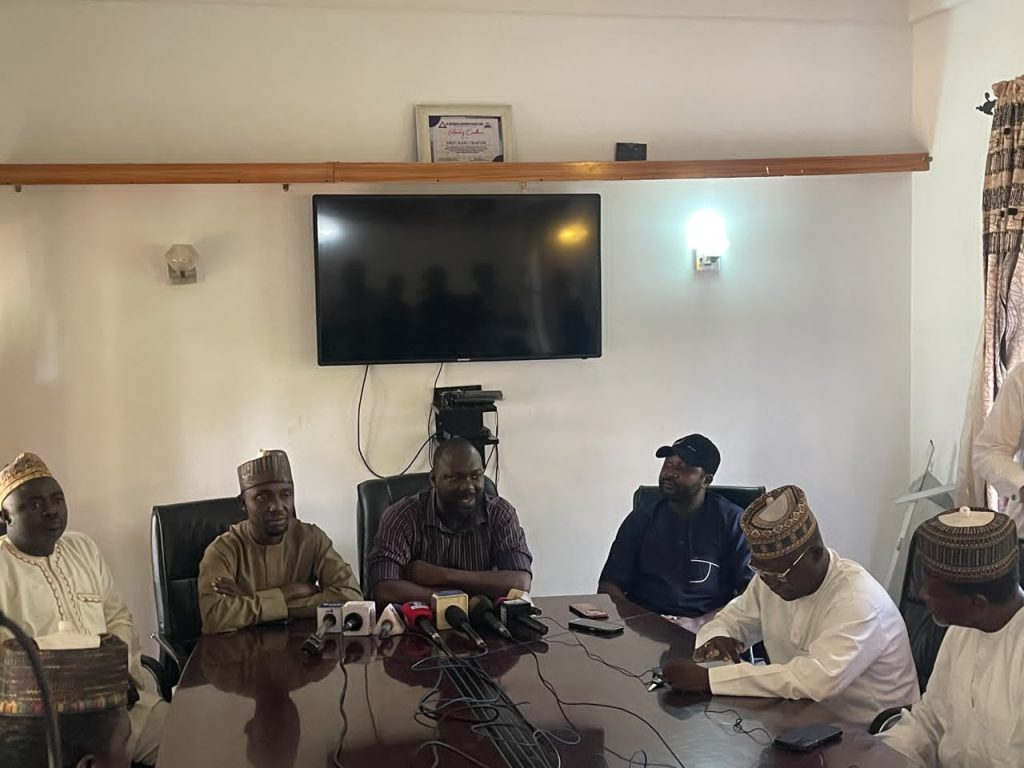
Academic Staff Union of Universities (ASUU), Kaduna State University (KASU) chapter, has commended the Kaduna State Government for addressing some of the longstanding challenges confronting the institution, while calling for sustained funding and improved welfare for staff.
The chairman of ASUU-KASU, Dr Abubakar Abdullahi, made the commendation today at a press briefing in Kaduna on the union’s two-week ultimatum to the state government over poor working conditions and other challenges affecting the university.
Abdullahi said the ultimatum was not aimed at castigating the government but was intended to draw its attention to areas requiring urgent intervention to strengthen the institution.
He acknowledged steps taken by the current administration to address some of the issues raised by the union, stressing that ASUU would continue to commend the government whenever it responded positively to the concerns of the university community.
“Where you have done something, we commend you, and where there is an issue, we bring it to your attention to address,” he said.
The ASUU chairman recalled that the government had implemented some aspects of previous agreements reached with the union, particularly on salaries and allowances.
He, however, said seven out of about 10 issues previously presented by the union remained unresolved, while three had been addressed.
Abdullahi also commended the government for reviewing an earlier decision to increase school fees, saying ASUU had opposed the increase because of its likely impact on students and their families.
“When the current government came about, they reviewed the decision and we commend them for that,” he said.
He stressed that the union’s demands went beyond the welfare of its members, explaining that they were aimed at protecting the university system and ensuring that tertiary education in Kaduna remained competitive.
According to him, the core responsibilities of the university include teaching, research and community service, adding that KASU had continued to perform creditably despite the challenges facing it.
Abdullahi described KASU as an institution capable of serving generations of Kaduna residents if adequately funded and supported.
“Roads would come and go. Physical infrastructure would not live more than 30 to 50 years. But KASU is an institution we hope and pray will still be here for the next 100 or 200 years,” he said.
He said KASU had recorded achievements that compared favourably with those of older universities in the country.
“I am not even talking about state universities. Federally established universities, first-generation universities, we go to places and we beat them, hands down,” he said.
The union leader therefore called for sustained government investment, improved staff welfare and adequate funding to enable KASU to retain qualified academics and maintain its standards.
On the two-week ultimatum, Abdullahi dismissed the perception that ASUU was eager to embark on industrial action, saying dialogue remained the union’s preferred approach to resolving disputes.
“Usually, people have this wrong notion that ASUU always wants to embark on strike. That is not our desire or passion,” he said.
He explained that the purpose of the briefing was to bring the outstanding issues to the attention of the government and the public, with the hope that they would be resolved before the expiration of the ultimatum.
Abdullahi said the union remained ready to engage the government in dialogue, stressing that peace and stability in the university were in the interest of all stakeholders.
“Even if the government calls us now, we are ready to move. Anything that will bring peace to the system, stability, that is what we want,” he said.
He also urged the state government to implement the provisions of the new Federal Government-ASUU agreement, saying it could improve funding, staff welfare and management of the university.
The ASUU-KASU chairman appealed to the government to regard the outstanding challenges as an opportunity to strengthen the institution and leave a lasting legacy in the education sector.
“The government has the opportunity to write its name in gold by actually fixing a problem system they inherited,” he said.
Abdullahi added that Kaduna, which had historically been regarded as a centre of learning, should remain at the forefront of educational development and not allow other states to overtake it in the sector.