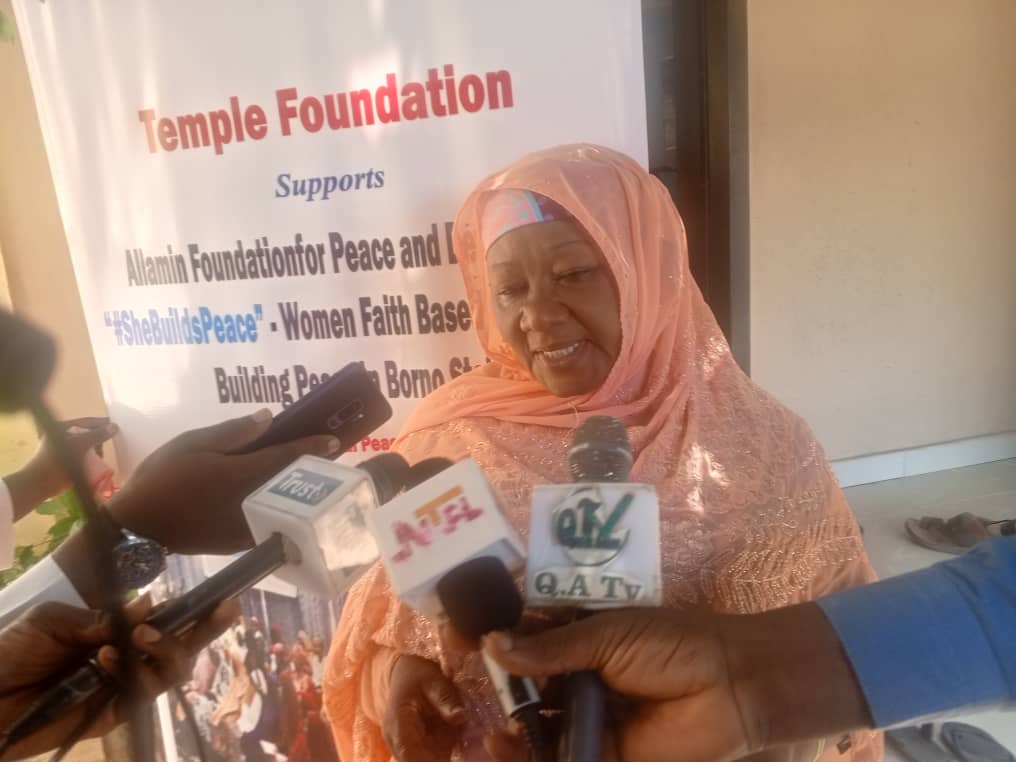
Executive Director of Allamin Foundation, Hajiya Hamsatu Allamin
Allamin Foundation for Peace and Development has identified about 3,000 children affected by radicalisation across Borno State, with 275 currently undergoing rehabilitation and deradicalisation, while 75 have already been successfully enrolled in schools.
The Executive Director of the foundation, Hajiya Hamsatu Allamin, disclosed this on Friday during a courtesy visit to the Borno State Commissioner for Education, Science, Technology and Innovation, Hon. Lawan Abba Wakilbe, at the ministry’s headquarters in the Musa Usman Secretariat, Maiduguri.
The visit was aimed at strengthening collaboration between the foundation and the Borno State Ministry of Education to improve access to education for children affected by violent extremism and facilitate their successful reintegration into society.
The intervention is being implemented under the project titled “Bridging the Gap for Sustainable Peace and Reconciliation in Borno State,” with funding support from the Canadian Fund for Local Initiatives (CFLI).
Speaking during the meeting, Hamsatu Allamin said education remains central to the rehabilitation process for children exposed to extremist ideologies.
She explained that the foundation had documented approximately 3,000 affected children across the state, with 275 currently benefiting from deradicalisation and rehabilitation programmes, while 75 had already returned to the classroom.
According to her, the organisation is committed to helping the children rebuild their lives by providing educational opportunities alongside psychosocial support and interventions designed to address the social, emotional and ideological consequences of violent extremism.
Also speaking, Dr. Ali Mustapha Ibrahim outlined the deradicalisation model developed by the foundation for individuals influenced by insurgent ideology.
He explained that the model draws on authentic teachings from the Qur’an and the Hadith of Prophet Muhammad to challenge extremist interpretations of Islam and promote peaceful coexistence.
Dr. Ibrahim also traced the historical context of religious teachings during the lifetime of Prophet Muhammad, using historical examples to demonstrate the importance of distinguishing genuine Islamic principles from distorted narratives promoted by extremist groups.
He questioned how individuals who profess the Islamic declaration of faith that there is no deity but Allah and that Muhammad is His Messenger could be persuaded to justify the killing of fellow Muslims who profess the same belief.
He noted that the model was developed under the supervision of more than 10 Islamic scholars to ensure that its religious content is firmly rooted in established Islamic teachings and capable of effectively countering extremist narratives.
According to him, the initiative is designed to help participants embrace peaceful interpretations of Islam while rejecting violent ideologies exploited by insurgent groups to recruit vulnerable individuals.
Responding, Commissioner for Education, Science, Technology and Innovation, Lawan Abba Wakilbe, commended the Allamin Foundation for its efforts and called for the development of a comprehensive, locally relevant deradicalisation framework.
He stressed that such a model must adequately address the varying ideological and operational structures of insurgent groups operating in the North-East.
Wakilbe urged the foundation to develop a framework that recognises the differences between groups such as the Islamic State West Africa Province (ISWAP) and Jama’atu Ahlis Sunna Lidda’awati wal-Jihad (JAS).
He further emphasised that the model should go beyond religious counselling by incorporating contributions from educationists, psychologists, medical practitioners, Islamic scholars, social workers, government agencies and other relevant stakeholders.
According to the commissioner, a multidisciplinary approach would ensure that the rehabilitation programme effectively addresses the complex challenges associated with deradicalisation and the reintegration of affected children into schools and communities.
He also expressed the ministry’s willingness to develop a working document that could serve as a widely accepted framework for the education and rehabilitation of deradicalised children in the state.
Wakilbe assured the foundation of the ministry’s institutional support, adding that government would work with relevant partners to guarantee affected children access to education and other essential services.
He disclosed that UNICEF was also available to support the development and implementation of educational interventions targeted at children affected by violent extremism.
The commissioner urged the foundation to clearly identify the educational needs of the beneficiaries, including school placement, learning materials, tuition support and other requirements necessary for their successful return to the school system.
He encouraged the organisation to remain committed despite the challenges, assuring that the Borno State Government and the Ministry of Education would continue supporting initiatives that offer vulnerable children a second chance at education and a peaceful future.
Wakilbe further revealed that deradicalised children would be considered for scholarship opportunities through the Borno State Scholarship Board to enable them to continue their education.
He maintained that providing education for children affected by violent extremism is crucial not only to their personal development but also to rebuilding communities and promoting lasting peace across Borno State.
The commissioner added that sustained collaboration among government institutions, civil society organisations, religious leaders, development partners, education experts and local communities would be essential for the successful rehabilitation and reintegration of children affected by insurgency.
The meeting ended with both parties expressing optimism that stronger collaboration between the Borno State Ministry of Education and the Allamin Foundation would expand educational opportunities for vulnerable children and contribute to sustainable peace and reconciliation across the state.