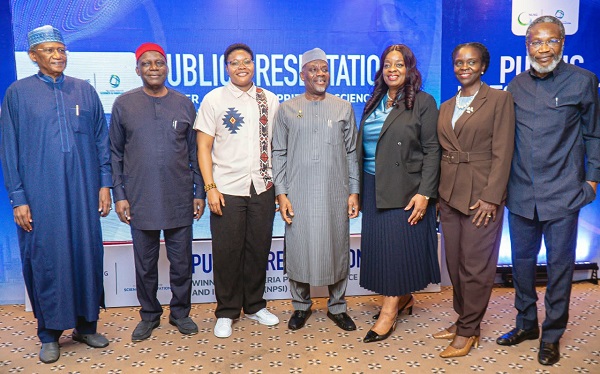
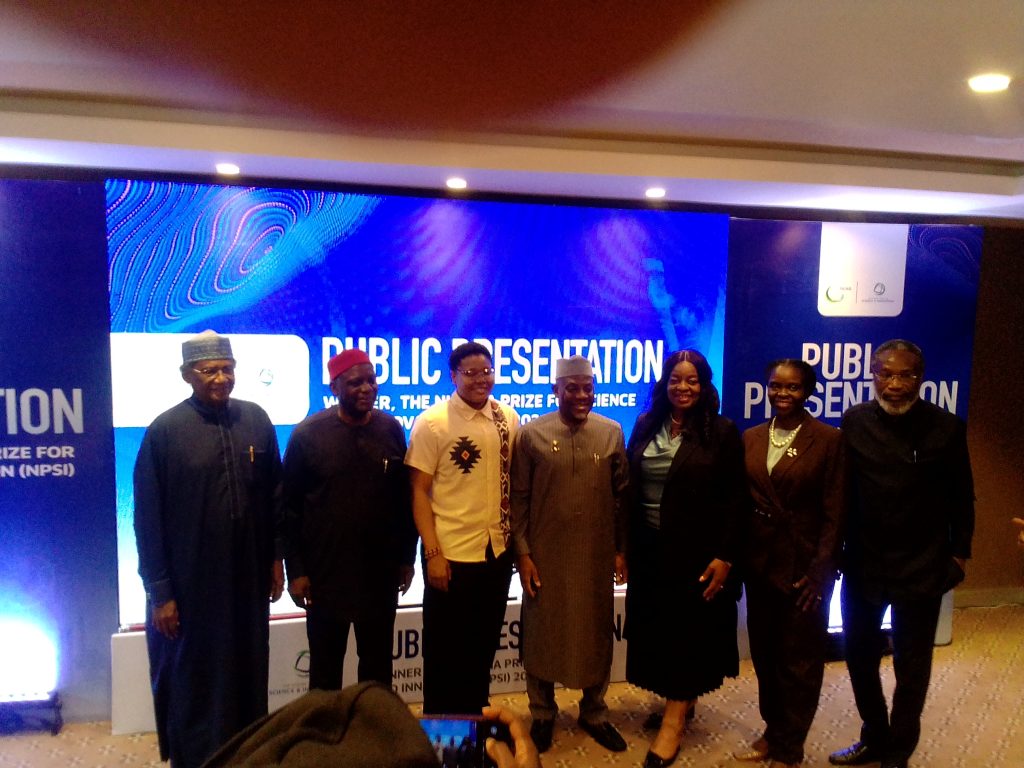
L-R (5th left): Dr. Sophia Horsfall, General Manager, External Relations and Sustainable Development, Nigeria LNG Limited (NLNG); 2nd left: Prof. Bart Nnaji, Chairman, Advisory Board of the Nigeria Prize for Science and Innovation; 3rd left: Mary-Brenda Akoda, winner of the $100,000 2026 Nigeria Prize for Science and Innovation; 4th left: Minister of Education, Dr. Tunji Alausa; 2nd right: Anne-Marie Palmer-Ikuku, Manager, Corporate Communications and Public Affairs, NLNG; and 1st right: Prof. Adesoji Adesugba, First Deputy President of the Abuja Chamber of Commerce and Industry (ACCI), during the public presentation of Akoda's award-winning GenScan AI innovation in Abuja on Monday. Photo credit: OFFOR CALLISTUS
Federal Government has moved to fast-track the deployment of Mary-Brenda Akoda’s Artificial Intelligence (AI)-powered Magnetic Resonance Imaging (MRI) technology into Nigerian hospitals, following the recognition of her innovation as the winner of the $100,000 2026 Nigeria Prize for Science and Innovation (NPSI) sponsored by Nigeria LNG Limited (NLNG).
The Minister of Education, Dr. Tunji Alausa, who attended the public presentation of the prize at Transcorp Hilton Hotel in Abuja, directed relevant stakeholders to support the young Nigerian innovator by facilitating clinical pilots of the technology across teaching hospitals and federal medical centres in the country.
Alausa also pledged to connect Akoda with the Minister of Health, Mohammed Ali Pate, saying the value of her invention must be recognised and supported by the health sector because of its potential to transform medical diagnosis in Nigeria and beyond.
The minister described GenScan AI, developed by Akoda’s company, as an example of the kind of science and innovation Nigeria needs—one that moves from research laboratories into society to solve real-life problems.
“Without innovation, Nigeria cannot hope to compete in a digital future,” Alausa said, recalling that the country had witnessed a significant turnaround after the Nigeria Prize for Science and Innovation produced a globally recognised innovation following a period where no entry met the required standard.
He congratulated Akoda, noting that her achievement demonstrated the strength of Nigeria’s education system and the ability of Nigerian youths to develop solutions capable of addressing global challenges.
“I thought maybe you were educated outside Nigeria, but when I heard you speak, I paused. Your journey started from Nigeria. That is an indication that this country’s educational system produces the best for the world,” the minister said.
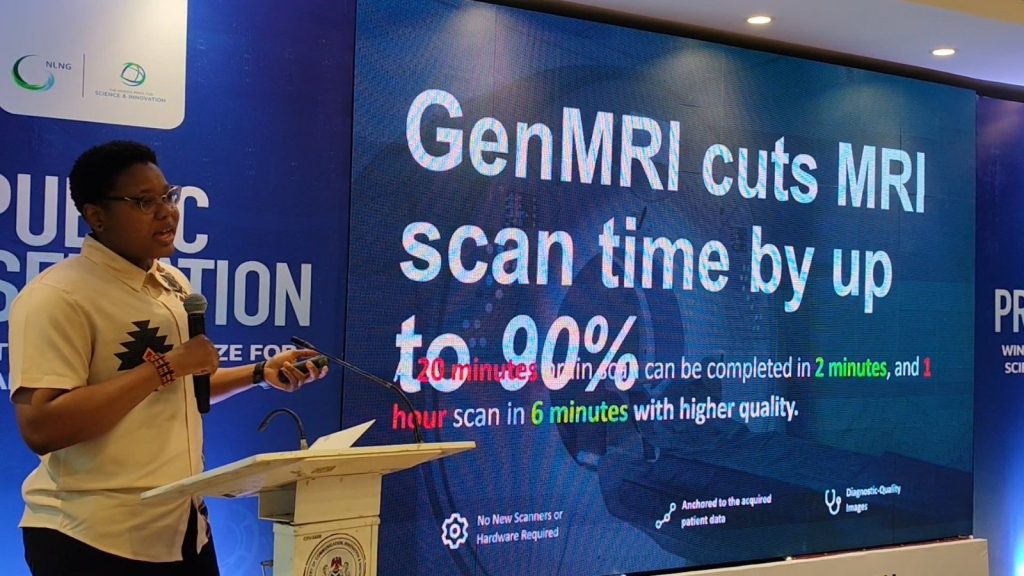
Alausa said the technology, which combines artificial intelligence with medical imaging, has the potential to reduce MRI scan time from as much as one hour to about six minutes, improving patient comfort, reducing pressure on healthcare facilities and allowing more people to access timely diagnosis.
He further advised Akoda to protect her intellectual property immediately, describing the innovation as a breakthrough that could attract global attention.
“This does not end with MRI alone. The same technology can be applied to CT scans, chest imaging and angiography. The entire world is your market,” he said.
The minister also directed the Chairman of the Advisory Board of the Nigeria Prize for Science and Innovation, Professor Bart Nnaji, to assist in connecting Akoda with the Committee of Medical Directors to create opportunities for hospitals to participate in pilot programmes.
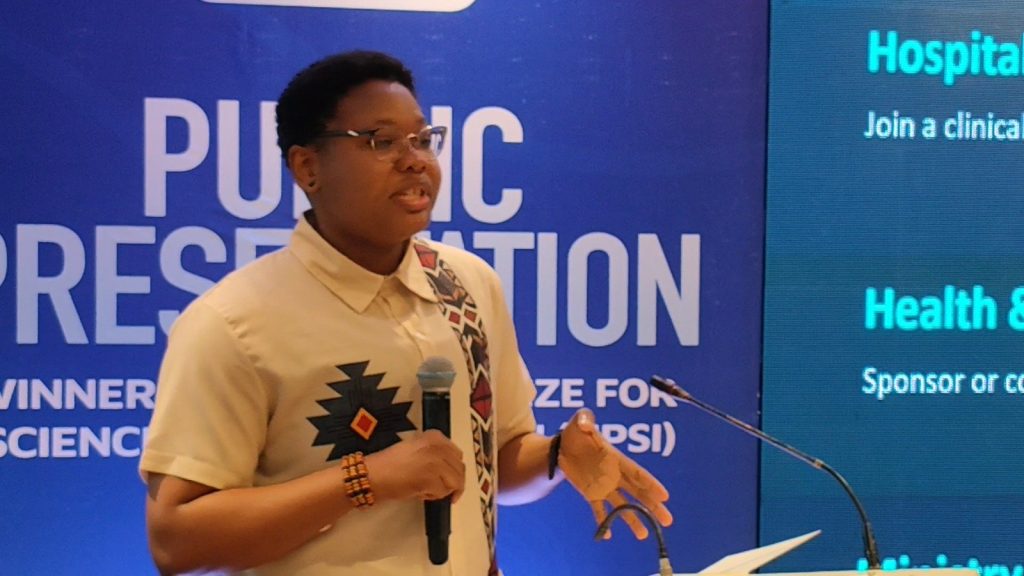
Speaking during the presentation, Akoda explained that her journey into developing GenScan AI was inspired by a painful personal experience involving a loved one who suffered a stroke and could not access urgent medical imaging on time.
She said the long waiting period for scans and delays in diagnosis can determine the difference between life and death for many patients.
“About three years ago, an elderly loved one suffered a stroke, and he needed an urgent scan. The queues were long, his condition deteriorated, and soon after, he passed away,” Akoda said.
She noted that the experience was not unique, as millions of people around the world face delays in accessing medical diagnosis for conditions such as stroke, cancer and trauma-related injuries.
According to her, stroke remains one of the leading causes of death globally, while medical imaging remains a critical first step in diagnosing many serious health conditions.
Akoda explained that conventional MRI procedures can take between 15 minutes and over one hour, requiring patients to remain completely still inside the scanner. This, she said, creates difficulties for elderly patients, children and infants who may require sedation, which also carries health risks and additional costs.
She said GenScan AI was developed to address these challenges by using artificial intelligence to accelerate MRI scans without requiring hospitals to purchase new machines.
“GenScan AI makes MRI scans up to 90 per cent faster—from a 20-minute scan to about two minutes and from an hour-long scan to six minutes—without having to spend millions of dollars buying new scanners,” she explained.
Akoda said the technology works by allowing artificial intelligence to reconstruct high-quality diagnostic images from fewer MRI data points, reducing scanning time while maintaining accuracy.
She added that assessments involving consultant radiologists showed that the AI-generated images were diagnostically equivalent to conventional MRI scans.
The innovation, she said, originated from her postgraduate artificial intelligence research at Imperial College London and has received recognition from international bodies, including Innovate UK and the NHS Clinical Entrepreneur Programme.
She disclosed that GenScan AI currently has clinical partners in the United Kingdom, United States, Kenya and Nigeria, adding that the next stage would involve regulatory approval and clinical pilots.
Akoda called for collaboration from healthcare providers, investors and policymakers to ensure Nigeria becomes one of the first countries to benefit from the technology.
Earlier, the General Manager, External Relations and Sustainable Development of NLNG, Dr. Sophia Horsfall, said the purpose of the public presentation was not only to celebrate the winner but also to allow professionals to examine the innovation and assess its practical application.
She said the 2026 Nigeria Prize for Science and Innovation focused on artificial intelligence, ICT and digital technologies capable of solving problems with real consequences for society.
According to her, GenScan AI emerged as the winning entry after judges found that it could significantly reduce MRI acquisition time, improve image quality and accommodate patient movement without requiring new hardware.
Horsfall said NLNG established the prize to recognise scientific excellence and encourage research that delivers practical benefits to Nigerians and the wider world.
She congratulated Akoda, describing her achievement as a significant milestone, especially as the first woman to win the prize as an individual recipient.
The Chairman of the Nigeria Prize for Science and Innovation Advisory Board, Professor Bart Nnaji, said Akoda’s achievement reflected the purpose of the prize, which is to reward innovations capable of solving major global problems while having relevance to Nigeria.
Nnaji explained that the competition was not simply a research award but a recognition of solutions that have moved beyond academic work into practical application.
He recalled that the 2025 cycle produced no winner because none of the entries met the rigorous standard required for the prize.
“This prize is not awarded for research alone. It is given because you have done something important in the world that is solving a world problem but has impacted Nigeria,” he said.
He added that previous winners had produced innovations with international relevance, stressing that Akoda’s achievement placed her among global innovators.
Nnaji said the advisory board was proud that this year’s winner emerged from the medical technology field, describing GenScan AI as a solution capable of changing how patients access MRI services.
Representing the Minister of Innovation, Science and Technology, Dr. Kingsley Tochukwu Udeh, the Director-General of the National Board for Technology Incubation (NBTI), Dr. Kazeem Kolawole Raji, assured Akoda of government support towards commercialising the innovation.
Raji said the agency was established to help transform Nigerian research outcomes into products and businesses that could attract investment.
He revealed that the government had been working to identify and support thousands of young innovators through its innovation programmes, adding that investors were increasingly interested in Nigerian technological solutions.
He urged Akoda to protect her intellectual property, stressing that safeguarding innovation was important before seeking investment opportunities.
Raji also invited Akoda to participate in international investor engagements, assuring her that government agencies would support efforts to take the technology to the global market.
The 2026 Nigeria Prize for Science and Innovation attracted 237 entries, with Akoda emerging as the winner for GenScan AI, an artificial intelligence-driven technology designed to make MRI scanning faster, more accessible and less stressful for patients.
With renewed government backing, clinical partnerships and investor interest, stakeholders believe the innovation could mark a major step towards improving healthcare delivery in Nigeria and positioning the country as a contributor to global artificial intelligence solutions.