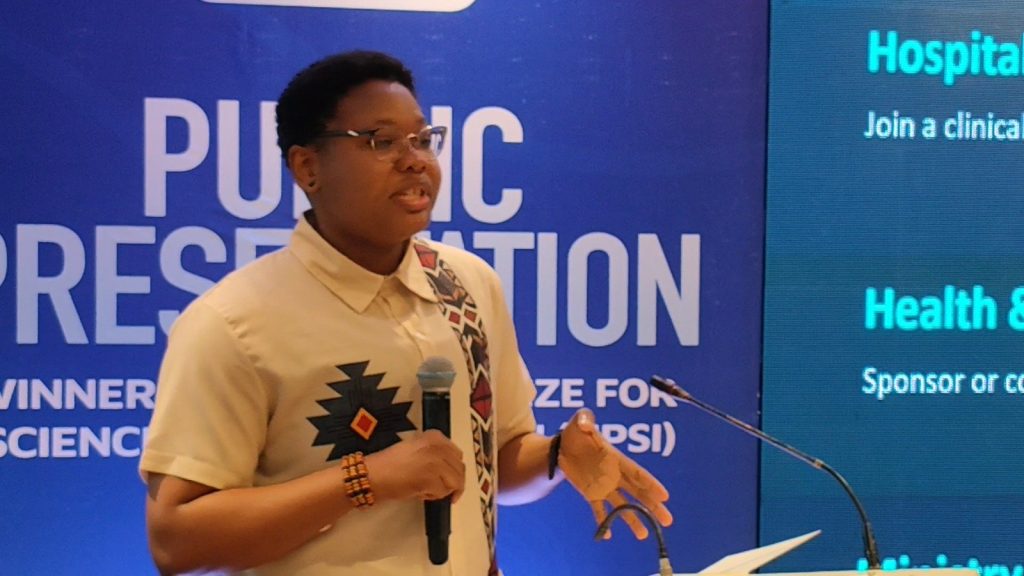
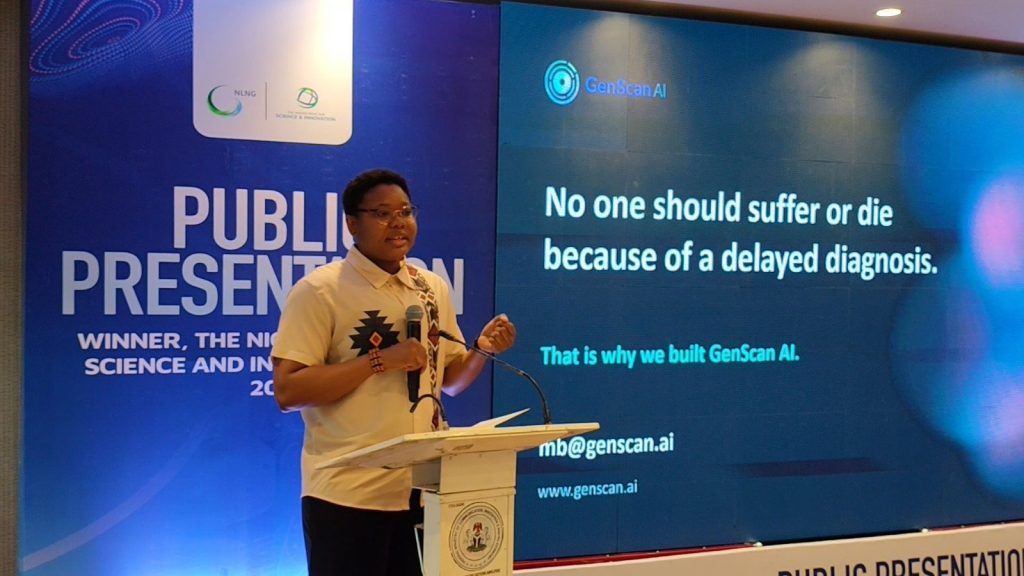
Mary-Brenda Akoda, winner of the $100,000 2026 Nigeria Prize for Science and Innovation, delivers a presentation on her award-winning GenScan AI technology during the public presentation of the innovation in Abuja on Monday.
Three years ago, Mary-Brenda Akoda watched helplessly as an elderly loved one suffered a stroke and waited endlessly for an MRI scan that never came in time.
The queues were long, the patient’s condition worsened, and before doctors could get the images needed for treatment, he died.
That painful experience became the turning point that inspired the Nigerian artificial intelligence researcher to develop a technology she believes could save millions of lives by speeding up medical diagnosis.
On Monday in Abuja, Akoda emotionally shared that personal story while presenting her innovation after emerging as the winner of the 2026 Nigeria Prize for Science and Innovation, sponsored by Nigeria LNG Limited (NLNG). Her groundbreaking invention, GenScan AI (GenMRI/C-MORE), earned her the prestigious $100,000 prize, making her the first woman and the first millennial to win the award as an individual recipient.
Standing before scientists, policymakers, health professionals and industry leaders at the Transcorp Hilton Hotel, Akoda said the innovation was born not in a laboratory alone, but from grief.
> “About three years ago, an elderly loved one suffered a stroke. Every second counts in such situations. He needed an urgent scan. The queues were long, his condition deteriorated, and soon after, he passed away. Sadly, his story isn’t unique.”
She reminded the audience that someone suffers a stroke every two seconds worldwide, while at least one Nigerian suffers a stroke every minute. Beyond stroke, millions die annually from cancer, accidents and other illnesses where early diagnosis often determines survival.
Akoda explained that one of the biggest challenges facing healthcare is the long time patients spend inside MRI scanners. A scan can take between 20 minutes and one hour, forcing patients—many already in severe pain—to remain completely still inside a confined machine.
If a patient moves, even slightly, the images become blurred and the scan must be repeated.
For children, elderly patients and critically ill people, hospitals often resort to sedation to keep them still, exposing patients to additional health risks and increasing treatment costs.
According to her, hospitals also struggle because MRI machines cost between $1.5 million and $3.5 million, have limited lifespans and can only examine a limited number of patients each day.
Rather than asking hospitals to buy expensive new scanners, Akoda said her team developed software that works with existing MRI machines.
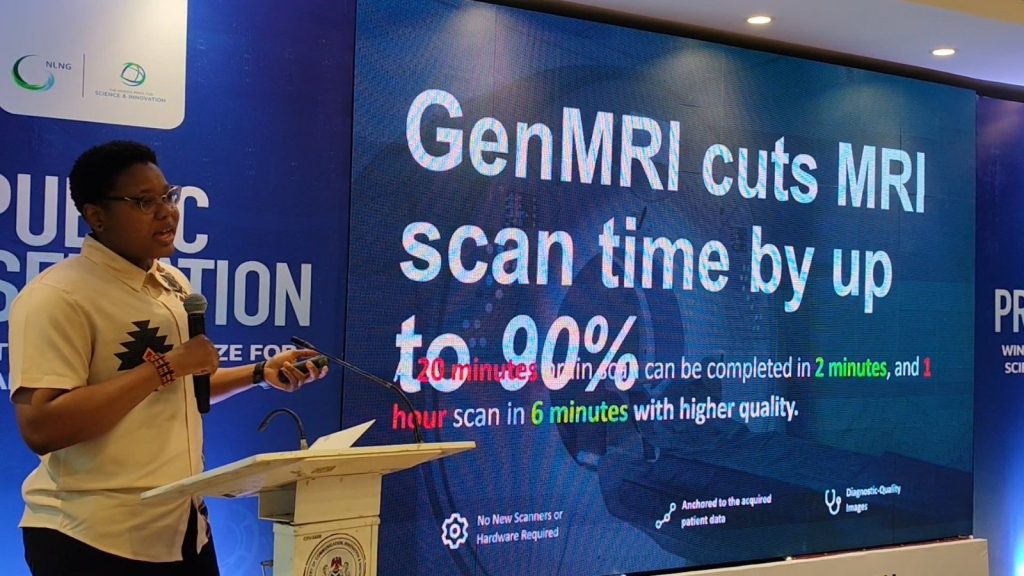
> “Gen MRI is a first-of-its-kind AI imaging software that makes MRI scans up to 90 per cent faster. A 20-minute scan can become two minutes, while an hour-long scan can become six minutes without hospitals buying new scanners.”
She compared the technology to solving a picture puzzle.
Instead of requiring every piece before producing a complete image, the AI learns to reconstruct a full diagnostic-quality scan from only a fraction of the data collected.
The result, she said, is a scan that doctors can rely on while dramatically reducing waiting times.
Beyond making patients more comfortable, the technology could transform healthcare delivery.
Akoda revealed that reducing a 20-minute scan to two minutes saves 18 minutes per patient. Across 1,000 scans, that translates into 300 additional operating hours, allowing hospitals to examine thousands more patients each year.
She said health economics studies conducted by her team showed that even operating at the lower end of the technology’s capabilities could enable hospitals to scan more than 40,000 additional patients annually.
To prove the system works, Akoda said the technology underwent rigorous scientific evaluation during her postgraduate artificial intelligence research at Imperial College London.
The AI achieved 99.7 per cent similarity with conventional MRI images and produced two peer-reviewed scientific publications.
More importantly, she said consultant radiologists who examined both conventional MRI images and AI-generated scans without knowing which was which judged them to be diagnostically equivalent in every case assessed.
> “Ultimately, our vision is that no one should suffer or die because of delayed diagnosis.”
The innovation has already attracted support from the UK’s Innovate UK, the National Health Service (NHS) Clinical Entrepreneur Programme, and research institutions across the United Kingdom, the United States, Kenya and Nigeria.
In Nigeria, Akoda disclosed that her company has secured support from the Chief Medical Director of EKO4 Diagnostic and Medical Centre for a clinical pilot, while discussions are ongoing to obtain regulatory approval and begin commercial deployment in the second half of next year.
She appealed to diagnostic centres, investors and the Federal Ministry of Health to support nationwide pilot programmes.
Akoda also urged policymakers to ensure Nigeria becomes one of the first countries to deploy locally developed medical innovations rather than waiting for technologies to succeed abroad before adopting them.
> “Nigeria should not be an afterthought. We want this technology rolled out here first because every minute matters.”
She noted that the project aligns with Nigeria’s Digital Health Initiative and could help improve access to faster diagnosis for stroke, cancer, accident victims and many other patients.
The Nigeria Prize for Science and Innovation, sponsored by Nigeria LNG Limited (NLNG), is one of Africa’s richest science awards. The 2026 edition focused on Innovations in Information and Communication Technology, Artificial Intelligence and Digital Technologies for Development.
Organisers said the competition received a record 237 entries, reflecting growing interest in home-grown scientific solutions capable of addressing national and global challenges.
For Akoda, however, the award represents more than recognition or prize money.
It is a tribute to the loved one whose life could not be saved in time and a promise that future patients may not have to endure the same painful wait.
> “If you believe this too, join us in ensuring that patients and their families get the answers and the care they need before it is too late.” She said.