North East governors
North-East Governors’ Forum (NEGF) has praised President Bola Ahmed Tinubu for supporting key infrastructure projects in the region while unveiling fresh measures to tackle insecurity, poverty and other development challenges affecting the North-East.
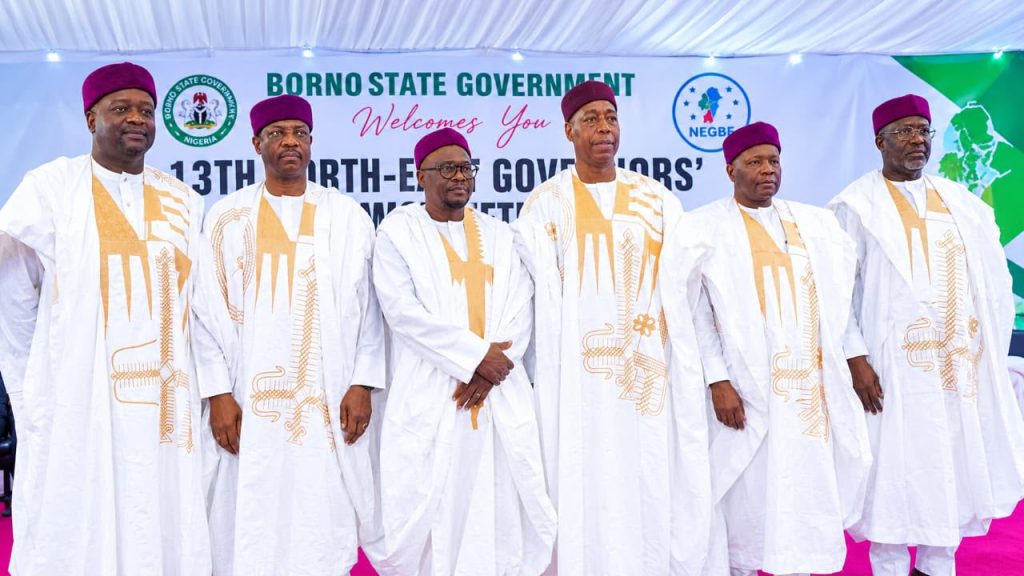
The position was presented at the 13th meeting of the North-East Governors’ Forum held on Saturday at the Government House, Maiduguri, where the Chairman of the Northern States Governors’ Forum (NSGF) and Governor of Gombe State, Muhammadu Inuwa Yahaya, reviewed the forum’s achievements over the past six and a half years and outlined priorities for the future.
Governor Yahaya said the forum had strengthened cooperation among the six North-East states despite security and economic challenges, leading to progress in infrastructure, education, healthcare, power supply and regional economic development.
He said the forum had built strong institutions, including a permanent secretariat, a Technical Working Committee of Secretaries to State Governments, a Technical Working Group of experts and sectoral committees to ensure that decisions taken at meetings are implemented.
According to him, the collective efforts of the governors have attracted greater federal attention to critical projects in the region.
He recalled that in September 2025, the six governors jointly presented 17 strategic road projects, the Port Harcourt-Jos-Bauchi-Maiduguri railway corridor and oil exploration in Kolmani and the Lake Chad Basin to President Tinubu for urgent intervention.
Yahaya noted that the Federal Government later flagged off the rehabilitation of the Dikwa-Gamboru Ngala and Bama-Banki roads, describing the nearly 99-kilometre corridors as vital to security, recovery and cross-border trade.
He also welcomed the adoption of the Akwanga-Jos-Bauchi-Gombe-Biu-Maiduguri highway as one of President Tinubu’s legacy road projects.
“We thank Mr. President for listening to the North-East,” he said.
The Gombe governor said the region had also made progress in electricity development following the operation of the Dadinkowa Hydropower Plant and reforms introduced under the new Electricity Act.
On economic development, he said the revival of the North-East Trade Fair in Bauchi in 2024 demonstrated the region’s commitment to boosting commerce and investment.
He disclosed that the six states had also agreed on a N30 billion financing plan, with each state contributing N5 billion, to establish a regional airline that would promote economic integration.
Yahaya said education and healthcare also received greater attention through the domestication of the Education Law 2022, the establishment of the North-East Education Council and closer collaboration among Commissioners of Health across the region.
He explained that the governors had adopted a common strategy against insecurity by combining military operations with efforts to address poverty, unemployment, illiteracy, drug abuse and illegal mining.
According to him, community-based security initiatives across the region are now sharing ideas and best practices.
He said the forum had helped change national and international perceptions of the North-East.
“The conversation has moved beyond emergency humanitarian relief towards recovery, resettlement, stabilisation and long-term development,” Yahaya said.
Despite the progress recorded, the governor said many of the region’s challenges remain unresolved.
“We must be honest with ourselves and with our people. The challenges we set out to confront in 2020 have not gone away. Boko Haram has been weakened but not defeated, and we still see attacks on our communities. Banditry and communal clashes are emerging as new threats.
“Many of our displaced citizens are still waiting to return home in safety and dignity. The Mambilla hydropower project, the railway connection to our region, and broadband infrastructure remain unrealised.
“The Kolmani exploration project holds great promise, but that promise must become production, jobs and revenue. Our solid minerals must be mined legally and for the benefit of our people, not to fund criminality. Too many of our children are still out of school, and our health indicators remain among the weakest in the country.”
He stressed that the next phase of the forum’s work must focus on delivering measurable results.
“To speak plainly, our next task is to turn political agreement into measurable results.
“We must close the gap between the resolutions we adopt and the outcomes our people can see and feel.
“I therefore welcome the proposals before this meeting: a results and delivery unit within the Secretariat, a dashboard to track federal infrastructure commitments, a regional power master plan, a stronger security and intelligence framework, and a focused set of flagship projects we can deliver and hand over.”
Yahaya said insecurity, poverty, unemployment, climate change, desertification and poor infrastructure remain common problems across Northern Nigeria, making stronger regional cooperation necessary.
He announced that the Northern States Governors’ Forum is restructuring its operations to improve implementation of joint decisions.
“We are establishing the Northern Nigeria Security Trust Fund. It will provide a sustainable, pooled source of support for security and peacebuilding across the region, complementing the efforts of federal security agencies and our state structures.
“We are reforming the New Nigeria Development Company (NNDC) so that it can once again drive investment, enterprise and economic development across the North, in line with the vision of its founders.”
He added that the reforms were designed to strengthen, not replace, sub-regional bodies like the North-East Governors’ Forum.
“The NEGF understands the specific realities of the North-East. The NSGF can provide scale, pooled resources and a united northern voice at the national level. Working together, the two can achieve far more than either could alone.”
Yahaya commended Borno State Governor and Chairman of the North-East Governors’ Forum, Prof. Babagana Umara Zulum, as well as the governors of Adamawa, Bauchi, Taraba and Yobe states for sustaining unity and cooperation in the region.
He also praised the Secretaries to the State Governments, the Technical Working Committee, the Technical Working Group and the NEGF Secretariat for ensuring that the forum’s decisions are implemented.
Looking ahead to the end of the current administrations in five of the six North-East states, Yahaya urged incoming leaders to sustain the spirit of regional cooperation.
“What we are handing over is not a finished project. It is a working platform, a tradition of cooperation, and an agenda that still needs completion.
“Our hope is that the next generation of leaders will protect this unity, build on what we started, and show even stronger commitment to peace, prosperity and development in the North-East,” he said.