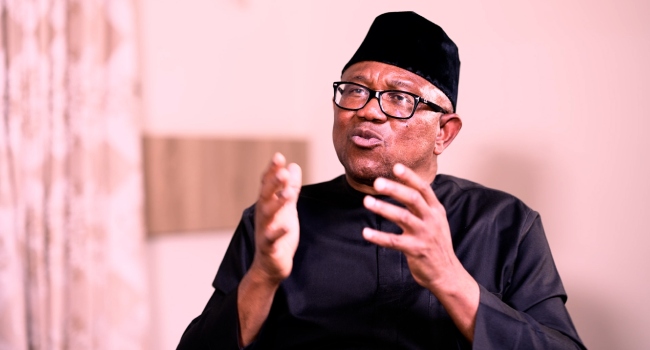
The NDC Presidential candidate, Peter Obi
Nigeria Democratic Congress (NDC) Presidential candidate, Peter Obi, has criticised the Federal Government over concerns raised by the United States about Nigeria’s investment environment, saying the report reflects deeper challenges affecting the country’s economic growth.
Obi, in a statement shared on his X handle on Wednesday, said the warning contained in the 2026 Nigeria Investment Climate Statement by the U.S. Department of State showed that Nigeria still faces major obstacles to attracting foreign investors.
He argued that while the All Progressives Congress (APC)-led administration continues to celebrate improvements in Nigeria’s macroeconomic indicators, the country must address issues affecting businesses and investor confidence.
According to him, the U.S. report identified corruption, insecurity, inconsistent regulatory enforcement, weaknesses in the judicial system, port delays and electricity challenges as major concerns for investors operating in Nigeria.
The former Anambra State governor said the concerns raised by the report should prompt urgent government action to improve Nigeria’s global economic image.
“The warning from the United States Government to prospective investors on inherent risks in Nigeria further affirms the general and correct assessment that President Bola Tinubu-led government is incompetent, ineffective and corrupt,” Obi said.
He added that the report cautioned foreign businesses about possible challenges, including regulatory pressures, arbitrary detention concerns and restrictions that could affect international investors.
As quoted by Obi, the U.S. report stated: “U.S. businesses are advised that standard business trips can escalate into detention if the firm is under regulatory suspicion or faces charges by Nigerian authorities.”
The report also noted that Nigeria’s ports remain a challenge for businesses, describing port inefficiency as a “hidden tax” on investment, while highlighting that traditional ports in Apapa and Tin Can continue to experience long cargo clearance periods.
Obi said countries seeking foreign investment must create a stable environment where businesses can operate with confidence, stressing that investors consider security, transparency, infrastructure and the rule of law before committing funds.
He maintained that Nigeria’s large population and economic potential should attract more foreign direct investment if the country addresses its structural challenges.
“Of the $10.37 billion in total capital importation in the first quarter of 2026, only $135.08 million (about 1.3 per cent of the total inflows) was Foreign Direct Investment (FDI),” Obi said.
He noted that most of the capital inflows came through Foreign Portfolio Investment (FPI), which accounted for about $9.86 billion, arguing that Nigeria needs more long-term productive investments that create jobs and strengthen the economy.
However, the Federal Government has repeatedly maintained that its economic reforms are aimed at stabilising the economy, improving investor confidence and creating conditions for sustainable growth.
Economic experts have also continued to stress that beyond headline economic figures, issues such as security, infrastructure, power supply, regulatory certainty and ease of doing business remain critical factors in attracting long-term investments.
Nigeria, Africa’s largest economy by population, has been seeking increased foreign investment to boost industrial growth, create employment opportunities and strengthen its position in the global economy.