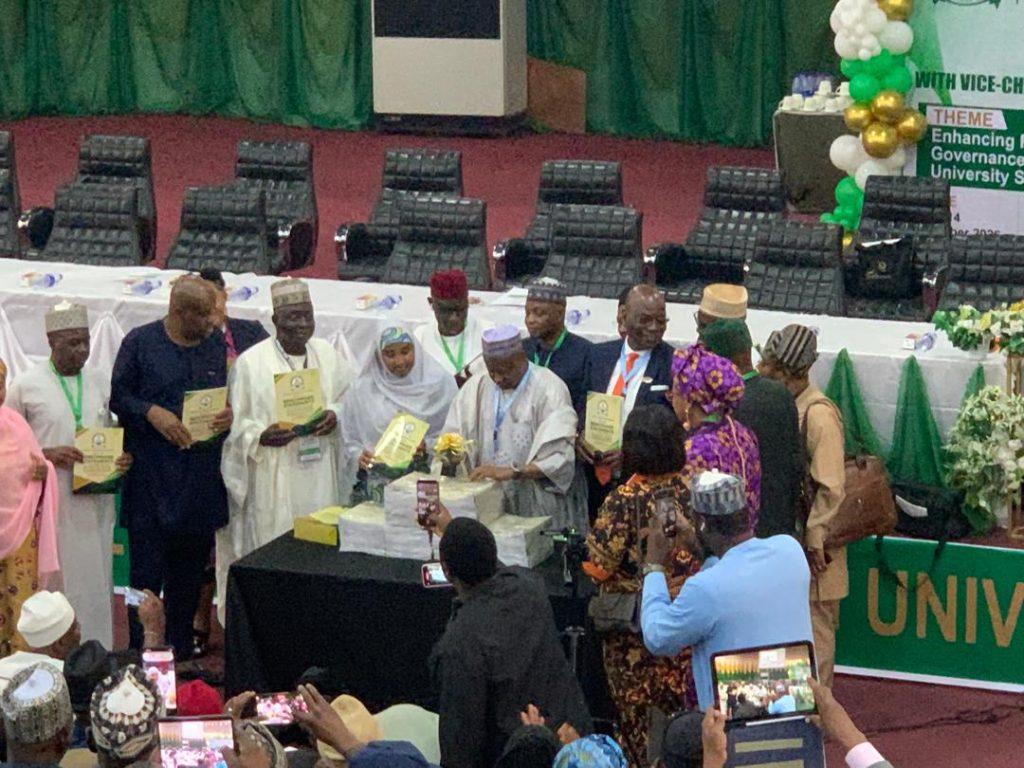
The Minister of State for Education, Professor Suwaiba Said Ahmad, has called for stronger regulatory compliance, transparent governance and transformational leadership across Nigerian universities, declaring that sustainable improvements in the nation’s higher education system require collective commitment and effective implementation of government policies.
Ahmad made the call on Tuesday while declaring open the 2026 retreat of the National Universities Commission (NUC) with vice-chancellors of all Nigerian universities at the Idris Abdulkadir Auditorium, NUC headquarters, Abuja.
The two-day retreat, scheduled for October 13 and 14, is themed “Enhancing Regulatory Compliance, Governance, Leadership, and Partnership in the Nigerian University System.”
The minister said the retreat was timely, given the Federal Government’s determination, under President Bola Ahmed Tinubu’s Renewed Hope Agenda, to accelerate the transformation of the Nigerian University System (NUS).
She commended the NUC’s ninth substantive Executive Secretary, Professor Abdullahi Yusufu Ribadu, and his management team for reviving the retreat after several years, describing the gathering as an important platform for strengthening engagement between the university regulator and institutional leaders.
According to her, the rapidly changing global higher education landscape, driven by artificial intelligence, digital learning, data analytics, research and innovation, and evolving funding models, requires Nigerian universities to adopt responsive policies and strengthen institutional capacity.
On his part, the Executive Secretary of the Commission, Professor Abdullahi Yusufu Ribadu has announced new measures aimed at strengthening quality assurance, research commercialisation and digital transformation in the Nigerian University System (NUS).
Ribadu said the initiatives were designed to improve the quality and relevance of university education, enhance institutional performance and position Nigerian universities for greater global competitiveness.
He stressed that universities must go beyond conventional academic instruction to produce graduates equipped with the knowledge, skills, creativity and competencies required to contribute meaningfully to society in an era of rapid technological advancement and artificial intelligence.
According to him, the retreat provides an opportunity for university administrators and other stakeholders to examine the challenges confronting the sector and develop practical and sustainable solutions.
The NUC boss highlighted several reforms introduced under his leadership since assuming office on December 23, 2024, including strengthening the Commission’s management structure, reviewing operational guidelines and introducing new monitoring mechanisms to improve standards across universities.
He disclosed that the Commission had developed new guidelines for the award and use of honorary doctorate degrees, including sanctions for universities that violate the provisions.
“The Commission has also introduced post-matriculation monitoring and carrying-capacity visits to universities to improve admission processes, alongside existing programme accreditation and resource verification exercises”.
Ribadu further revealed that the NUC Policy Development Strategy Committee had completed a comprehensive review and produced Blueprint 2.0 for the Rapid Revitalisation of Nigerian University Education.
He added that the Commission was developing a 21st-century strategic plan as it transitions from the Annual Performance Evaluation Report system to the Performance Monitoring System, pioneered by the Office of the Head of the Civil Service of the Federation.
Earlier in his welcome address, the Chairman of the Local Organising Committee and Director of Research, Innovation and Information Technology (DRIIT), L.M. Faruk, described the retreat as a timely initiative to address longstanding and emerging challenges facing university education in Nigeria.
Faruk commended the Executive Secretary of the NUC, Professor Abdullahi Ribadu, for his visionary leadership and the revival of the retreat, noting that sustained engagement between the Commission and university leaders would promote effective administration, institutional accountability and quality assurance.