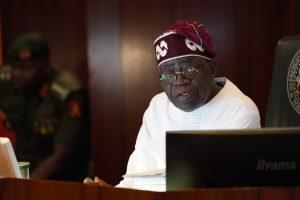
President Bola Tinubu
A United States federal court has rejected a request to compel discovery against President Bola Ahmed Tinubu and DCI Group in an ongoing Freedom of Information Act (FOIA) lawsuit involving the Federal Bureau of Investigation (FBI) and the Drug Enforcement Administration (DEA).
The ruling, delivered on October 30 by the United States District Court for the District of Columbia, also denied a motion for summary judgment filed by the plaintiff, Aaron Greenspan, according to a statement issued by the Presidency through Presidential spokesman Bayo Onanuga.
The court held that Greenspan’s request for limited discovery, which centred on alleged cyberattacks on his website, was not relevant to the main issues before the court in the FOIA case involving the FBI and DEA.
Reacting to the decision, attorney Christopher W. Carmichael said: “The Court’s decision makes clear that this Freedom of Information Act proceeding cannot be used to pursue discovery unrelated to the legal questions before it. By denying the request for discovery against President Tinubu and DCI Group, the Court reinforced the importance of keeping this litigation focused on the issues properly before it.”
The court also dismissed a separate application by non-party Karl Von Batten, who had sought permission to file an amicus curiae (friend-of-the-court) brief. It equally rejected Greenspan’s request for judicial notice connected to that application.
In addition, the court refused Greenspan’s motion for summary judgment.
Commenting on the outcome, attorney Oluwole Afolabi said: “The Court also denied the plaintiff’s motion for summary judgment and rejected a separate request to introduce an amicus brief. While the underlying FOIA issues remain before the Court, these rulings establish important procedural boundaries and clarify which matters are appropriate for consideration in this litigation.”
The lawsuit is part of Greenspan’s effort to obtain records from the FBI and DEA under the US Freedom of Information Act. The latest ruling does not determine the substance of the FOIA case but limits the scope of issues that can be considered as the litigation continues.
The decision is being viewed by the Presidency as a procedural victory because it prevents the expansion of the case to include matters the court considers unrelated to the central FOIA dispute.