What, really, should determine the composition of a presidential campaign team?
Is it the candidate’s political strength? The geographical spread of the party? The experience and competence of those recruited for the job? Their ability to mobilise voters? Or is a campaign council simply another opportunity to accommodate as many political heavyweights, loyalists, associates and interest groups as possible?
And, perhaps more importantly, what does the size of a campaign council have to do with winning an election?
These questions have become unavoidable following the unveiling of the 207-member Presidential Campaign Council announced for President Bola Ahmed Tinubu and Vice President Kashim Shettima ahead of the 2027 presidential election.
The sheer size of the council immediately attracted attention. But beyond the numbers, questions have also been raised about the electoral value, credibility and individual contribution of some of those listed.
Those questions are legitimate.
After all, a presidential campaign is not a convention of political office holders. It is an organised battle for votes. Its success should therefore be measured by its capacity to persuade, mobilise, coordinate, communicate and ultimately deliver voters—not by how many prominent names can be accommodated on a list.
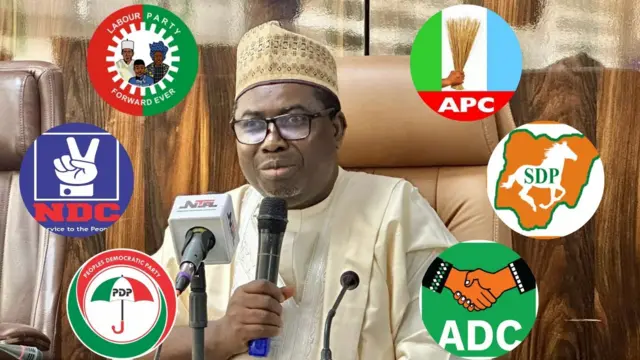
- INEC Chairman Prof Joash Amupitan and the major political parties (Photo: BBC News)
And this is where Nigeria’s presidential campaign history becomes instructive.
From modest teams to political armies
I first became interested in Nigeria’s electoral politics as an 18-year-old during the 1983 general elections. Five major parties were competing for power at the time, and, with almost unlimited access to television, radio and newspapers, I followed the campaigns with the curiosity of a young man fascinated by the political drama unfolding around him.
What struck me then was not the size of the campaign machinery of the competing parties. It was the quality of the people involved and the effectiveness of the campaigns they conducted.
The political parties had relatively compact structures. They had party leaders, campaign managers, strategists, mobilisers, spokespersons and, of course, the presidential candidate and running mate.
But they did not need hundreds of people to give the impression that a campaign was serious.
The campaigns themselves were the spectacle.
In the Second Republic, Alhaji Shehu Shagari’s presidential campaign was essentially driven by the machinery of the National Party of Nigeria under Chief Adisa Akinloye, supported by influential party and government figures such as Chief O.P. Lulu-Briggs, Alhaji Adamu Ciroma, Dr Umaru Dikko and Dr Chuba Okadigbo. Shagari and his running mate, Dr Alex Ekwueme, were also central figures in the campaign.
The same pattern could be seen in the Unity Party of Nigeria. Chief Obafemi Awolowo’s campaigns were anchored by the party’s organisational machinery, with Chief Ebenezer Babatope playing a prominent coordinating role alongside such figures as Prof Akin Mabogunje, Prof Hezekiah Oluwasanmi and the party’s state governors.
The Nigerian Peoples Party’s campaign for Dr Nnamdi Azikiwe similarly revolved around its national leadership, with Chief Adeniran Ogunsanya, Wantaregh Paul Unongo and other prominent party figures providing strategic and organisational support.
There was no suggestion that victory depended on assembling a small army of politicians around the candidate.
The emphasis was on political organisation, messaging, mobilisation and persuasion.
When campaign managers became Directors-General
Over time, however, Nigeria’s presidential campaigns became more elaborate.
The 1993 election, for instance, introduced a more recognisable campaign organisation structure. Chief MKO Abiola’s famous “Hope ’93” campaign had Dr Jonathan Silas Zwingina as Director-General, while the broader campaign was supported by the leadership of the Social Democratic Party and other influential political actors.
The NRC campaign for Bashir Tofa was similarly organised, with Ibrahim Mantu as Director-General and Dr Doyin Okupe as spokesman.
The return to democracy in 1999 further institutionalised the campaign organisation.
Dr Iyorchia Ayu headed the Obasanjo Presidential Campaign Organisation, supported by figures including Atiku Abubakar, Onyema Ugochukwu, Alex Ekwueme and Prof Jerry Gana.
By 2003, the campaign structure had become more specialised, with separate responsibilities for zones, media, mobilisation and other areas.
The trend continued through the 2007, 2011 and 2015 elections.
But even as the structures became more sophisticated, the core principle remained reasonably straightforward: identify the people capable of performing specific functions and put them in charge of those functions.
Then came the era of the mega-campaign council.
When everybody became a campaigner
The 2015 presidential election appears to have marked a significant turning point.
The APC campaign for Muhammadu Buhari and Yemi Osinbajo had a formidable leadership structure. Rotimi Amaechi served as Director-General, while the campaign featured prominent figures such as Bola Ahmed Tinubu, Atiku Abubakar, John Odigie-Oyegun, Olorunnimbe Mamora, Audu Ogbeh, Babatunde Fashola, Garba Shehu, Abdulrahman Dambazau, Boss Mustapha and Kayode Fayemi, among others.
There were clearly defined directorates for fundraising, media and publicity, security, contact and mobilisation, policy research and strategy, election planning, legal affairs, youth mobilisation, women mobilisation, administration and finance.
That structure made sense.
A presidential election is a complex operation. Different responsibilities require different specialists. A national campaign needs people who understand politics, communication, logistics, fundraising, security, research, election monitoring and voter mobilisation.
The problem, therefore, is not necessarily a large campaign structure.
The problem begins when size becomes an end in itself.
By 2019, the campaign structures had become even more politically expansive. Buhari’s campaign was again led by Amaechi, with Tinubu, Osinbajo, Adams Oshiomhole, George Akume, Ken Nnamani and others occupying senior positions.
The PDP campaign for Atiku Abubakar was similarly populated by governors, former governors, former ministers, party leaders, technical advisers and zonal coordinators.
By 2023, the pattern had become firmly established across the major political parties.
Tinubu’s APC campaign featured former President Muhammadu Buhari as overall chairman, while the candidate himself, Kashim Shettima, Abdullahi Adamu, Adams Oshiomhole, Hadiza Bala Usman, James Faleke and several governors occupied important positions.
The PDP’s Atiku Abubakar campaign was also headed by a formidable collection of political figures, including Aminu Tambuwal, Udom Emmanuel, Ifeanyi Okowa, Bukola Saraki, Pius Anyim, Ibrahim Shekarau and others.
The Labour Party’s Peter Obi campaign, meanwhile, operated with its own identifiable leadership structure.
In other words, the evolution is clear: campaign teams have gradually moved from being functional political machines to becoming miniature political establishments.
And that raises an uncomfortable question.
Is a campaign council still a campaign council?
A campaign council should, in principle, be a war room.
It should be where strategy is developed, voter blocs are analysed, messages are tested, weaknesses are identified, resources are allocated and the candidate’s route to victory is constantly reassessed.
A war room does not become more effective because it has more generals.
Indeed, there is a point at which additional layers of leadership begin to slow rather than accelerate decision-making.
Who is responsible when everybody is responsible?
Who takes the blame when the strategy fails?
Who has the authority to make an urgent decision when dozens of political interests are represented around the table?
And perhaps the most important question: how many of those appointed to these enormous campaign councils are actually expected to campaign?
There is another dimension that deserves attention.
In Nigerian politics, political appointments are rarely interpreted purely in administrative terms. A position on a campaign council can confer status, recognition and access. It can also reassure political actors that they have not been forgotten.
This may explain, at least partly, why campaign councils continue to grow.
The campaign council can become a political settlement table.
Everybody who matters—or who believes he or she matters—must find a place.
But elections are won outside the council room
There is, however, a fundamental difference between political accommodation and electoral effectiveness.
A politician may be influential within a party but have little influence over actual voters.
A former governor may command enormous respect in his state but possess little capacity to persuade voters outside his immediate political network.
A media personality may have thousands of followers but be incapable of translating social-media visibility into votes.
A party heavyweight may occupy an impressive title on a campaign council without delivering a single polling unit.
Conversely, someone without a grand political title may quietly control networks capable of delivering thousands of votes.
This is why the obsession with titles and numbers can become dangerous.
Elections are ultimately won at the polling unit.
Not in the conference room.
Not on the campaign council’s letterhead.
Not because 207 distinguished Nigerians have their names on a document.
The real question is: who can deliver voters?
The 2027 test
This is what makes the controversy surrounding the APC’s 2027 campaign council particularly interesting.
The council reportedly contains 207 members, although there have been indications that the list may subsequently have been withdrawn or revised.
President Tinubu and Vice President Shettima were listed as chairman and vice chairman, with APC National Chairman Nentawe Yilwatda and former Zamfara Governor Abdulaziz Yari occupying senior positions.
The list also contains an impressive array of political figures, including governors, legislators, former governors, party leaders, ministers, media practitioners and other prominent Nigerians.
Names such as Hope Uzodimma, Bisi Akande, Segun Osoba, Rochas Okorocha, Abdullahi Adamu, Godswill Akpabio, Tajudeen Abbas, Adams Oshiomhole, James Faleke, Bayo Onanuga, Dele Alake and many others naturally give the council political weight.
But political weight is not necessarily electoral weight.
That distinction will become increasingly important as the 2027 contest gathers momentum.
If the objective is to win an election, the APC will ultimately have to answer a simple question about every member of its campaign machinery:
What exactly can this person deliver?
Can he or she mobilise a constituency?
Can the person influence undecided voters?
Can the person strengthen the party’s position in a difficult state or senatorial district?
Can the person develop an effective message?
Can the person neutralise opposition narratives?
Can the person identify emerging voter concerns before they become political problems?
Can the person deliver votes?
If the answer to these questions is yes, then the person’s presence is justified—whether the council has 20 members or 200.
If the answer is no, then the title may be little more than decoration.
The opposition should be asking the same questions
Interestingly, the issue is not peculiar to the APC.
The other presidential contenders for 2027—including Atiku Abubakar, Peter Obi, Donald Duke, Sandy Onor, Adewole Adebayo and Seyi Makinde, as listed in the material available at the time of writing—had yet to unveil their respective campaign councils.
When they eventually do, Nigerians should resist the temptation to judge them by the number of political heavyweights on their lists.
Instead, we should ask the same questions of every campaign organisation.
What is the strategy?
Who is responsible for it?
What are the measurable targets?
How are voters being segmented?
What is the campaign’s message?
Who is responsible for youth voters, women voters, first-time voters and the millions of Nigerians who may be politically disengaged?
How will the campaign penetrate communities where social-media propaganda has little influence?
And, ultimately, who is responsible for turning political enthusiasm into votes?
These are far more important questions than the number of people listed on a campaign document.
We have been here before
Looking back at Nigeria’s electoral history, one lesson stands out.
The most memorable presidential campaigns were not necessarily those with the largest campaign councils. They were campaigns driven by ideas, personalities, political organisation, communication and mobilisation.
The 1983 campaigns I watched as a young man remain memorable to me not because of the number of people surrounding the candidates, but because of the quality and intensity of the political contest.
That is what seems to have been lost somewhere along the way.
We have gradually transformed campaign organisations into elaborate political directories.
We have replaced the campaign manager with the Director-General, then surrounded the Director-General with deputy directors, zonal coordinators, advisers, committee chairmen, special assistants and an assortment of other titles.
And, before long, everybody is a campaign official.
But when everybody is important, perhaps nobody is truly accountable.
That is the danger.
Bigger is not always better
There is nothing inherently wrong with a large campaign organisation. Nigeria is a vast country with 36 states, the Federal Capital Territory, hundreds of ethnic and linguistic communities and an electorate spread across thousands of polling units.
A national campaign necessarily requires a broad network.
But broad does not have to mean bloated.
The best campaign structure is not necessarily the one with the largest number of names. It is the one in which every person has a clearly defined responsibility, measurable targets and the capacity to deliver.
A campaign council should be a machine for winning votes—not a reward system for political loyalty.
As the 2027 presidential election approaches, that distinction may become more important than ever.
Because at the end of the day, Nigerians will not vote for the 207 members of a campaign council.
They will vote for the candidate.
And when the votes are counted, the ballot box will not ask how many big names were on the campaign council.
It will ask only one question:
How many voters did you convince?