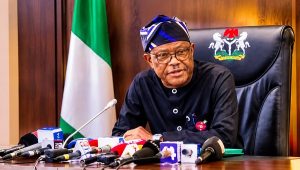
Minister of State for Petroleum Resources (Gas), Ekperikpe Ekpo,
A leading socio-cultural organisation in Akwa Ibom State, Mboho Mkparawa Ibibio (MMI), has criticised the Minister of State for Petroleum Resources (Gas), Ekperikpe Ekpo, over what it described as the alleged uneven distribution of employment opportunities into key federal agencies in the oil and gas sector.
The group alleged that a recently circulated list of appointments facilitated by the minister showed that the overwhelming majority of beneficiaries were drawn from his own senatorial district, raising concerns over fairness and equitable representation.
In a statement made available to journalists and signed by its Public Relations Officer, Idongesit Ikono, MMI said it had observed “with grave concern” a publication attributed to the minister detailing employment opportunities allegedly secured for Akwa Ibom indigenes in agencies under his supervision.
According to the group, out of 34 employment opportunities reportedly facilitated by the minister, 30 were allocated to individuals from Akwa Ibom North-West Senatorial District, while the remaining two senatorial districts received only two slots each.
The statement read: “While MMI recognises the importance of creating employment opportunities for Akwa Ibom people, we are concerned by the apparent lopsidedness in the distribution of these opportunities, particularly where the beneficiaries appear to be disproportionately drawn from the Minister’s senatorial district.”
MMI stressed that Ekpo serves as a federal minister representing the entire state and not a single senatorial district.
“He does not occupy the position as a representative of Akwa Ibom North-West Senatorial District, otherwise known as Ikot Ekpene Senatorial District,” the group said.
It added: “Consequently, any intervention, employment opportunity or other federal benefit facilitated through his office ought, as much as possible, to reflect the principle of fairness, inclusiveness and broad representation of the three senatorial districts and the various communities of Akwa Ibom State.”
The organisation argued that if the published figures are accurate, they would represent “a bad precedent for public administration and equitable representation.”
MMI further warned that public office holders should not be seen as concentrating opportunities within their immediate political constituencies.
“Such a practice could encourage a dangerous precedent in which every political office holder seeks to appropriate public opportunities primarily for his or her locality, thereby undermining the principle of state character, inclusiveness and equitable distribution of government benefits.”
The group called on the minister to publicly explain the basis for the appointments and the criteria used in selecting beneficiaries.
“MMI therefore calls on the Minister to clarify the circumstances surrounding the published list and the criteria used in selecting the beneficiaries, particularly the apparent concentration of beneficiaries from his senatorial district.”
It also urged political office holders from Akwa Ibom to place the collective interest of the state above sectional considerations.
The statement continued: “We equally urge the Minister and all other political office holders from Akwa Ibom State to rise above narrow political, senatorial, local government or community considerations and put the collective interest of Akwa Ibom people first.”
Reaffirming its position on equity, the group said: “MMI believes that public office is a trust and that every Akwa Ibom indigene, irrespective of senatorial district, local government area, political affiliation or community, deserves a fair opportunity to benefit from government programmes and interventions.”
The organisation concluded by condemning any verified act of discrimination in the allocation of public opportunities and called for greater transparency and inclusiveness.
“We therefore condemn any proven act of discrimination or preferential allocation of public opportunities and urge all people of good conscience to speak against practices that undermine fairness, unity and equal opportunity in our state.
“Akwa Ibom belongs to all of us. Public opportunities must therefore be administered with fairness, transparency and inclusiveness.”