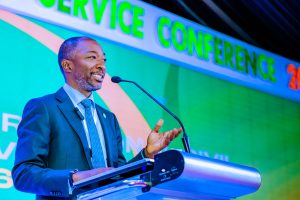
Minister of Education, Tunji Alausa
Federal Government has unveiled the 2026 agreements with staff unions in tertiary institutions, reaffirming its commitment to improved staff welfare, industrial harmony and uninterrupted academic calendars across the country.
Minister of Education, Dr Tunji Alausa, announced this at the unveiling of the 2026 Federal Government Staff Unions Agreements for Tertiary Institutions, where he assured the unions that the government would fulfil its obligations under the agreements.
Alausa said the agreements marked a significant step towards restoring confidence between the government and education sector workers, while ensuring that students could pursue their studies without repeated disruptions caused by industrial disputes.
He expressed appreciation to President Bola Tinubu, for his leadership and support in resolving longstanding challenges in the education sector, noting that the achievement aligned with the administration’s Renewed Hope Agenda.
According to the minister, previous agreements between the government and staff unions had often been characterised by delayed, incomplete or unfulfilled commitments, leading to recurring disputes and prolonged industrial actions.
He observed that the consequences of such disruptions were borne largely by students and their families, while teaching, research and institutional development also suffered.
“During his campaign, President Bola Ahmed Tinubu, GCFR, promised that a four-year course would be completed in four years. Today, through his leadership, these agreements give practical expression to that pledge: a promise made, a promise kept, and trust restored,” Alausa said.
He, however, stressed that the success of the agreements would depend on faithful implementation, adding that the government recognised the importance of honouring its commitments to sustain public confidence.
The minister explained that the agreements included the Consolidated Academic Tools Allowance (CATA) for the Academic Staff Union of Polytechnics (ASUP) and the Colleges of Education Academic Staff Union (COEASU), as well as the Consolidated Non-Teaching Tools Allowance (CONTTA) for eligible non-teaching staff unions in universities, polytechnics and colleges of education.
He stated that the allowances would take effect from January 1, 2026, in accordance with the agreements and applicable implementation guidelines.
According to him, the allowances are intended to support the professional and operational needs of eligible personnel, reflecting the government’s recognition that the quality of tertiary education depends significantly on the welfare, motivation and professional well-being of its workforce.
Alausa added that staff welfare must extend beyond allowances to include fair treatment, transparent promotion processes, occupational safety and opportunities for career advancement.
He assured stakeholders that the Federal Ministry of Education would continue to work with relevant government agencies, governing councils, institutional managements and unions to create an environment conducive to effective teaching, learning and research.
Earlier, the Chairman of the Federal Government Tertiary Institutions Expanded Negotiation Committee, Alhaji Yayale Ahmed, commended the government and the unions for reaching agreements through dialogue and mutual understanding.
Ahmed said the negotiations were guided by collective bargaining, mutual respect and a willingness by both parties to accommodate each other’s concerns.
He urged the unions to exercise patience during implementation, noting that government processes could take time.
Ahmed also called for the harmonisation of identified discrepancies in the agreements to ensure that no union felt disadvantaged.
In his remarks, Mr Mohammed Ibrahim, the President, Senior Staff Association of Nigerian Universities (SSANU), commended Alausa for his role in resolving longstanding issues affecting tertiary institution workers.Nigerian news
Ibrahim said the payment of outstanding salary arrears and the implementation of the allowances had improved workers’ morale.
He also urged the government to ensure the full implementation of all components of the agreements, beyond the payment of allowances.
He expressed optimism that the inauguration of the joint implementation and monitoring committee would facilitate the timely resolution of outstanding issues