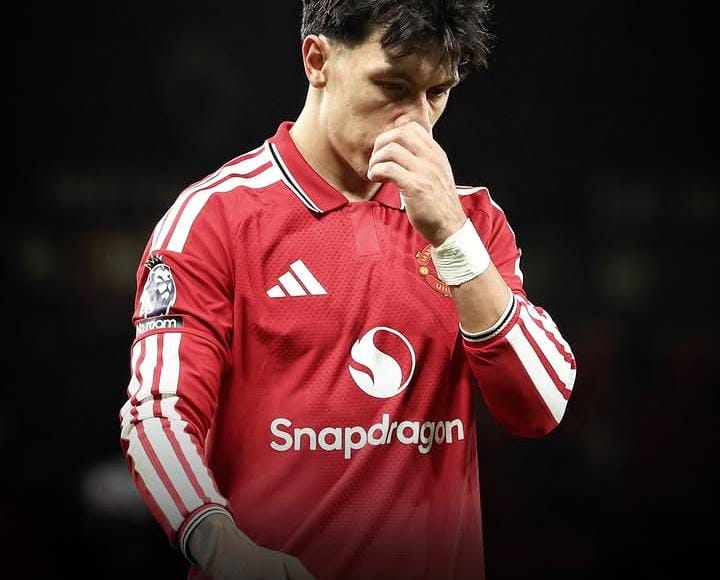
Manchester United star, Lisandro Martínez
Lisandro Martínez could face disciplinary consequences for publicly criticising Manchester United’s leadership, but his outburst has also brought back memories of Cristiano Ronaldo’s bitter fallout with the club in 2022.
The Argentine defender took aim at United’s recruitment and questioned the support given to manager Michael Carrick after Tuesday’s 2-0 Champions League defeat to Atlético Madrid, insisting that the problems at Old Trafford go beyond the players and the man in the dugout.
Martínez singled out director of football Jason Wilcox, saying he expected more from the club’s hierarchy after a summer transfer window he believes left the squad short of the quality needed to compete at the highest level.
“I expect more from our technical director. I have to be honest,” Martínez said, while admitting that the players also needed to improve.
His criticism did not stop there. The defender questioned United’s habit of changing managers whenever results deteriorate, arguing that those responsible for building the squad must also answer for the club’s struggles.
“You start changing, changing, changing manager. But what about other areas?” he asked.
The remarks have put Martínez in a difficult position, with reports suggesting that United could fine him for speaking out against the club’s hierarchy. However, a fine has not been officially confirmed.
His comments have also divided opinion, with critics arguing that such grievances should be handled internally, particularly when the team is struggling for results.
Yet the controversy has revived an uncomfortable question that has followed United for years: can the club fix its problems by changing managers and holding players accountable without examining the decisions made by those running it?
That question was at the heart of Ronaldo’s explosive interview with Piers Morgan in November 2022.
The Portuguese forward accused United of betraying him, questioned the club’s progress since Sir Alex Ferguson’s departure and launched a public attack on then-manager Erik ten Hag.
“I felt betrayed,” Ronaldo said during the interview, which triggered a major fallout between him and the club.
United subsequently announced that Ronaldo’s contract had been terminated by mutual agreement, bringing his second spell at Old Trafford to an abrupt end.
But while the two incidents share similarities, Martínez’s position is different.
Ronaldo’s interview was a personal confrontation that targeted the manager and the club’s leadership, while Martínez has defended Carrick and directed his frustration towards those responsible for strengthening the squad.
The Argentine believes the manager needs better support in the transfer market, particularly as United attempt to compete with teams that have invested heavily in their squads.
His argument is not without complications. United’s players must still answer for their performances, and Martínez himself cannot escape scrutiny simply because he has questioned the club’s recruitment.
Former United captain Wayne Rooney has criticised the defender for airing his concerns publicly, reflecting the view that disagreements of this nature should be settled behind closed doors rather than becoming another distraction for a struggling team.
There is also the question of whether Martínez’s comments will help Carrick or make an already difficult situation worse.
Still, his criticism has drawn attention to a problem that has outlasted several managers. United have repeatedly sought a fresh start by changing the person in charge, but questions about recruitment, squad depth and the club’s long-term direction continue to surface.
Ronaldo’s departure did not end those questions. Martínez’s outburst has now brought them back into the conversation, with the possibility of a fine adding another layer to the drama.
The club has a decision to make over how it handles a player who has openly challenged its leadership. But beyond any disciplinary action, United must also consider why those questions keep returning.
Ronaldo spoke out and left. Martínez has chosen to defend his manager while demanding more from the people above him.
Their circumstances are different, but both episodes expose the tension between the players expected to deliver results and the leadership responsible for giving them the tools to succeed.
For United, the bigger challenge is not simply deciding whether Martínez should be punished. It is addressing the problems behind his outburst before another season of disappointment produces the same arguments all over again.