- From youth leadership and the Yar’Adua era to public service, political ideas and a new generation of leadership
By MUHAMMAD ABUBAKAR –
Katsina has never lacked influential political figures. From the traditional institutions that have long shaped the social order of the ancient Hausa city to the politicians, administrators, intellectuals and technocrats who have occupied positions of authority in the modern state, Katsina’s political history has been defined by the interaction between personalities and institutions across generations.
Occasionally, however, a public figure emerges whose career offers a useful way to understand the changing character of the state itself.
Engineer Muttaqha Rabe Darma, PhD, is one such figure.
His career has crossed several professional and political boundaries. He has been an engineer, academic, youth leader, grassroots politician, administrator, public intellectual, author and senior public servant. He has served at both state and federal levels while maintaining a strong intellectual and emotional connection to Katsina.
His journey has also spanned several important phases of Nigeria’s political development—from the political environment of the late 1980s and 1990s, through the administration of the late Governor Umaru Musa Yar’Adua in Katsina, to his national public-service career and, most recently, his appointment as Minister of Housing and Urban Development.
Darma’s story is therefore more than a personal biography. It is also a lens through which to examine Katsina’s changing political landscape and the evolution of political leadership in the state.
The making of an engineer and intellectual
Born in Katsina City on 23 July 1966, Darma began his education at Rafindadi Primary School before proceeding to Government Day Secondary School, K/Yandaka. He later attended Bayero University, Kano, where he earned a Bachelor of Engineering degree in Mechanical Engineering with Second Class Upper Division in 1989.
His pursuit of education continued. He obtained an MBA from Bayero University in 1994 and later earned a master’s degree in Engineering, specialising in Production, from the University of Benin.
The combination of qualifications was significant. Mechanical engineering provided technical training, while business administration and production engineering broadened his understanding of management, industry and organisational systems.
That multidisciplinary background would later become evident in his approach to public administration and development.
The official profile published by the Petroleum Technology Development Fund describes him as a grassroots politician and youth leader, as well as a former university don.
His intellectual interests have since extended well beyond engineering.
Darma has written extensively on governance, development, youth, peace, political leadership and the future of Katsina State. His published works include a multi-volume project on pathways to making Katsina great again, including Pathways to Greatness: The Katsina State of the Future and Pathway to Good Governance.
These works reveal an important dimension of his public life: his engagement with Katsina is not limited to political mobilisation. It is also intellectual and developmental.
A politician shaped by youth leadership
Before attaining senior government positions, Darma was involved in youth and grassroots political activities.
This part of his background is important to understanding his political outlook.
The Nigerian political environment in which he came of age was dominated by established political structures and older political figures. His involvement in youth leadership gave him an early opportunity to understand political organisation, mobilisation and community interests from the grassroots.
His activities also included advocacy for the creation of additional local governments in Katsina State. The PTDF profile identifies him as chairman and convener of the Movement for the Creation of Dan-Marna Local Government, as well as chairman of a movement advocating the creation of additional local governments in the state.
These activities point to a recurring theme in his career: an interest in how political and administrative structures affect ordinary communities.
That concern would later reappear in his writings on governance.
The Yar’Adua connection
Few periods are more important to understanding Darma’s political identity than the era of Umaru Musa Yar’Adua.
Yar’Adua’s eight-year tenure as Governor of Katsina State, from 1999 to 2007, remains one of the most consequential chapters in the state’s modern political history. Darma served as a commissioner during that period and became part of the administration’s political and administrative establishment.
But the relationship extended beyond formal government structures.
Darma has written extensively about his association with the late Umaru Musa Yar’Adua, including a paper titled What Umaru Musa ‘Yar’Adua Told and Taught Me: Some Lessons on Leadership. In the paper, he reflects on lessons he says he learned from his association with the late President.
He also produced An Insider Viewpoint on Umaru Musa ‘Yar’Adua’s Administration in Katsina State: 1999–2007, examining Yar’Adua’s years as governor.
This intellectual engagement with the Yar’Adua years is significant. It suggests that, for Darma, Yar’Adua was not merely a former political superior or personal associate. He represented a political philosophy and administrative experience that Darma continues to study, interpret and discuss.
That relationship remains an important part of the political narrative surrounding him.
From Katsina politics to the national stage
Darma’s political and administrative career eventually took him beyond Katsina.
On 8 November 2008, he was appointed Executive Secretary of the Petroleum Technology Development Fund (PTDF), becoming the fifth person to hold the position. The PTDF’s published profile records the appointment and outlines the mandate he pursued at the agency.
His tenure lasted from 2008 to 2012, a period also reflected in contemporary records of PTDF leadership.
His appointment was significant because PTDF occupies an important position in Nigeria’s oil and gas human-capacity development architecture.
It also demonstrated that Darma’s career could transcend state politics. He was no longer simply a Katsina political actor; he was operating within one of the country’s major federal institutions and dealing with issues of education, skills development, technological capacity and the oil and gas industry.
The experience strengthened the technocratic dimension of his public profile.
The return to Katsina
After his federal assignment, Darma returned to the political and developmental conversation in Katsina.
He later served in the Katsina State Government in commissioner-level positions, including Works, Housing and Transport, as well as Rural and Social Development. The Presidency confirmed these positions in its announcement of his appointment as minister in 2026.
His return was noteworthy.
Many politicians who leave state politics for national appointments gradually become detached from their original constituencies. Darma, by contrast, continued to maintain a strong public presence in Katsina and remained engaged with questions concerning the state’s development.
His establishment and leadership of the Umaru Musa Yar’Adua Human Development Centre further reinforced that connection.
The centre became one of the platforms through which he continued to engage with leadership, governance, education and human development.
Katsina as an intellectual project
Perhaps the most distinctive feature of Darma’s public life is the extent to which he has treated Katsina not merely as a political constituency but as an intellectual project.
His published works repeatedly return to the question of how Katsina can achieve sustainable development.
In Pathway to Good Governance, he examines governance from the historical development of Hausa societies to contemporary Katsina and discusses institutional approaches to improving governance.
In Foundation for Greatness, he focuses on development financing and education while exploring ways to build a stronger foundation for the state’s future.
He has also written directly to the state’s political leadership. His 2023 A Letter to Katsina State Governor-Elect proposed several governance priorities and presented an evidence-driven framework for addressing the state’s developmental challenges.
These works reflect a political philosophy centred on institutions, human capital, governance and long-term development.
Whether one agrees with every proposition he advances is a separate matter. What is difficult to dispute is that he has consistently sought to place ideas and policy prescriptions alongside political activity.
The politics of a changing Katsina
Katsina’s political environment is changing.
Traditional political structures remain influential, but they now coexist with a more educated and politically conscious population, expanding social-media influence, a large youth demographic and increasingly sophisticated expectations of government performance.
The politics of personality is gradually being challenged by the politics of performance.
Political loyalty remains important, but competence, accessibility, development outcomes and the ability to communicate with younger generations are becoming increasingly significant.
This is where Darma’s profile becomes particularly interesting.
He belongs simultaneously to two political generations. He is part of the generation shaped by the formative political years of the Yar’Adua era, but he also possesses the educational, technological and communication orientation required to participate in contemporary political discourse.
His career therefore provides a bridge between Katsina’s established political order and an emerging politics centred on ideas, professional competence and youth engagement.
The APC factor
Darma is also an established figure within the All Progressives Congress political environment.
His political journey predates the APC itself. This matters because his political identity was formed across different platforms and political eras rather than being created by the APC.
His current alignment must therefore be understood against the background of a much longer political career.
Experienced politicians can sometimes serve as bridges among political tendencies that might otherwise remain disconnected. In Katsina’s evolving political environment, such relationships may become increasingly important as the state moves towards a new generation of leadership.
A new national responsibility
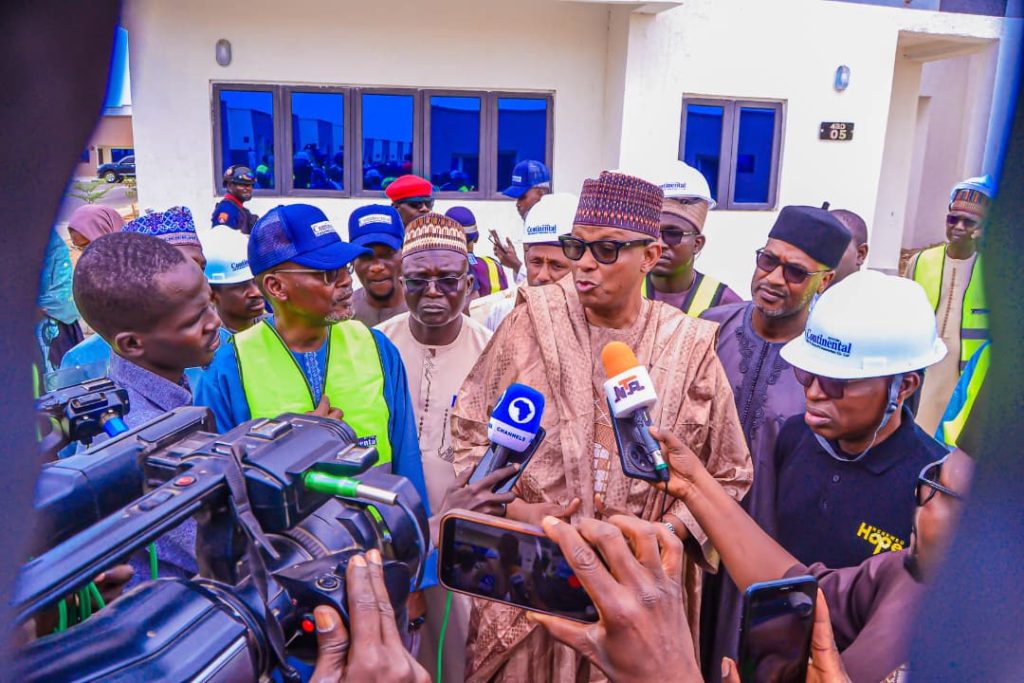
On 24 April 2026, President Bola Ahmed Tinubu administered the oath of office to Dr Muttaqha Rabe Darma as Minister of Housing and Urban Development, following his clearance by the Nigerian Senate.
The Presidency described him as a scholar, administrator and development expert, citing his academic qualifications, previous service as PTDF Executive Secretary, commissioner-level experience in Katsina and contributions to academia and governance.
The appointment represents another major transition in his career.
Housing and urban development have profound implications for Nigeria’s future, particularly at a time of rapid urbanisation, housing deficits and growing pressure on infrastructure.
For Darma, the assignment offers an opportunity to translate his long-standing interest in development, planning and governance into national policy.
For Katsina, it places another senior political figure from the state at the centre of federal decision-making.
The confidence of President Bola Tinubu
The significance of Darma’s appointment extends beyond the portfolio he now holds.
By selecting him for a sensitive national assignment, President Bola Ahmed Tinubu has demonstrated confidence in his competence, political judgment and capacity to deliver among the many politicians of Katsina State origin.
That confidence carries particular political weight as the country approaches the forthcoming general elections.
In a state where political networks, historical relationships and federal connections continue to influence electoral calculations, the President’s reliance on Darma places him in a strategically important position. He is not merely a minister representing Katsina at the federal level; he is also one of the figures through whom the administration can engage the state’s political class, grassroots structures and electorate.
His experience in youth leadership, state administration, federal public service and intellectual advocacy gives him the ability to communicate with different constituencies. His association with the Yar’Adua political tradition provides historical depth, while his current role in the Tinubu administration connects him to the present federal political establishment.
For President Tinubu, that combination may prove valuable in efforts to consolidate support and secure re-election in the forthcoming general elections.
For Darma, the confidence placed in him creates both an opportunity and a responsibility. He must demonstrate that political trust can be converted into effective representation, meaningful development and credible engagement with the people of Katsina.
The appointment may reshape perceptions of his influence. It could strengthen his standing among Katsina politicians, expand his access to national decision-making and position him as an important intermediary between the Presidency and the state’s political community.
Ultimately, however, the measure of that confidence will not be the symbolism of the appointment alone. It will depend on whether Darma can use his position to advance Katsina’s interests, support the administration’s national agenda and help build the political coalition required for the President’s re-election.
The question of political influence
The central question is not simply who Engineer Muttaqha Rabe Darma is.
The more important question is what role a figure with his background can play in Katsina’s emerging political configuration.
Several possibilities stand out.
First, his long experience gives him institutional memory. He has seen Katsina politics from inside government and has served in both state and federal administrations.
Second, his association with Umaru Musa Yar’Adua gives him a historical connection to one of the most influential political traditions to emerge from Katsina during the Fourth Republic.
Third, his academic and intellectual activities give him a policy-oriented dimension that is relatively unusual among political actors.
Fourth, his engagement with youth and community issues potentially provides a bridge to constituencies that are increasingly important in contemporary politics.
Finally, his new national responsibility as minister places him once again at the centre of federal policymaking.
These factors do not automatically translate into political control or electoral dominance. Politics is too fluid for such conclusions.
They do, however, provide the ingredients for influence.
Beyond personality politics
The future of Katsina politics may ultimately depend on whether the state can move beyond politics centred exclusively on personalities and develop stronger institutions capable of producing continuity in governance.
That is also one of the central themes of Darma’s intellectual work.
His 2023 paper on designing a workable Katsina State argued for systemic improvements in decision-making, governance, economic management and public institutions.
That proposition may prove more important than any individual political contest.
A state does not become great merely because it produces powerful politicians. It becomes great when its institutions become strong enough to outlive individual politicians.
This may be one of the most important questions confronting Katsina’s next political generation.
The Darma proposition
The political significance of Engineer Muttaqha Rabe Darma can be understood through three overlapping identities:
The Engineer—trained to analyse systems, identify problems and seek technical solutions.
The Politician—shaped by grassroots mobilisation, youth leadership, government service and long-standing political relationships.
The Intellectual—committed to studying governance, development, leadership and the future of Katsina.
These three identities have accompanied him throughout his career.
His story is therefore more complex than that of a conventional politician.
He is a product of Katsina’s political history, but he is also an observer and critic of that history. He has participated in government while writing about how government should work. He has benefited from political networks while advocating institutional reform. And despite spending significant periods in national public service, he has maintained an unusually strong connection to his birthplace.
That attachment to Katsina may explain the persistence of his public engagement with the state.
Looking ahead
Katsina is entering another phase of political transition.
The generation that dominated the political landscape during the early years of the Fourth Republic is gradually giving way to a new generation. The electorate is younger. Political communication has changed. The demands of governance have become more complex. The boundaries between politics, public policy, intellectual discourse and social mobilisation are increasingly blurred.
Against this background, Engineer Muttaqha Rabe Darma’s career offers an instructive case study.
From a young mechanical engineer trained at Bayero University to a youth leader; from commissioner in the Yar’Adua administration to an associate of the late President; from Executive Secretary of PTDF to author and development thinker; and from Katsina political actor to federal minister, his journey has been marked by movement between ideas, institutions and political responsibility.
His future influence in Katsina will depend not only on the offices he occupies but also on the ideas he advances, the relationships he builds, the people he mentors and the extent to which his experience contributes to a new political culture.
The confidence placed in him by President Bola Ahmed Tinubu adds a new dimension to that future. It places Darma at the intersection of federal political strategy, Katsina’s internal dynamics and the forthcoming electoral contest.
The real test is not whether Engineer Muttaqha Rabe Darma can remain politically relevant.
It is whether his experience can help Katsina move from a politics of personalities to a politics of institutions, competence, accountability and sustainable development, while also helping to build the confidence and support necessary for President Tinubu’s re-election.
That is the larger question.
It is also what makes Muttaqha Rabe Darma’s political journey worth watching—not merely as the story of one Katsina politician, but as a window into the changing political landscape of an ancient city and a state searching for its next chapter.