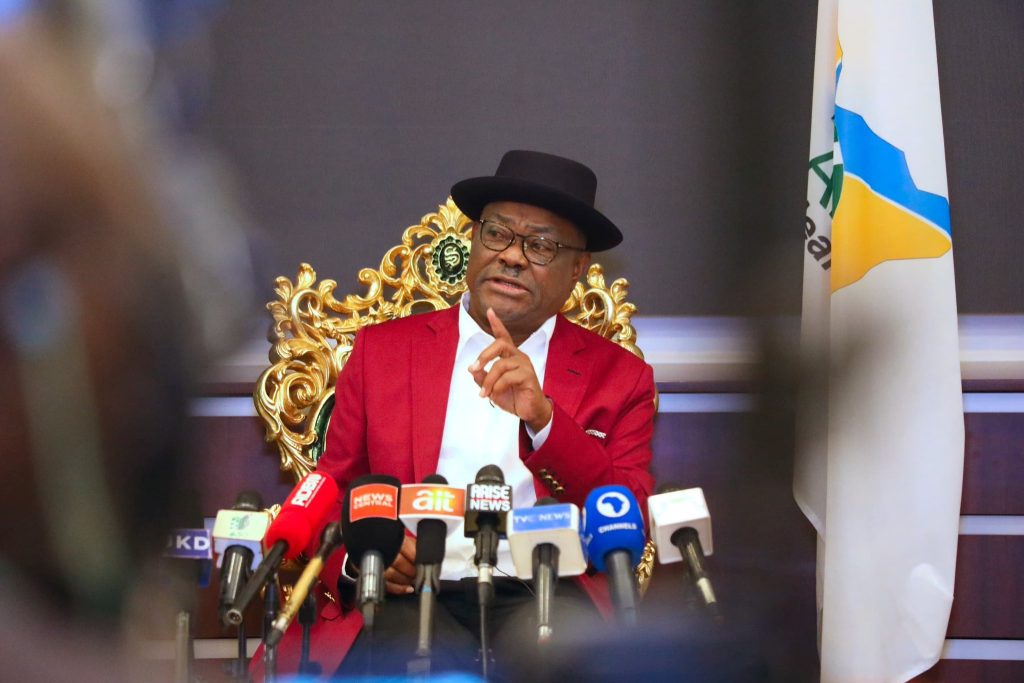
FCT Minister, Nyesom Wike speaking with newsmen during a media chat in Abuja
Reuben Abati of Arise TV has characterised Nyesom Wike as a “political mercenary”, a description that may generate considerable debate about the former Rivers State governor’s extraordinary political journey and his evolving relationship with President Bola Ahmed Tinubu. The metaphor is deliberately provocative. A mercenary, in its conventional sense, fights for a cause or patron other than his own. Applied to Wike, it suggests a politician whose principal political value lies in his capacity to deploy his networks and political machinery in support of another political project, even when that project belongs to a rival political party. Whether the description is fair is debatable; what is increasingly difficult to dispute is that Wike has developed a political profile that makes the metaphor politically relevant.
Wike’s trajectory since the 2023 presidential election provides the essential context. He was one of the five PDP governors who formed the G5 and opposed the presidential candidacy of Atiku Abubakar, despite remaining a member of the PDP. The G5’s refusal to support the PDP presidential candidate contributed to the fragmentation of the opposition vote and was widely regarded as one of the factors that benefited Bola Tinubu in the 2023 presidential election. Wike subsequently accepted appointment as Minister of the Federal Capital Territory in the Tinubu administration after publicly denying he would not serve as minister. Thus, a prominent PDP politician became a powerful minister in an APC government while retaining his membership of the opposition party.
That arrangement was unusual enough in itself. But Wike’s subsequent conduct has made it considerably more consequential. Rather than becoming a marginal figure within the PDP, he has continued to exercise influence over its internal politics while openly supporting the Tinubu administration. His continuing involvement in Rivers politics, his influence within sections of the PDP and his increasingly explicit support for Tinubu have produced a peculiar political configuration: a PDP politician helping to consolidate the political fortunes of an APC president.
The emergence of Wike’s “Rainbow Coalition” has now brought this unusual arrangement into direct conflict with elements of the APC itself. The coalition, as Wike describes it, is a cross-party platform designed to mobilise political actors behind Tinubu’s 2027 presidential bid while allowing them to retain their identities and, potentially, support candidates other than APC candidates in national and state legislative elections. Wike has repeatedly insisted that the coalition is not an APC structure and that his commitment to Tinubu’s re-election is distinct from an obligation to support every APC candidate.
It is precisely this distinction that has provoked the latest confrontation. The APC Progressive Governors’ Forum, led by Imo State Governor Hope Uzodimma, rejected political arrangements that could weaken the APC or undermine its candidates. The governors stated that their campaign commitment would be to all APC candidates, not to an external coalition that might support non-APC candidates while simultaneously campaigning for Tinubu at the presidential level.
The disagreement is deeper than a personality clash between Wike and some APC governors. It represents a fundamental disagreement over the structure of the APC 2027 campaign. Should Tinubu’s re-election campaign be organised primarily through the formal structures of the APC, or can it legitimately be built around a wider coalition of politicians who support Tinubu but remain free to oppose APC candidates in other contests?
Wike’s argument is straightforward. Presidential politics and sub-national politics are not necessarily the same. A politician can support Tinubu for president while supporting another party’s candidate for governor or senator. Wike points to the experience of the 2023 elections, when voters in some states split their votes between presidential and legislative candidates of different parties. In his view, there is therefore nothing inherently contradictory about a politician supporting Tinubu at the presidential level while retaining freedom of choice in other elections.
The APC governors see the matter differently. Their concern is that such a model could effectively create two competing political structures: the formal APC machinery working for APC candidates at every level, and the Rainbow Coalition working for Tinubu while potentially supporting candidates from other parties. That could strengthen the President’s personal electoral project while weakening the party that is sponsoring his candidacy.
This is the heart of the controversy. Wike is building a presidential coalition that does not necessarily correspond with the governing party’s electoral structure. That makes him useful to Tinubu, but it also makes him potentially disruptive to the APC’s governors and candidates. The confrontation became sufficiently serious that the APC Presidential Campaign Council publicly urged Wike and the APC governors to stop their media exchanges and concentrate on mobilising voters for Tinubu. The campaign council described the dispute as essentially a quarrel among political allies pursuing the same presidential objective but disagreeing about how to achieve it.
Wike has made it clear that he does not regard himself as subordinate to the APC governors. In his recent media comments, he said that the governors were not privy to his political discussions with Tinubu and insisted that the President was aware of his Rainbow Coalition initiative. He also dismissed the governors’ objections, arguing that his support for Tinubu had never been negotiated with them and that he was not responsible for their political difficulties in their respective states.
This is where the political significance of President Tinubu’s reported intervention becomes particularly important. According to reports published on September 21, the President is moving to give Wike a clearly defined role as campaign coordinator for Rivers State and the FCT, effectively placing his political assignment within the broader presidential campaign structure.
If confirmed and implemented as reported, this is a significant political compromise. Rather than allowing the dispute over the Rainbow Coalition to remain an open-ended contest between Wike and the APC governors, Tinubu appears to be seeking to define Wike’s role territorially and electorally. The arrangement would give Wike a recognised responsibility for mobilising support for the President in Rivers and the FCT, while potentially reducing the ambiguity surrounding his place within the broader campaign structure.
The political calculation is understandable. Tinubu needs both Wike and the APC governors. Wike brings cross-party networks, political experience and a capacity to mobilise actors who may not ordinarily work within the APC. The governors, on the other hand, control formal party structures, state machinery and substantial grassroots political networks. The President therefore faces the delicate task of using Wike’s political capital without alienating the governors whose cooperation is indispensable to a successful national campaign. This explains the apparent paradox at the centre of the controversy. The President may need Wike precisely because Wike is not entirely an APC politician. His value lies partly in his ability to reach politicians and networks beyond the APC. But that same independence is what alarms the APC governors.
For Wike, this is a remarkable evolution. He has moved from being one of the most powerful politicians in the PDP to becoming a central actor in the political strategy of an APC president. He has retained his PDP membership, served as a minister in an APC government and now appears set to receive an official role in the presidential campaign of the APC incumbent. Few developments illustrate more dramatically how fluid Nigerian party politics has become.
It also strengthens the case for examining Abati’s “political mercenary” metaphor, even if one does not accept the label as an objective description. Wike’s political identity increasingly appears to transcend formal party boundaries. He is not operating like a conventional opposition politician whose primary responsibility is to defeat the governing party. Nor is he a conventional APC politician whose first obligation is to defend APC candidates at every level. He occupies an unusual middle ground: formally associated with the opposition, institutionally embedded in the government and politically committed to the re-election of the President.
That position gives Wike extraordinary bargaining power. But it also creates a potential problem of political accountability. If Wike supports Tinubu for president but backs candidates who oppose APC governors and legislators, who exactly does he represent? The PDP? The APC? The Rainbow Coalition? Or primarily Wike’s own political network? Perhaps the answer is that he represents none of them exclusively. His politics may increasingly be understood as network politics rather than party politics.
This has implications beyond Wike and Tinubu. Nigerian democracy is built formally around political parties. Parties are supposed to aggregate interests, formulate programmes, recruit candidates and provide citizens with alternative choices. But the Wike phenomenon illustrates the growing power of political networks that cut across party boundaries. There is nothing inherently undemocratic about cross-party coalitions. Democracies everywhere accommodate alliances, defections and political realignments. The concern arises when political parties become merely shells around powerful individuals and when electoral outcomes depend more upon elite bargains than upon competition between clearly differentiated programmes and policy alternatives.
The Rainbow Coalition could therefore represent either a broader form of political inclusion or another manifestation of the personalisation of Nigerian politics. Much depends on how it operates in practice.
For Tinubu, Wike is both an asset and a complication. The President can potentially benefit from a political network that reaches beyond the APC. But the more he relies upon Wike, the more he must manage the tensions between Wike’s independent political network and the formal structures of his ruling party.
For the APC governors, the concern is understandable from their institutional perspective. They are not merely presidential campaigners. They are also politicians fighting to retain their governorships, protect their legislative allies and influence the political succession in their states. A structure that helps Tinubu but simultaneously empowers opposition candidates against APC candidates could serve the President’s immediate interest while weakening the party’s broader electoral position.
For Wike, however, the calculation may be different. His objective appears to be to demonstrate that political influence does not necessarily require formal control of a party. If he can mobilise politicians across party lines behind Tinubu while maintaining their independence in other elections, he establishes himself as a political broker whose influence extends beyond the traditional party system. That is precisely what makes him both valuable and controversial.
The PDP, meanwhile, faces perhaps the most difficult question. Can it remain a credible opposition party when one of its most influential figures is helping to mobilise support for the incumbent President? Wike may insist that he remains committed to the PDP’s right to contest legislative and governorship elections, but the broader political effect is that the party’s internal divisions continue to complicate its capacity to present a united national alternative.
It would be premature to conclude that Wike’s objective is simply to destroy the PDP, but it is clear that it is to prevent PDP from producing a presidential candidate making it easy for him to support President Bola Ahmed Tinibu. It is also reasonable to observe that Wike’s political strategy has contributed to the fragmentation of the entire opposition and has created an unusual situation in which a major opposition politician is helping the incumbent president consolidate his political coalition.
The deeper democratic question is what this means for Nigeria’s party system. If politicians can support a presidential candidate from one party while campaigning against that party’s candidates at other levels, the traditional distinction between government and opposition becomes increasingly blurred. The electorate may gain more choices, but it may also find it harder to identify coherent political programmes and party commitments. The Wike phenomenon therefore deserves to be examined not simply as another episode in Nigeria’s political intrigues but as a case study in the transformation of political organisation itself.
Is Wike a political mercenary? Abati’s description is a classical political characterisation. It captures the central question surrounding Wike’s present political role: is he primarily advancing a broader political project, or has he become a highly effective political entrepreneur whose loyalty is determined by strategic alliances rather than conventional party boundaries? Wike’s activities appear to justify this classification. He appears as someone who has entered political alliances primarily for strategic advantage, influence, access, or personal political gain, rather than out of enduring ideological or organisational commitment. Wike understands that his political relevance depends on the political jobbing he performs for President Tinubu.
Perhaps the more important question is what his emergence tells us about Nigerian democracy. For Wike, the wager is his political legacy. For Tinubu, the challenge is to harness Wike’s political machinery without allowing it to fracture the APC’s own electoral organisation. For the APC governors, the challenge is to reconcile loyalty to the President with the survival of their own political structures. For the PDP, the challenge is existential: whether it can rebuild itself into a coherent opposition force during and after 2027.
For Nigeria, however, the question is much bigger than Wike. It is whether the country’s democracy is gradually moving from a system in which political parties compete on programmes and ideas to one in which powerful individuals, networks and elite bargains increasingly determine the shape of political competition. The Wike-Tinubu relationship, and now the confrontation over the Rainbow Coalition, may ultimately become one of the clearest illustrations of that transformation.