There are moments in the life of a nation when an economic policy ceases to be a matter for government papers, economists and policy conferences and becomes painfully personal.
For millions of Nigerians, the removal of fuel subsidy is one such moment.
It is no longer merely about what government spends or saves. It is about how much it costs to get to work, take a child to school, transport farm produce to the market, move goods from one city to another and, ultimately, put food on the family table.
That explains the renewed intensity of the conversation around petrol subsidy removal and, increasingly, compressed natural gas (CNG) as a possible escape route from the crushing cost of transportation.
But there is a fundamental question which Nigeria must confront: Can CNG really provide the relief Nigerians desperately need, or are we simply replacing one national argument over fuel with another?
President Bola Ahmed Tinubu announced the removal of petrol subsidy on May 29, 2023, his first day in office. At the time, petrol sold at significantly lower prices than today. The subsequent escalation in the pump price of petrol has had consequences far beyond the filling station. Transportation costs rose, and transportation in turn became one of the principal channels through which higher energy costs fed into the prices of food and other essential commodities.
For nearly four years, Nigerians have lived with the consequences.
Then came August 20, 2026.
Atiku Abubakar, presidential candidate of the African Democratic Congress (ADC), announced that he would restore the fuel subsidy if elected president. Whatever one’s political interpretation of that declaration, its timing was significant. It immediately reignited a national conversation that had, perhaps, become too familiar to command the urgency it deserved.
Government’s response was swift.
On August 27, President Tinubu directed the rollout of an additional 500 CNG refuelling stations nationwide, bringing the planned Federal Government network to 1,000 stations. The objective was to use cheaper energy sources, including CNG and electricity, to bring down transportation costs.
The significance of the move is difficult to miss.
If the withdrawal of subsidy has made petrol unaffordable for many Nigerians, then a credible alternative energy system could provide part of the answer without returning the country to the enormous fiscal burden associated with petrol subsidy.
But that “if” is important.
Because an alternative fuel is only an alternative when people can actually access it.
The CNG promise
CNG is not a mysterious new technology. It is natural gas compressed to occupy a much smaller volume and used as a fuel, particularly for vehicles. Its attraction is obvious: compared with petrol and diesel, it can offer lower operating costs and lower emissions.
For motorists and transport operators, however, the most compelling argument is not necessarily its environmental advantage. It is economics.
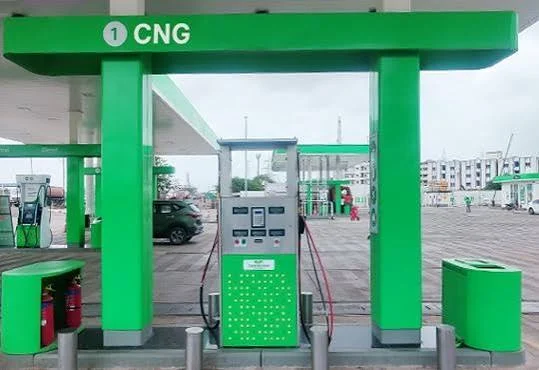
If a commercial vehicle can travel significantly more cheaply on CNG, the potential benefit is not limited to the vehicle owner. It can cascade through the economy—from transport fares to the cost of moving agricultural produce, manufactured goods and other commodities.
That is why the infrastructure question is so critical.
The Independent Petroleum Marketers Association of Nigeria (IPMAN), while welcoming the Federal Government’s decision to expand the CNG network, has proposed a 100-station trucking corridor network. The association argues that strategically located stations along major haulage routes could help reduce the cost of transporting goods and consequently ease pressure on food and commodity prices.
IPMAN says it already has locations, potential offtakers and arrangements for gas supply for the proposed network, and argues that funding rather than preparation is the principal obstacle to deployment.
That argument deserves serious consideration.
There is little economic wisdom in converting thousands of vehicles to CNG while leaving their owners to search endlessly for somewhere to refill them.
Indeed, IPMAN points to a particularly uncomfortable paradox: more than 120,000 vehicles have reportedly been converted to CNG, while the country still requires a much larger network of refuelling stations, mother stations and service centres to support them.
It is a little like building a fleet of vehicles and forgetting to build the roads.
Is CNG already working?
The answer, at least in some places, appears to be yes.
In his September 19 update on the National Affordable CNG Transit Programme, President Tinubu cited examples from several states where CNG and electric-powered transport initiatives have already been associated with lower fares.
According to the President, commuters on some routes in Borno pay between ₦50 and ₦100 where commercial operators charge between ₦300 and ₦600. In Kaduna, he said, 100 CNG-powered buses provide free transportation on major routes and carried about 3.2 million passengers in their first year, generating savings of more than ₦3.5 billion for commuters.
He also cited reductions on routes in Oyo, Adamawa, Enugu, Plateau, Abuja and Niger, while Abia has deployed electric buses with subsidised fares. In Abuja, for example, he said CNG-converted commercial vehicles operating on some routes have produced fare reductions of about 40 per cent.
These examples are important because they move the CNG debate from theory to experience.
But examples are not yet a national solution.
The real test is whether these pockets of success can be reproduced at scale, sustained over time and extended beyond the major urban centres where infrastructure, investment and government intervention are comparatively easier to organise.
That is where the real challenge begins.
The missing Nigerian: the rural commuter
Much of the CNG conversation appears to be taking place around cities, major highways and commercially viable transport corridors.
But Nigeria is much bigger than Abuja, Lagos, Kaduna, Port Harcourt or Kano.
What happens to the farmer in a remote community like Mbadede in Vandeikya LGA of benue state where there is no CNG station, no conversion centre and perhaps no electricity reliable enough to support modern transport infrastructure?
What happens to the trader whose journey begins several kilometres away from the nearest major road?
What happens to the rural Nigerian for whom even the word “CNG” may sound more like an urban policy acronym than a practical transportation option?
These questions cannot be treated as peripheral.
A national energy transition that benefits mainly those who live along commercially attractive corridors could unintentionally deepen an existing urban-rural divide.
The Federal Government therefore needs to explain not only how many CNG stations it intends to build, but where they will be located, who will use them, how they will be sustained and how the benefits will reach Nigerians outside the major transportation corridors.
The announcement that the first batch of 500 CNG stations is expected by the end of October, with another 500 subsequently to be ordered, represents a major infrastructure ambition. The Presidential CNG Initiative has also indicated that deployment will be guided by economic factors such as vehicle numbers and traffic.
But economic viability must not become a euphemism for abandoning communities where commercial returns are initially low.
Government exists partly to make possible what the market alone may consider unattractive.
Beyond CNG
Perhaps Nigeria should therefore resist the temptation to see CNG as a magic wand.
CNG can be part of the answer. It cannot be the whole answer.
The country’s transportation crisis is fundamentally a question of infrastructure, energy, logistics and economic planning.
That is why rail transportation deserves far greater attention.
Imagine a functioning rail network connecting Akwanga–Keffi–Abuja; Abuja–Suleja–Minna; Kaduna–Zaria–Kano; or the eastern corridor linking Enugu–Awka–Onitsha–Benin and beyond.
Imagine the effect on the number of trailers and tankers currently competing with passenger vehicles for space on Nigeria’s already overstretched roads.
Imagine, too, a serious revival of inland water transportation.
The Niger and Benue river systems offer possibilities that have remained largely underexploited. Where geography permits, moving people and especially heavy goods by water could complement road and rail transportation while reducing pressure on highways.
The question, ultimately, is not whether Nigeria should choose petrol, CNG, electricity, rail or water.
It is why Nigeria must choose only one.
A sensible national transportation policy should use all available and economically viable options—CNG and electricity for appropriate vehicles and routes; rail for mass passenger and freight movement; waterways where feasible; and improved roads for the connectivity that only road transportation can provide.
The real test
There is another danger that Nigeria must avoid: celebrating announcements instead of outcomes.
The success of the CNG programme should not ultimately be measured by the number of stations commissioned, conversion centres opened, buses unveiled or agreements signed.
It should be measured by something much simpler:
How much does it cost an ordinary Nigerian to move from one place to another?
If the cost falls sustainably, then the policy is beginning to work.
If transport becomes cheaper but food prices remain elevated because haulage costs have not fallen, then the chain remains broken.
If vehicles are converted but motorists cannot find refuelling stations, then the transition remains incomplete.
If CNG stations proliferate in the cities while rural communities remain stranded, then the national character of the programme must be questioned.
And if government succeeds in reducing the cost of energy but the savings are absorbed somewhere along the transportation chain rather than passed to commuters and consumers, then the purpose of the exercise will have been defeated.
President Tinubu has set October 1 as the target for Nigerians to begin seeing measurable reductions in transportation costs. That deadline should therefore be more than another date on the government’s calendar. It should become a point at which Nigerians begin to ask a very simple question: Can we actually feel the difference?
Because, ultimately, the worth of public policy is not determined by the elegance of its announcement but by the reality of its impact on the lives of citizens.
And perhaps this is where the conversation about fuel subsidy becomes larger than fuel.
For years, the Nigerian state subsidised petrol. The argument for removing the subsidy was that government could no longer continue bearing the enormous fiscal burden. The counter-question from ordinary Nigerians has always been: If government no longer subsidises the fuel, what exactly will replace the relief that subsidy once provided?
That is the heart of the matter.
Citizens do not necessarily demand that government make everything cheap. They demand something more fundamental: that the burdens imposed in the name of reform should eventually produce a society in which life becomes more affordable, opportunity becomes more accessible and the sacrifice is seen to have a purpose.
A subsidy, therefore, is not merely an accounting entry in a government budget. It is also part of the social contract—a mechanism through which the state cushions the citizen from the harshest consequences of economic realities.
Remove one form of subsidy and the responsibility does not disappear. It merely changes form.
The question is whether the state can replace the old cushion with something more sustainable: cheaper transportation, reliable infrastructure, efficient public services, productive industries and an economy in which ordinary citizens can earn enough to live with dignity.
CNG may be an important part of that transition. But it cannot carry the entire burden.
Nigeria needs to think beyond petrol. Beyond CNG. Beyond subsidies themselves.
It needs to think about mobility, productivity and human dignity.
For ultimately, the success of any economic reform should not be measured only by how much money government saves, but by whether the citizen whose sacrifice made those savings possible can eventually say: “My life is better because of it.”
That, perhaps, is the real meaning of the social contract—and the real test awaiting the Tinubu administration.