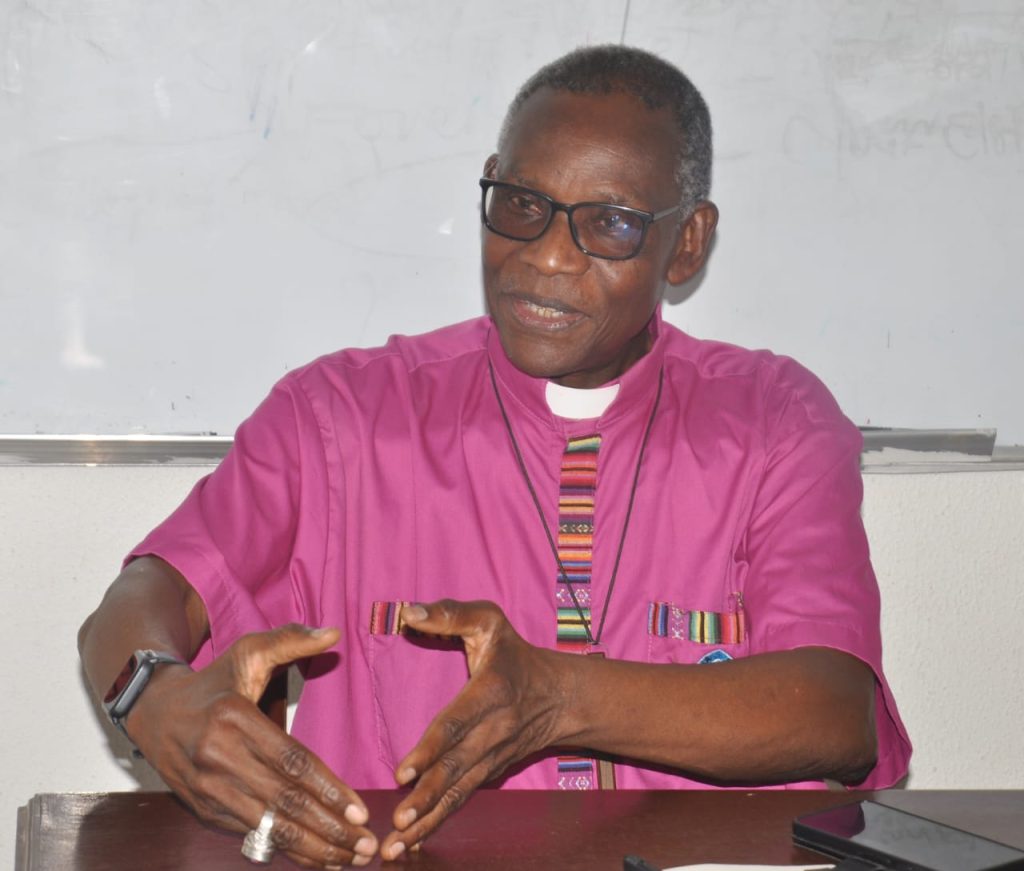
Bishop Josiah Idowu-Fearon
Immediate past Secretary General of the Anglican Communion worldwide, Bishop Josiah Idowu-Fearon, has urged the Federal Government to acknowledge the economic hardship confronting Nigerians rather than deny its existence.
Idowu-Fearon, who is the Founder and Director of the Kaduna Centre for the Study of Christian-Muslim Relations, said millions of Nigerians were struggling with rising food prices, transportation costs, electricity challenges and other difficulties caused by the worsening cost of living.
The former Chairman of the Kaduna State Peace Commission spoke on Monday in Kaduna while reacting to the state of the economy and the recent meeting between President Bola Ahmed Tinubu and Catholic Archbishops.
He said his frequent interactions with ordinary Nigerians had exposed him to the realities of poverty, stressing that the hardship being experienced by citizens could not be dismissed.
“To say people are not suffering as a result of what is going on in our country, I think we are being economical with the truth,” he said.
According to the bishop, some Nigerians can no longer afford transportation to places of worship, while many families struggle to provide even one meal a day.
“You can see suffering. There is no doubt about that. A good number of people just have one meal a day. They can hardly even have a balanced meal,” he said.
Idowu-Fearon also questioned the impact of increased government revenue and allocations to states and local governments, asking whether the funds were translating into improved living conditions for ordinary Nigerians.
“I also heard the Minister of Finance talking about trillions coming in, trillions going to the state governors, going to the local government chairmen. And I ask, where is the money? Where is this money?” he asked.
He cited the rising prices of household items as evidence of the severity of inflation, recalling that a bathroom soap holder that previously cost about N500 was recently priced at N5,000 during efforts to repair his house after a fire incident.
“Something that we were paying about 500 Naira for, 5,000! Tomatoes, anything you ask, they tell you thousand, thousand. What do we do?” he said.
The bishop also lamented the poor electricity supply in his area, saying his residence had been without public power supply for several days and that he had to rely on solar power to preserve food stored in his freezer.
He therefore called on the government to communicate more clearly with Nigerians about the measures being taken to address the economic crisis.
“Instead of denying, government should say, ‘We are aware. This is what we are doing, this is what we are doing,’” he said.
On the role of religious leaders in politics, Idowu-Fearon warned clerics against becoming too close to politicians, saying excessive dependence on political leaders could compromise their ability to speak truth to power.
“As religious leaders whether an Imam or a priest, a Sheikh or a Bishop, whatever when you begin to frequent politicians, you get corrupted,” he said.
He stressed that religious leaders should maintain their independence and hold public officials accountable, irrespective of their political, ethnic or religious affiliations.
“If I give you money, if I make sure that you are very comfortable, you cannot challenge me. You’d rather become economical with the truth, and that is the problem we are facing,” he said.
On the 2027 elections, the bishop urged Nigerians to look beyond the religious identity of political candidates and instead support leaders who genuinely practise the values of their faith.
“Nigeria, honestly, this country does not need a Muslim or a Christian president. What we need is a president who is Christian or Muslim. There is a difference,” he said.
He maintained that neither Christianity nor Islam encourages corruption, tribalism, dishonesty or exploitation, arguing that political leaders should be judged
As the 2027 elections draw closer, Idowu-Fearon called on religious and traditional leaders to encourage citizens to vote but cautioned them against directing their followers to support particular candidates.
He said Imams, Sheikhs, Emirs, Bishops and traditional rulers should instead educate voters about the candidates, assess government performance and encourage public debates.
“We should have debates. We should encourage debates!” he said.
The former peace commission chairman also acknowledged improvements in the security situation in some parts of Kaduna State, particularly Birnin Gwari, but urged the government and security agencies not to relent in the fight against criminal elements.
“The government is trying, but they should not relent. They should keep the pressure on those who are committed to creating problems,” he said.
He also clarified that the dissolution of the Kaduna State Peace Commission, which he previously chaired, was not caused by any disagreement with the state government.
According to him, the commission’s enabling law provided for a five-year tenure, which had already elapsed, adding that discussions were held with the government on the matter.
“There was no bad blood, no bad feeling. It was a constitutional matter,” he said.
Idowu-Fearon further called for greater attention to young Nigerians, urging religious institutions to teach the younger generation that life should not be defined solely by the pursuit of wealth and material possessions.
“Life is not just money, it’s not just money. It’s not material possession,” he said.
He urged Christians and Muslims to work together to promote human dignity and mutual respect, stressing that both the Bible and Quran recognise the dignity of human beings.
“Don’t look at me as a Kaduna Christian; look at me as a human being,” he said.
The bishop said the Kaduna Centre for the Study of Christian-Muslim Relations was using interfaith initiatives, including scriptural reasoning, to encourage Christians and Muslims to focus on their shared values.
“We have a lot in common. We are created by the same God, we are endowed by the same God,” he said.
He urged Nigerians to judge political leaders by their character, performance and commitment to the common good rather than their religious identity.