By CHIBUZOR NNABUIKE (University of Georgia, Athens) –
HIGHLIGHTS:
- “I did not like school”
- “Teachers and Bigger Boys were the first bullies I encountered”
- “I used to escape on the way to school to hide in the bushes”
“I preferred the peace of nature in the bush to the cold lifeless cement floor of the classroom”
- “The teachers used to hunt for and arrest me, bring me back to the classroom as a captive”
- “My soldier father threatened to beat up a teacher for trying to stop me writing with my left hand”
Easily one of Nigeria’s more readable newspaper columnists, Chidi Amuta engages constantly with his fluid prose and often arresting logic. His background as a teacher and scholar of literature accounts perhaps for the fluidity of his style. Yet, only a few in his audience know anything about the man behind the mask of words and limitless stylistic acrobatics.
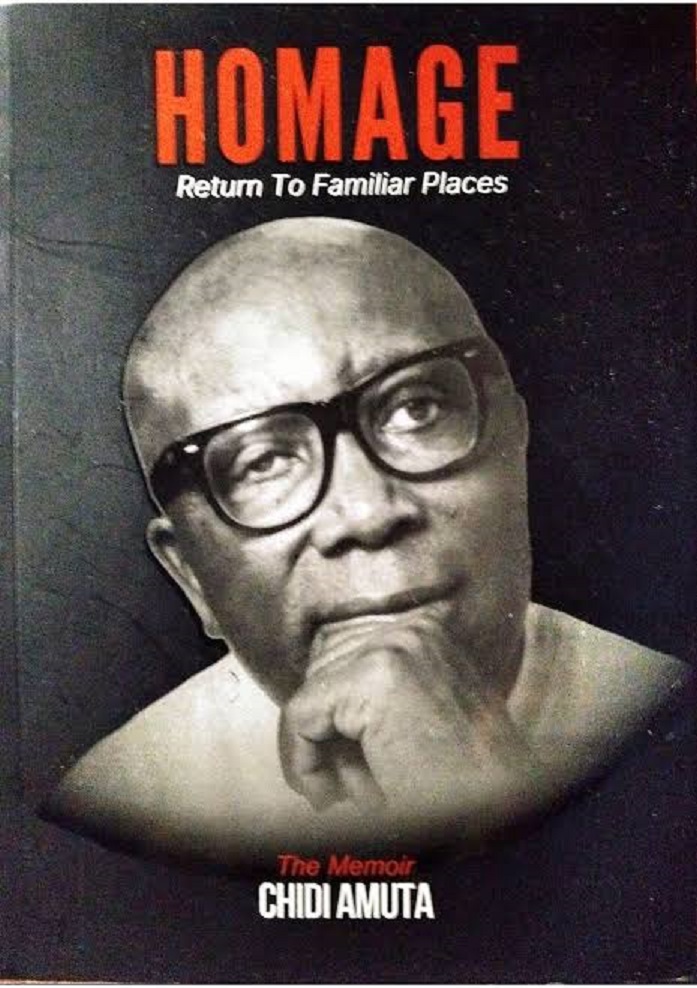
His just released memoir, “HOMAGE: Return to Familiar Places” seems designed to fill the gap of perception about this remarkable writer, journalist and engaged Nigerian public intellectual. In this unusual autobiography, Amuta lets us into the privacy of his typically Nigerian rural background. There is no silver spoon. There was not even a spoon to scoop his eba as a child growing up in the rusty rural environment of Umuguru, a typical Igbo village. We learn of life in his Umuguru village in today’s Abia state. The landscape is an agrarian natural one. It is a world of superstition and subsistence on the bare essentials. It is a world ruled by all manner of deities and ardent belief in them. Superstition is a religion in itself almost. Man and nature meet on the farm land, riverside and narrow bush pathways that traverse the unspoilt terrain. People commune through rituals and seasonal festivities. The wishes of the gods are conveyed through prophets, diviners and medicine men. Each birth and each death is a rite of passage marked by circumscribed rituals and festivities that hold the community together through informal consensus.
Amuta recalls his birth as relayed by his maternal grandmother in very ritualistic terms:
“ …it is not too early to drink from the calabash of wisdom of the ancients. Out of the burst dam of the eternal river of a woman’s water and blood , a child is born. A child is the result of the conspiracy of gods and ancestors in the dark shadows of flesh and blood. The flesh and blood become a life, a destiny , a career and the emergence of infinite possibilities in human form.”
Growing up in this rural terrain was in itself an adventure into the unknown. Darkness held a perpetual mystery in the absence of electricity. The dark nights were the abode of ghosts and spirits. The real world was an extension of the landscape explored in folk tales and stories told in village squares and compounds at night under moonlight. The wily tortoise, the pranking spiders and the gossiping birds are the carriers of wisdom.
In the day, children accompanied their parents to farms. This pastoral and superstitious world was rounded and ‘complete’ in itself. All his experiences out of and away from this environment was a long journey into modernity fashioned by education and the pull of urban and cosmopolitan culture.
Growing up in his rural Umuguru village is an extension of this ritual existence of rich informal education. Going to the village school is part of this ritual passage. A certain resistance to the separation from home in daily schooling is part of the tragedy of cultural separation. For the young Amuta, school was a wound in the soul of his comfort cultural zone. So, he was never in love with school:
“ I do not like the village school…In fact I hate school, any school. School is limiting, like a prison house. School imposes the authority of school teachers and bigger boys. I do not like people who tell you what to do. School is the place where teachers and big boys bully you to obey their will. ..I want to be free…, to explore the wild and savour the beauty of nature…”
His early school days in the village occasionally featured some drama. One of these was when the class teacher tried to discourage young Chidi Amuta- a natural sautpur- from writing with his left hand. The teacher tried many tricks including bandaging his left hand, tying heavy objects to weigh down the left hand and sometimes flogging him whenever he insisted on writing with his left hand. The boy’s father will not hear of this.
So, he stormed the school in justifiable rage. Not satisfied with the affected teacher’s excuses, the ex -soldier almost went physical with the poor teacher who obviously did not know any better. The teachers saw the foolishness of their effort. After being placated and reassured that the little boy would henceforth be left alone, Amuta’s father then went on to lecture the humbled teachers on how natural it was for children to be left alone to use their strengths. He gave them numerous instances of all the smart people he had encountered in his travels around the world who were sautpaws and performed many brilliant tasks. That settled the matter for all time and spared the village school similar potentially ugly incidents.
It is one of the astonishing realities of this life story that Amuta emerged from the dread and hatred of school into an adulthood of academic excellence and literary brilliance . He ended up with a distinction in high school, graduating First Class Honours at Ife and beginning f a subsequent career as an academic, literary critic and public intellectual of national and international reckoning.
A further startling transformation in the life of this subject is his emergence into cosmopolitan culture as a man of good taste and cultural accomplishment. From a rustic village background, Amuta later emerged into the bright light of urban refinement with neither silver spoon nor designer clothing but just the raw will to escape from the naked anonymity of rural innocence.
Easily the most significant achievement of this autobiography is the insight which it provides, through arresting story telling, into this journey. It is a journey that has led to heights of academia, the pinnacle of journalism and significant business success. Such insight is rare in contemporary African writing except perhaps in early original works like Camara Laye’s The Dark Child and Ngugi’s The River Between.
This beginning is like those of every African child of this independence generation of the 1950s and 1960s, Africa’s Baby Boomers as it were. Through this important book, Amuta bridges an important gap in new African memoir writing. A personal memoir also aspires to continental historical resonance by tracing the trajectory of one remarkable life from innocent rurality to sophisticated cosmopolitan accomplishment and global resonance. This is a very outstanding memoir, a bridge across numerous divides. This is life story made into literature, literature transformed into history and history celebrated in journalistic flourish.