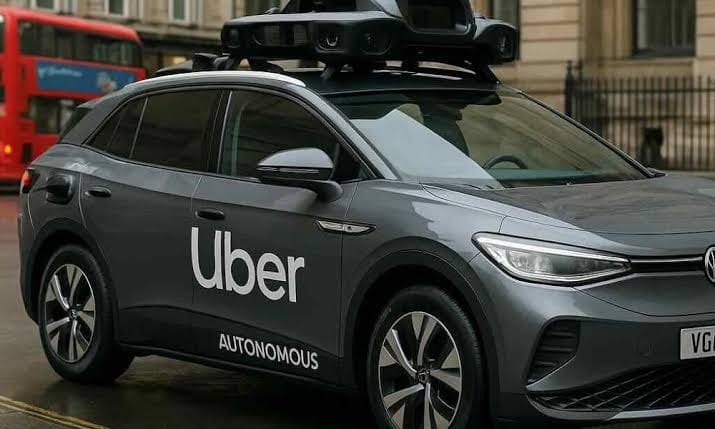
Uber has launched autonomous ride-hailing services in London, marking a major expansion of its investment in artificial intelligence and driverless mobility just a day after the company ended its operations in Nigeria.
The London service, announced on Thursday September 3 is powered by artificial intelligence technology developed by British autonomous-driving startup Wayve and makes London the second European city, after Zagreb, Croatia, where Uber is offering autonomous rides.
Uber’s Global Head of Autonomous Mobility, Sarfraz Maredia, said the initiative would help build confidence among consumers and regulators as the company expands its autonomous mobility business.
Wayve Chief Executive Officer and co-founder, Alex Kendall, said London provided an appropriate environment for testing the technology because of the complexity of its roads and traffic conditions.
At launch, fewer than 20 Wayve-powered Ford Mustang Mach-E electric vehicles will operate on Uber’s platform, with licensed human operators onboard to monitor the vehicles.
The company said riders requesting UberX, Uber Comfort or Uber Electric in areas covered by the pilot could be matched with an autonomous vehicle at no additional cost.
The London launch came barely 24 hours after Uber announced that it was winding down its ride-hailing operations in Nigeria and Uganda following a review of its business in the two markets.
Uber said the decision was limited to the two countries and would not affect its other operations in Africa.
The company said it was concentrating investment on markets where it could create greater value for drivers and provide earning opportunities at scale while maintaining seamless mobility for riders.
_Implications for Nigeria_
Uber’s exit is expected to intensify competition among the remaining ride-hailing platforms, while reducing the number of major international operators available to Nigerian riders and drivers.
The departure could also create opportunities for competitors such as Bolt, LagRide and inDrive to expand their customer and driver bases. Bolt has already reaffirmed its commitment to Nigeria, describing the country as an important market for its growth.
For drivers, however, Uber’s exit highlights the growing pressure facing Nigeria’s ride-hailing industry. Rising fuel prices, vehicle maintenance costs and other operating expenses have squeezed drivers’ earnings, while fare increases have not always kept pace with rising costs.
The contrasting developments also underline a strategic shift in Uber’s global business. While the company is withdrawing from a market where operating economics have become increasingly challenging, it is simultaneously committing resources to autonomous vehicles and AI-driven transportation in developed markets.
For Nigerian consumers, the exit could mean fewer platform choices and potentially weaker competition if remaining operators do not expand sufficiently.
For the industry, it could accelerate calls for more sustainable pricing models, improved operating conditions and innovation capable of reducing the high costs associated with conventional driver-dependent ride-hailing.
At the same time, Uber’s investment in autonomous mobility demonstrates the direction in which the global ride-hailing industry is moving, with artificial intelligence and driverless technology increasingly becoming central to the future of urban transportation.