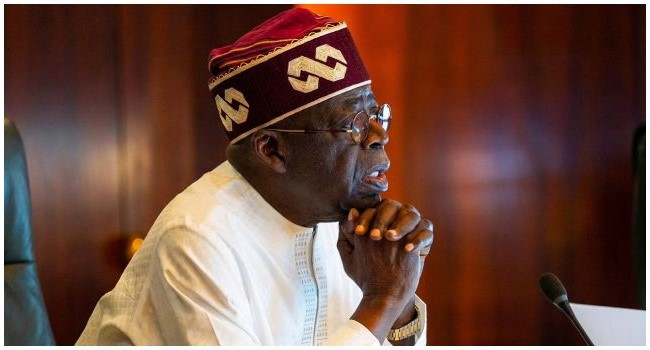
President Bola Tinubu
The Presidency has moved to clear the air over reports surrounding an ongoing Freedom of Information Act (FOIA) case involving President Bola Ahmed Tinubu before the United States District Court for the District of Columbia, insisting that the matter is purely a civil records-disclosure dispute and not a criminal proceeding.
In a statement issued on Thursday by the Special Adviser to the President on Information and Strategy, Bayo Onanuga, the Presidency said recent reports and public commentary had misrepresented the nature of the case.
According to Onanuga, the litigation does not amount to a criminal trial against President Tinubu, neither has any American court found him guilty of any offence.
“It is not a criminal case against President Bola Ahmed Tinubu, nor has the court found him guilty of any criminal wrongdoing,” the statement said.
The Presidency explained that the case began after American citizen Aaron Greenspan submitted Freedom of Information Act requests in 2022 to several United States government agencies seeking documents relating to Tinubu.
After some of the agencies either withheld the requested records or declined to confirm whether such records existed, Greenspan filed Civil Action No. 23-1816 before the US District Court in 2023. President Tinubu later joined the proceedings as an intervenor after the court granted him permission.
Onanuga also recalled that the issue had previously been addressed more than two decades ago, noting that the American Consulate in Lagos, in a letter dated February 4, 2003, informed the then Inspector-General of Police, Tafa Balogun, that an FBI records search found no criminal arrest records, outstanding warrants or wants against Tinubu, who was then Governor of Lagos State.
The statement further explained that several US government agencies relied on what is known as the “Glomar defence,” a legal position that allows agencies to neither confirm nor deny the existence of certain records where disclosure could affect law enforcement operations or national security.
As a result, the court dismissed the Central Intelligence Agency (CIA), Executive Office for United States Attorneys (EOUSA), Department of State, Department of the Treasury and the Internal Revenue Service (IRS) from the suit after granting them summary judgment.
The remaining issues before the court involve the Federal Bureau of Investigation (FBI) and the Drug Enforcement Administration (DEA), both of which have already produced 399 pages of documents with portions redacted under exemptions permitted by US law.
Greenspan is challenging those redactions, while the FBI and DEA, through the US Department of Justice, argue that some information cannot legally be disclosed because it relates to grand jury proceedings, attorney-client privilege, law enforcement investigations, personal privacy, confidential sources and investigative methods protected under the Freedom of Information Act.
The Presidency added that President Tinubu has also invoked his rights under FOIA Exemption 7(C) on the advice of his legal team.
According to the court timetable, the plaintiff has until September 11, 2026, to file his response, while the FBI, DEA and President Tinubu have until September 18 to reply.
The Presidency stressed that the dispute is strictly about access to government records and whether the redactions made by the FBI and DEA comply with the law.
“The release or withholding of records under FOIA does not, by itself, establish criminal liability. The case concerns access to government records and the proper application of statutory exemptions,” the statement said.
Onanuga also dismissed comments by some public commentators, saying they had wrongly portrayed themselves as key participants in the proceedings.
“Neither is a party to the case,” he said while referring to recent remarks by Karl von Batten and his client.
He maintained that the final decision rests solely with Judge Beryl A. Howell of the US District Court, who will determine the matter based on the law, evidence and arguments presented before the court.
“The United States District Court will decide that issue based on the filings and applicable US law, not political commentary,” the statement added.
The Presidency therefore urged journalists and members of the public to rely on verified court proceedings and avoid drawing conclusions from political speculation.