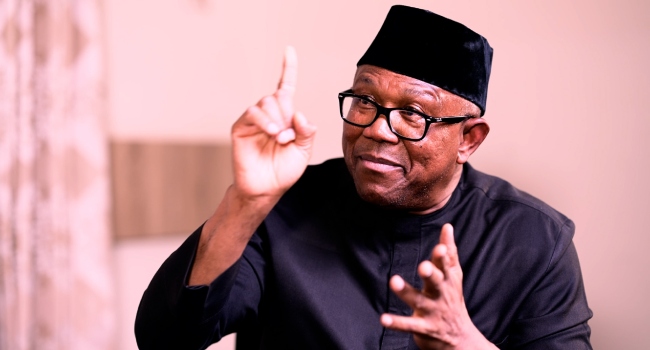
NDC Presidential candidate, Peter Obi
Nigeria Democratic Congress (NDC) Presidential candidate, Peter Obi, on Friday rejected claims that he left Anambra State with a debt of $123.77 million, insisting that the figure being circulated by the state government misrepresents development funding received under his administration.
Obi, in a statement posted on his verified X account, said he had remained silent in recent days because he was mourning the death of his elder brother and friend, Chief Okey Ezeibe. He, however, said it had become necessary to respond to issues surrounding the debt controversy.
The former Anambra governor urged Nigerians to focus on the country’s economic and social challenges instead of political distractions.
“I respectfully urge everyone to concentrate on the existential challenges confronting Nigeria and the hardships endured by its citizens, rather than on the needless distractions that have become widespread in our politics.”
Obi also dismissed suggestions of a political disagreement with Anambra State Governor, Chukwuma Soludo, or any other governor.
“I wish to assure the public that I have no disagreement with my dear elder brother, Governor Soludo, or with any governor in Nigeria. I am not seeking the office of governor in any state, and I will not seek that position again, even if the Constitution is amended.”
He appealed to governors across the country to allow all presidential candidates and other political contestants to campaign freely, saying voters should decide who leads them.
Addressing the debt allegation, Obi said he never obtained commercial loans or issued bonds on behalf of Anambra State while serving as governor.
“As Governor of Anambra State, I did not approach any financial institution to borrow funds or issue a bond on behalf of the state.”
He recalled that the former Director-General of the Debt Management Office (DMO), Abraham Nwankwo, publicly acknowledged him as the only governor during his tenure who did not seek a loan facility from the agency.
Obi further stated that when he left office on March 17, 2014, Anambra owed no salaries, pensions, gratuities or verified payments to contractors.
Explaining the funds in dispute, Obi said they were concessionary development programmes funded mainly by the World Bank and the International Fund for Agricultural Development (IFAD) through the Federal Government for participating states.
According to him, the Soludo administration wrongly combined the total approved amounts, the actual funds drawn during his tenure and the balances left after he exited office before presenting them as loans inherited from him.
“The government has combined these distinct categories, added them together, and described the resulting US$123.77 million as ‘loans left by Peter Obi.’ That is an incorrect application of public-sector accounting.”
The former governor stressed that while the facilities carried repayment obligations, they were not commercial loans personally secured by his administration.
He also questioned what he described as inconsistencies in the state government’s figures, citing Debt Management Office records.
According to Obi, DMO records showed Anambra’s external debt stood at about $18 million when he assumed office in 2006, rose to about $30 million when he left in March 2014, and increased to about $45.15 million by December 2014.
He argued that the figures contradicted claims that he handed over debts amounting to $123.77 million.
“The Anambra State Government must therefore clarify how a state whose recorded external debt was about US$30 million in March 2014 and US$45.15 million in December 2014 could supposedly have inherited US$123.77 million from Peter Obi, who left office in March of that same year.”
The debt controversy follows recent exchanges over Anambra’s financial records, with the state government maintaining that the funds formed part of obligations inherited from previous administrations. Obi, however, insists the figures require proper distinction between approved development programmes, actual disbursements and outstanding balances, saying public financial records should be presented accurately to Nigerians.