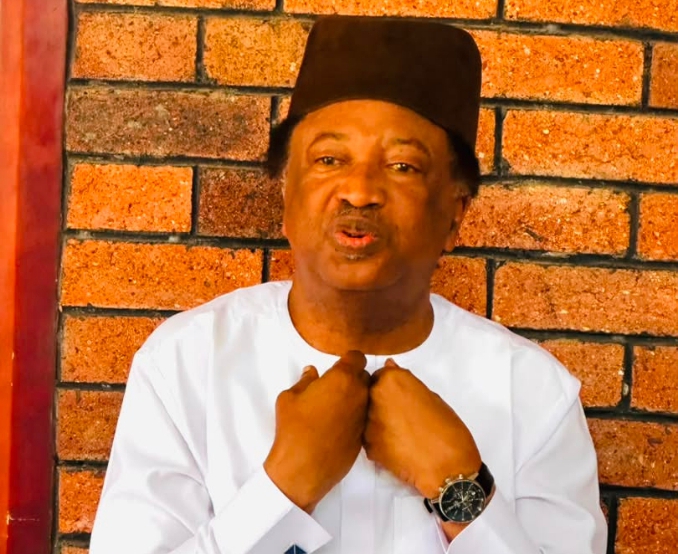
Former Senator Shehu Sani
Former Kaduna Central Senator, Shehu Sani, has warned that attempts by northern political leaders to reclaim the presidency in 2027 could reignite separatist agitations in southern Nigeria, arguing that the prospect of continued southern leadership has helped ease calls for secession.
Sani said the expectation that President Bola Tinubu would complete the South’s turn in the presidency had renewed confidence in Nigeria’s political system among some groups previously agitating for independence.
The former lawmaker, who is seeking a return to the Senate on the platform of the All Progressives Congress (APC), spoke during an interview with selected journalists in Kaduna on Friday.
He addressed issues surrounding the 2027 presidential election, power rotation, insecurity and legislative representation, insisting that political leaders must prioritise national unity over ethnic and regional interests.
“Today, if you look at it, the agitation for Biafra has gone to the lowest point because they are hopeful that one of their own is contesting the presidency of this country,” Sani said.
He also cited agitations for a Yoruba republic and a Niger Delta republic, arguing that the prospect of a southerner leading the country had helped reduce feelings of political exclusion among some separatist groups.
According to him, abandoning the informal power-rotation arrangement could undermine the confidence generated by the current political situation and create fresh tensions across the country.
“The danger of disrupting this rotational idea is the fact that whatever you are doing to Tinubu for ethnic reasons, you are causing problem by saying Tinubu must go,” he said.
Sani argued that the North should allow Tinubu to complete the South’s expected eight-year turn before seeking to produce another president, maintaining that such an arrangement would be consistent with the principle of power rotation.
He recalled that former President Muhammadu Buhari, who governed between 2015 and 2023, spent eight years in office before handing over to Tinubu in 2023.
“The principle of rotation of power makes it clear that Buhari has been in power for eight years. It is only logical and rational that you have a southerner,” he said.
The former senator maintained that northern politicians could pursue their presidential ambitions in 2031 rather than seek to disrupt the current arrangement in 2027.
He also questioned arguments suggesting that former Vice-President Atiku Abubakar’s presidential ambition represented a consensus position among northern political leaders.
Sani recalled Atiku’s previous presidential contests against former Presidents Olusegun Obasanjo, Umaru Musa Yar’Adua, Goodluck Jonathan and Buhari, arguing that the North’s political interests should not be reduced to the ambition of an individual.
On insecurity, the former lawmaker acknowledged that the Tinubu administration continued to face serious security challenges but criticised what he described as selective criticism by some northern political leaders.
He said those condemning the current government over insecurity should also assess the performance of previous administrations, particularly the Buhari government, during which banditry, terrorism, mass abductions and attacks on schools and communities persisted across northern Nigeria.
Sani cited the abductions of schoolchildren in Dapchi, Kankara, Jangebe and Yauri, as well as the kidnapping of students from Greenfield University in Kaduna State, as examples of the security challenges that confronted the country under previous administrations.
He insisted that political leaders must apply the same standards of accountability to successive governments, irrespective of the president’s ethnic background or region of origin.
“We cannot address security challenges in the country when we shielded our own who failed to address the problem, and now shift blame and use it for political reasons to achieve certain political ends,” he said.
Sani warned against exploiting insecurity for partisan advantage, urging politicians to focus on practical solutions rather than ethnic sentiments and regional considerations.
On representation at the National Assembly, he said northern communities needed experienced lawmakers capable of addressing insecurity, poverty, inadequate healthcare and educational deficits.
He added that Kaduna State’s strategic importance and diverse population made effective legislative representation essential for attracting federal interventions and promoting development.
Reflecting on his previous tenure in the Senate, Sani said he facilitated between seven and eight primary healthcare facilities, alongside scholarships, educational interventions, women’s empowerment programmes and other constituency projects.
He also urged political leaders in Kaduna State to promote cooperation across ethnic and religious divides, warning against using communal differences for political gain.
The former senator, further, cautioned leaders against using public office to intimidate critics or marginalise sections of the population, stressing that political power was temporary.
He maintained that national unity could only be strengthened through inclusion, fairness and accountability in the management of the country’s political affairs.