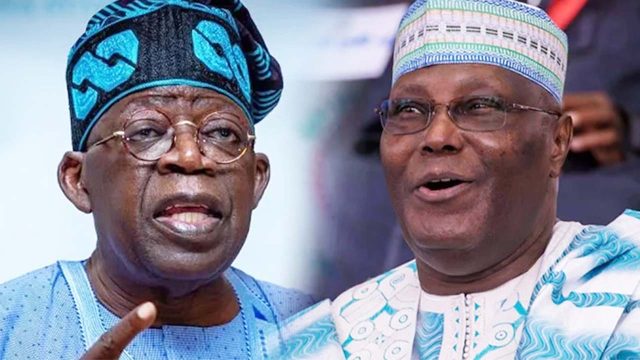
President Bola Tinubu and former VP Atiku Abubakar
Presidency has defended President Bola Ahmed Tinubu’s economic policies, describing former Vice President Atiku Abubakar’s criticism of the government’s fuel price measures as politically motivated and lacking understanding of global energy realities.
The Special Adviser to the President on Media and Public Communications, Dr Sunday Dare, said Atiku’s recent comments on the 30-day petrol price discount by NNPC Retail and the government’s price modulation framework were aimed at gaining political advantage rather than offering workable solutions.
Dare, in a statement, argued that the current administration’s approach was designed to provide temporary relief for Nigerians while protecting the economy from the challenges associated with the old fuel subsidy system.
He said Atiku’s call for a production subsidy was unrealistic because Nigeria does not control all the crude oil produced in the country.
According to him, Nigeria’s crude production is affected by existing agreements, including Joint Ventures (JVs) and Production Sharing Contracts (PSCs), which determine how crude earnings are shared among stakeholders.
Dare explained that after meeting contractual obligations, the volume of crude directly available to the government is limited, making a blanket subsidy system difficult to sustain.
“To propose a blanket “targeted production subsidy” on crude without the physical, unencumbered volume to back it up is pure economic illiteracy,” the statement said.
The Presidency also rejected claims that NNPC Retail’s petrol discount represented a return to fuel subsidy, explaining that the company was only reducing its profit margin temporarily to cushion consumers from rising global oil market pressures.
“Atiku’s attempt to frame NNPC Retail’s decision to forgo its profit margin as a “return to the fuel subsidy” is a deliberate mischaracterisation designed to mislead the public,” Dare said.
He added that the government’s intervention was a market stabilisation measure aimed at preventing sudden increases in fuel prices and transportation costs.
The statement said the N1,350 per litre ceiling on ex-gantry costs was introduced as a shock absorber to reduce the impact of international crude price changes on Nigerian consumers.
“N1,400 today and N1,400 tomorrow provides far greater economic stability than N1,500 today and N1,300 tomorrow,” the Presidency stated.
Dare said the Tinubu administration was pursuing long-term solutions in the energy sector through measures such as Compressed Natural Gas (CNG) expansion, local refining support and strategic energy reserves.
He said CNG, which is cheaper than petrol, was being promoted as an alternative fuel option for transport operators and businesses.
The Presidency also highlighted the government’s naira-for-crude arrangement with domestic refiners, saying the policy was designed to reduce the impact of foreign exchange fluctuations on fuel prices.
Dare maintained that the removal of fuel subsidy and the unification of the foreign exchange market were difficult but necessary decisions taken to prevent further economic decline.
He said the reforms had helped increase allocations to states and local governments through the Federation Account Allocation Committee (FAAC), while eliminating fuel queues caused by shortages under the previous subsidy regime.
“The multi-trillion-naira drain that starved state governments of capital for education, healthcare, and infrastructure has permanently stopped,” the statement said.
The Presidency further listed social intervention programmes, wage support initiatives, infrastructure projects and energy reforms as part of the administration’s efforts to improve the economy.
The statement noted that Nigeria’s economic challenges were built over several years and would require sustainable policies rather than quick solutions.
Dare said Nigerians should focus on policies capable of delivering long-term economic stability instead of proposals that could recreate the problems associated with the old subsidy regime.
“President Bola Ahmed Tinubu’s administration has chosen the hard, courageous, and necessary path,” the statement added.
The latest exchange comes amid growing political debate over economic reforms, fuel prices and the best approach to managing Nigeria’s cost-of-living challenges ahead of the 2027 general elections.