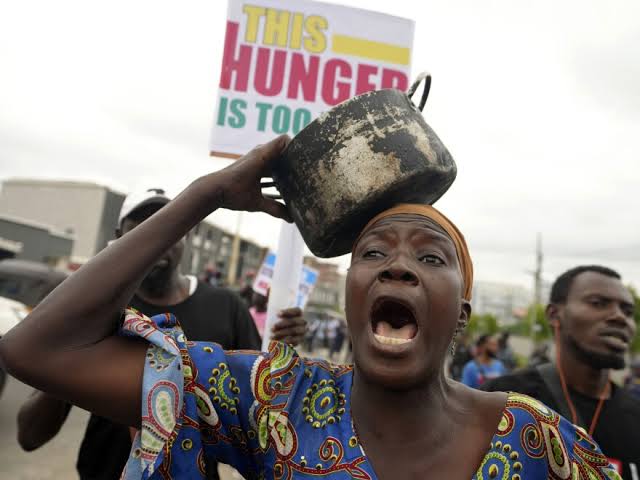
Hunger protest
Nigeria’s economic reforms may be improving some key macroeconomic indicators, but the stubbornly high cost of food, energy and transportation is preventing millions of households from fully benefiting from the recovery.
That contradiction lies at the heart of Nigeria’s economic challenge today: while official statistics point to improving macroeconomic stability, millions of Nigerians continue to experience an economy defined by expensive food, costly transportation, high energy bills, unemployment and declining purchasing power.
A voice poll conducted by the NATIONAL ACCORD Newspaper Business and Economy Desk in Abuja suburbs, including Nyanya, Kabusa and Karimo, offers a sobering picture of how citizens perceive the economy. The responses suggest a widening gap between Nigeria’s improving economic fundamentals and the financial realities confronting households, as rising living costs continue to consume a large share of disposable income.
The findings are reinforced by the World Bank’s latest assessment, which acknowledges that Nigeria has made meaningful progress towards macroeconomic stability, including stronger external and fiscal positions, improved foreign exchange conditions and resilient economic growth. Yet the bank also cautions that household incomes have not fully recovered and poverty remains high.
The contrast could hardly be more striking. Among those interviewed, an overwhelming majority expressed negative views about prevailing economic conditions. About 96 per cent said they did not believe the economy had improved significantly. Respondents also reported shortages or difficulties relating to food, medical care, transportation, water and cooking fuel, while unemployment emerged as one of their most pressing concerns.
The rising cost of living was identified as the most frequently cited issue Nigerians want the government to address. Poverty, unemployment, transportation and economic management also ranked prominently among the concerns raised by citizens, alongside crime and insecurity.
These responses matter because they highlight a fundamental weakness in judging an economy exclusively by its headline indicators. A country can record stronger GDP growth, improved foreign exchange conditions and greater fiscal stability while households remain unable to afford basic necessities.
The food problem
Food remains one of the clearest tests of whether Nigeria’s economic recovery is translating into improved welfare.
The World Bank has previously estimated that poor Nigerian households spend as much as 70 per cent of their income on food. That means even a relatively modest increase in food prices can leave families with significantly less money for rent, education, healthcare, transportation and other essential needs.
The bank’s analysis also showed that prices of food products most consumed by poor households increased about fivefold between 2020 and 2024. Food prices in Nigeria, it noted, rose much faster than in peer countries, reflecting deep structural problems involving agricultural inputs, insecurity, logistics, infrastructure and market access.
Those pressures have not disappeared. The National Bureau of Statistics reported headline inflation of 15.39 per cent in August 2026, while food inflation stood considerably higher at 19.57 per cent.
For ordinary households, the distinction is crucial. A decline in headline inflation does not mean that food has become cheaper. It simply means that prices are increasing at a slower rate than before.
That difference is often lost in the celebration of declining inflation figures. For a family already struggling to buy food, what matters is not merely whether prices are rising more slowly, but whether wages and household incomes are rising fast enough to afford those prices.
Transport: The hidden tax on households
Transportation provides another important channel through which the costs of economic adjustment reach households.
The National Bureau of Statistics’ monthly Transport Fare Watch tracks fares across Nigeria’s 774 local government areas and the Federal Capital Territory, providing a picture of what households actually pay to move around the country.
The problem, however, extends far beyond the cost of commuting to work.
Higher fuel and transportation costs increase the expense of moving agricultural produce from rural communities to urban markets. They also raise the cost of transporting manufactured goods, raw materials and other products across the country.
The result is a multiplier effect.
Higher fuel prices raise transport costs. Higher transport costs increase distribution expenses. Businesses pass some of those costs to consumers. Consumers then face higher prices for food and other necessities. In effect, transportation becomes a hidden tax on both households and businesses.
The World Bank has identified transportation, electricity, storage and logistics as structural bottlenecks that must be addressed if lower inflation is to translate into improved living standards.
The International Monetary Fund has similarly warned that rising domestic and international transportation costs could weigh on Nigeria’s non-oil economic activity. Higher food and fuel prices, it projected, could add to inflationary pressure and weaken economic activity.
Energy costs remain a major vulnerability.
Nigeria’s energy challenge further exposes the fragility of the household recovery. Recent increases in petrol prices have demonstrated how vulnerable households and businesses remain to changes in energy costs.
Reuters reported in September that petrol prices had risen to about ₦1,400 per litre in Lagos and Abuja, with prices reaching as high as ₦1,500 in parts of northern Nigeria. Diesel prices had also moved above ₦2,000 per litre. The development came despite the operation of the Dangote refinery at full capacity, highlighting the continued exposure of the domestic fuel market to international crude oil prices and other market forces.
For manufacturers, farmers, transport operators and distributors, higher energy costs translate into higher operating expenses. For households, the consequences eventually appear in the form of more expensive transportation, food and other essential goods.
The IMF consequently projected that higher food and fuel prices could push Nigeria’s inflation rate to about 17 per cent by the end of 2026 under its baseline scenario.
_Macroeconomic gains, household pain_
The central question confronting Nigeria’s economic policymakers is therefore no longer simply whether the reforms are working at the macroeconomic level.
The more important question is whether they are working for the average Nigerian.
Nigeria’s real GDP grew by 4.2 per cent in the first half of 2026, according to the World Bank, compared with 3.9 per cent a year earlier. The bank attributed the growth largely to services and stronger agricultural activity.
But growth alone does not automatically translate into prosperity.
The World Bank has cautioned that Nigeria’s current growth rate remains insufficient to create enough productive jobs and materially reduce poverty.
This is where the disconnect between GDP and household welfare becomes important. GDP can expand while households remain under pressure when economic growth is concentrated in sectors that generate relatively few jobs, or when increases in prices outpace increases in incomes.
The World Bank estimates that 69.6 per cent of Nigerians lived below the lower-middle-income poverty line of $4.20 a day in 2025, while 50.8 per cent, equivalent to about 123 million people, lived in extreme poverty.
The IMF has also estimated poverty at 63 per cent using Nigeria’s national poverty line and reported that 27 million Nigerians faced food insecurity in late 2025. It warned that poverty and food insecurity could worsen if food and fuel prices remain elevated.
These figures raise an uncomfortable question: What does economic recovery mean if a large proportion of citizens cannot feel it in their pockets?
There is little doubt that some of the government’s reforms were necessary. The removal of the petrol subsidy, foreign-exchange reforms and tighter macroeconomic policies were designed to correct long-standing distortions, improve fiscal sustainability and restore investor confidence. These measures have contributed to improvements in some areas of macroeconomic stability.
But reform has also imposed significant adjustment costs.
Consumers have borne much of the immediate burden through higher transportation, food, energy and other living expenses.
This is where the next phase of Nigeria’s economic programme becomes critical. Stabilisation cannot be the final destination. It must create the conditions for inclusive growth and rising household incomes.
The government therefore needs to move beyond celebrating macroeconomic indicators and focus more aggressively on the supply-side problems that keep prices elevated.
That means improving agricultural productivity, securing farming communities, strengthening transport infrastructure, expanding storage and cold-chain facilities, improving electricity supply, reducing logistics costs and ensuring that public spending produces measurable economic benefits.
Businesses are feeling the pressure too. The cost-of-living crisis is not only a household problem. It is increasingly a business problem.
Persistent food, energy and transport inflation raises the cost of fuel, employee transportation, logistics, raw materials and distribution.
Small businesses are particularly vulnerable because they often lack the financial capacity to absorb higher operating costs. Yet passing the entire increase on to consumers is also difficult because households whose purchasing power has been weakened by inflation have less capacity to spend. This creates a dangerous cycle:
Higher operating costs → higher prices → weaker consumer demand → lower sales → reduced investment → pressure on employment.
If that cycle persists, the consequences could extend beyond household welfare to economic growth itself.
Weak purchasing power can undermine consumption, while high production and logistics costs can discourage private-sector investment and job creation. In that sense, persistent inflation is not merely a social problem; it is also a threat to the sustainability of the economic recovery.
_The real test of reform_
Nigeria’s economic reforms should ultimately be judged not only by the exchange rate, foreign reserves, GDP growth or fiscal balances, important as those indicators are. They should also be judged by whether Nigerians can buy more food with their incomes, travel to work at affordable costs, run businesses without crippling energy expenses and secure productive employment.
The government’s immediate policy challenge is therefore to ensure that the gains from macroeconomic stabilisation are not undermined by persistent supply-side inflation.
Monetary policy alone cannot solve the problem. Nigeria needs stronger agricultural production, improved security, better roads and rail infrastructure, reliable electricity, expanded storage and cold-chain systems, more efficient markets and targeted social protection for vulnerable households.
The real measure of economic recovery is ultimately simple: Can ordinary Nigerians afford a better life than they could before the reforms began?
Until food, transportation and energy costs moderate and household incomes begin to grow faster than living expenses, Nigeria’s recovery risks remaining more visible in national statistics than in the daily experience of the people.
That is the uncomfortable gap the government must now close.