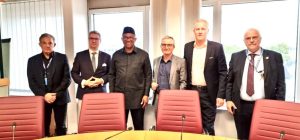
Minister of Interior, Olubunmi Tunji-Ojo
Bunmi Tunji-Ojo Skill Acquisition and Training (BTOSAT) programme is opening new business opportunities for youths in Ondo State by linking vocational training with production and contracts.
The development emerged at the 11th BTOSAT Business Development Meeting, where beneficiaries displayed products made from their training and shared how the programme had changed their economic prospects.
Supported by the Minister of Interior, Olubunmi Tunji-Ojo, the programme draws participants from communities covered by the Ondo Community Connect (OCC) initiative.
Rather than stop at skills acquisition, the programme seeks to help beneficiaries apply their knowledge, secure contracts and build sustainable businesses.
OCC State Coordinator, Iretidola Akinrowo Ojekhoa, said the real measure of success was what participants achieved after completing their training.
“We are not just interested in saying we have trained 53 people. We want to see what happens after the training,” Ojekhoa said.
More than 100 people registered for the programme, while 53 participants from six groups completed the training.
The groups received training in solar and inverter installation, shoemaking and leatherwork, bar soap and detergent production, perfumery and air freshener production.
They also learnt liquid soap and Super Wash production.
Ojekhoa said some beneficiaries had already secured contracts and were becoming partners in projects linked to OCC.
“We are trying to create a system where people are trained, they practise what they have learnt and then they get opportunities to earn from it,” she said.
She pointed to the shoemaking and leatherwork group as an example of how the model could work.
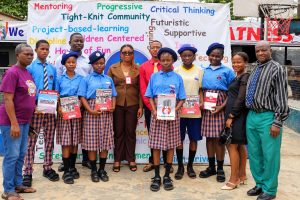
The group produced school bags that were distributed to schoolchildren at the beginning of a new academic term.
Ojekhoa said the project showed that vocational skills could serve practical needs while creating a market for beneficiaries.
“We want the beneficiaries to be able to stand on their own. The ultimate goal is for them to use the skills, get contracts, produce and also train other people,” she said.
The latest meeting followed two weeks of market surveys and branding exercises designed to help the beneficiaries understand their customers and improve their products.
During the meeting, the solar and inverter team gave updates on ongoing field contracts.
The shoemaking and leatherwork group also showcased bags and shoes that OCC continues to purchase.
Beneficiaries in perfumery, bar soap, liquid soap, disinfectant wash, body creams, oils and detergent production also reported growing patronage and positive feedback.
Ojekhoa used the session to share practical lessons on branding, business development and sustainability.
She announced that the current cohort would hold its Passing Out and Exhibition Ceremony in November. Preparations would then begin for another intake next year.
She also disclosed plans to fully equip the beneficiaries’ production houses and offices.
According to her, the goal is to develop a sustainable model that can expand across Ondo State and eventually be replicated in other parts of Nigeria.
The BTOSAT programme forms part of OCC’s wider community development efforts.
OCC is targeting all 203 wards across Ondo State’s 18 local government areas. About 800 communities had registered for the initiative at the time of the meeting.
Of those communities, 110 had undergone assessments, while 74 interventions had been carried out.
The projects include solar streetlights, road rehabilitation, drainage and water schemes, as well as support for public institutions.
Ojekhoa said beneficiaries living in communities that had received OCC infrastructure projects had expressed appreciation to Tunji-Ojo for supporting the skills initiative.
For the trainees, the programme has provided an opportunity to turn classroom lessons into actual products and services.
Oluwaseyi Afolabi, a member of the Shoemaking and Leatherwork group, said the team had secured contracts to produce school bags and shoes.
“We made school bags and shoes, and the school bags were given to schoolchildren. Seeing the children receive something we produced ourselves showed us that the skills we learnt could actually help people,” he said.
Afolabi added that the group had received a generator and an industrial machine to strengthen its production capacity.
Another beneficiary, Akinmolayan Olasinbo, from Idanre and resident in Akure North, said the perfumery training had given him a skill he could use independently.
“I can now produce perfume myself, and I can also teach somebody else what I have learnt. Before the training, I did not have this level of knowledge,” Olasinbo said.
Michael Moses Abiodun of Mercy Land said he initially doubted the programme but became convinced after the practical training started.
“I was initially thinking it could be a scam, but when we started the training, I realised it was real. We were taught practically and encouraged to use what we learnt,” he said.
Another beneficiary, Abimbola Akinbinu, said she could now produce bar soap, detergent, perfume, liquid soap and air freshener without supervision.
The school-bag project illustrates the programme’s approach of connecting skills training with actual community needs.
OCC said its wider intervention strategy identifies community priorities through physical assessments. It considers factors including impact, urgency, cost-effectiveness and speed of delivery when selecting projects.