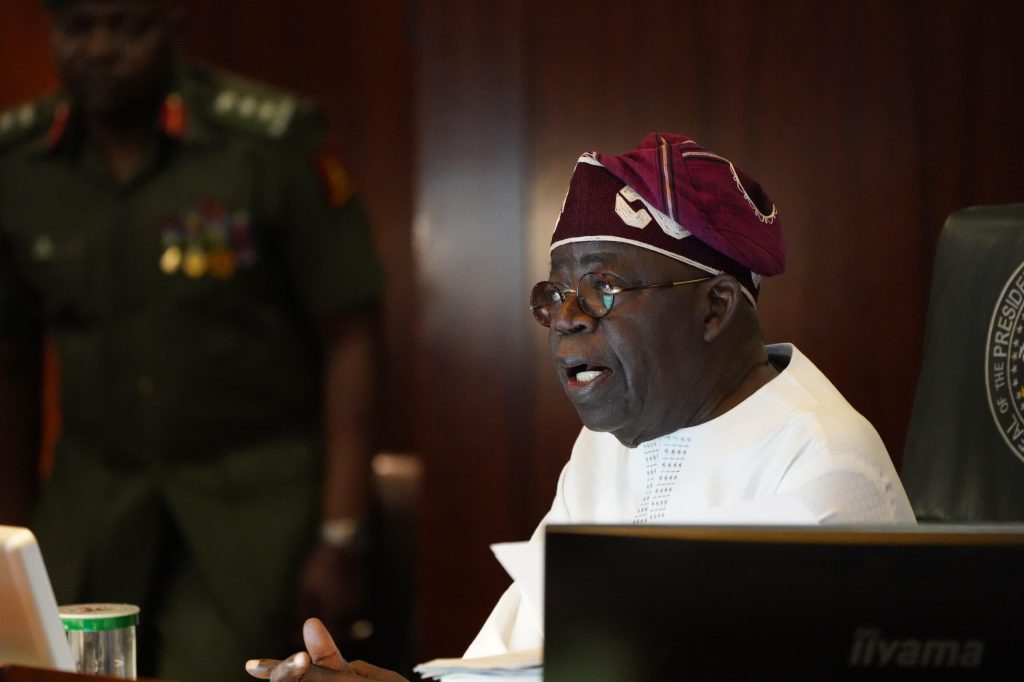
President Bola Tinubu
Nigeria has appealed to the international community to stop what it described as a “naming and shaming” approach when addressing the country’s security difficulties, insisting that genuine partnership is the only path to lasting solutions.
The call was made in New York by Syndoph Endoni, Nigeria’s Chargé d’Affaires at the Permanent Mission to the United Nations, while presenting Nigeria’s position at a UN Security Council session on the illicit spread of small arms and light weapons and its devastating impact across the Sahel.
Endoni warned that the unchecked movement of small arms has worsened conflicts and prolonged insurgencies, giving terrorist and extremist groups the firepower to wreak havoc.
“The human toll, including lives lost, communities displaced and livelihoods destroyed, remind us that this is not merely a security issue but a profound humanitarian and developmental concern,” he said.
He condemned the violence made possible by these widely accessible weapons, saying such acts “are inhuman, wicked and outrightly unacceptable.”
According to him, “It is not by naming and shaming that we can solve this enormous problem but only by working together that the problem can be solved.”
Nigeria’s remarks come against the backdrop of the United States listing the country as a “Country of Particular Concern” over alleged religious persecution — a designation Nigerian authorities have strongly dismissed.
Endoni told the Council that the steady flow of illicit arms remains a major threat to peace and stability in the Sahel.
“In the Sahel, the convergence of illicit arms trafficking, terrorism, organised crime and human trafficking has created a complex security environment that threatens not only regional but also international peace and security,” he said.
For Nigeria, he added, the consequences are “direct and severe,” as illegal weapons continue to fuel terrorism, sustain banditry, inflame communal clashes and undermine progress toward sustainable development.
He highlighted steps Nigeria has taken to curb the problem, including the creation of the National Centre for the Control of Small Arms and Light Weapons in 2021 to coordinate national efforts and align them with global arms-control standards.
Regionally, Nigeria maintains close collaboration with ECOWAS and the Multinational Joint Task Force to strengthen border controls, share intelligence and carry out joint operations targeting trafficking networks and arms supplies to criminal groups.
On the global stage, he noted that Nigeria remains committed to the UN Programme of Action, the International Tracing Instrument and the Arms Trade Treaty — which Nigeria was the first African country to sign and ratify. These frameworks, he said, are essential to stopping illicit arms flows and enforcing greater accountability.
He urged the Security Council to ensure that small arms control is woven into wider strategies on conflict prevention, peacekeeping and peacebuilding, and emphasised the need for effective implementation of sanctions regimes and arms embargoes.
Nigeria also called for more international assistance in technology transfer, border security and capacity-building, alongside deeper cooperation between the UN, regional bodies and national governments to address the root causes of instability — from poverty and inequality to weak governance and limited opportunities for young people.
Endoni reaffirmed Nigeria’s commitment to working with all partners for a peaceful and stable Sahel “where small arms and light weapons no longer threaten our collective aspiration for lasting stability and development.”