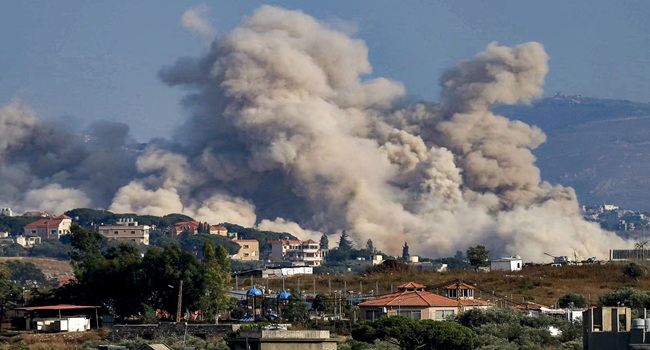
Smoke rises following an Israeli controlled-explosion on the village of Kfartibnit as seen from Nabatieh in southern Lebanon on July 29, 2026. While violence has declined since the signing of a preliminary US-Iran deal in June and the Lebanon-Israel agreement, Lebanon continues to report intermittent Israeli strikes and artillery shelling on the south. Lebanon's army on July 26 condemned ongoing Israeli military activities that it said were preventing its full deployment under the framework deal. (Photo by Ammar Ammar / AFP) /
United States (US) has resumed military strikes against Iran, targeting two rocket launchers on Larak Island in the strategically important Strait of Hormuz.
According to the US military, the operation was carried out on Sunday after intelligence indicated that forces of Iran’s Islamic Revolutionary Guard Corps (IRGC) were preparing to deploy rockets alongside sea mines into the vital shipping corridor.
“Earlier today, US forces struck two Iranian launchers on Larak Island. Islamic Revolutionary Guard Corps forces were observed preparing to launch rockets with sea mines into the Strait of Hormuz,” US Navy Captain Tim Hawkins said in a message to AFP.
The latest operation marks the first American strike on Iranian territory since late July and comes amid renewed tensions in one of the world’s busiest maritime routes.
The US Central Command (CENTCOM) said the strikes were intended to prevent any attempt to disrupt international shipping.
“US forces took limited, precise action against IRGC minelaying forces posing an imminent threat in the Strait of Hormuz,” CENTCOM said in a post on X.
In recent weeks, President Donald Trump’s administration had focused largely on economic measures against Tehran rather than direct military action.
Iran has effectively blocked the Strait of Hormuz, a key global oil transit route through which about one-fifth of the world’s crude oil moved before hostilities escalated following US and Israeli strikes on Iran on February 28.
The US military said it had only recently completed clearing sea mines from international shipping lanes in the strait.
“Last week, CENTCOM completed clearing sea mines from the strait’s international shipping routes,” Hawkins said.
He added, “US forces are monitoring the area closely and remain prepared to protect the free flow of commerce through this essential waterway.”
Although an April ceasefire ended the heaviest phase of the conflict, intermittent attacks—mostly around the Strait of Hormuz—have continued, raising concerns over the chances of reaching a lasting peace agreement.
Before Sunday’s operation, the last US strike on Iran took place on July 29 following what the American military described as “an attempted surprise attack on US forces” in the region. Earlier in July, CENTCOM conducted air operations against Iranian targets for 13 consecutive nights.
Throughout the conflict, Iran has responded by targeting US military facilities and allied interests across the Gulf, including locations in Kuwait, Oman, Saudi Arabia and the United Arab Emirates.
The prolonged disruption of shipping through the Strait of Hormuz has affected global markets, contributing to higher energy costs and shortages of fertiliser supplies. Oil prices also reacted to the latest developments, with both major crude benchmarks rising by at least two per cent on Monday.
AFP