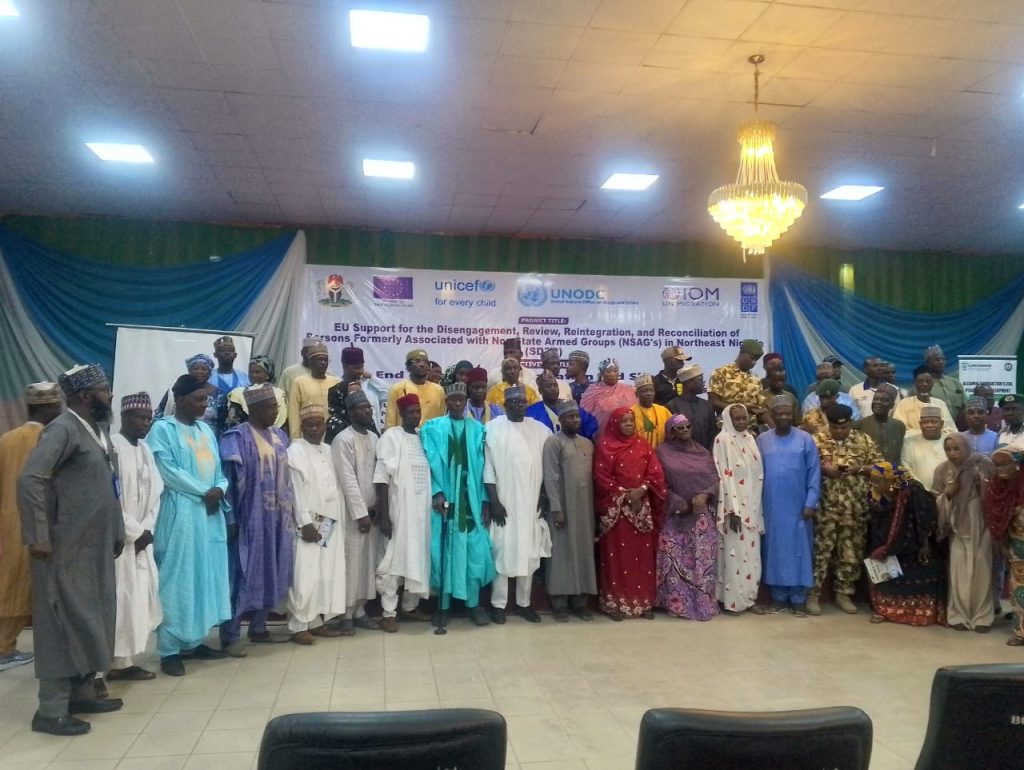
Allamin Foundation for Peace and Development, in partnership with the United Nations Development Programme (UNDP) and the European Union (EU), has concluded the implementation of its Support for the Disengagement, Deradicalisation, Reintegration and Reconciliation (SD3R) project in Borno State with a dissemination event highlighting its achievements, lessons learnt and challenges.
The event, held on Monday at Borno State Hotel in Maiduguri, brought together representatives of civil society organisations, non-governmental organisations, community-based organisations, government ministries, traditional rulers, religious leaders, security agencies, members of the Civilian Joint Task Force (CJTF), vigilante groups, former associates of non-state armed groups, conflict victims and survivors, among other stakeholders.
The six-month project, funded by the European Union, focused on supporting the disengagement, rehabilitation, reintegration and reconciliation of persons formerly associated with non-state armed groups in Bama and Gwoza Local Government Areas of Borno State.
Executive Director of the Allamin Foundation, Hajiya Hamsatu Allamin, said the initiative was implemented with the approval and support of the Borno State Government.
She explained that the project strengthened community peace structures through the establishment of Community Women Mediators Forum (CWMF) and Community Advocates for Transitional Justice (CATJ), while empowering local communities to design and implement peacebuilding initiatives.
According to her, the programme focused on equipping women mediators and community advocates with the skills needed to promote reconciliation and facilitate the reintegration of returnees into their communities.
She appreciated the European Union, the Borno State Government, local government authorities, development partners, the media, traditional and religious leaders, community stakeholders and security agencies for supporting the project.
She also commended participants who travelled from Bama and Gwoza despite security challenges to attend the dissemination programme.
The Foundation’s Monitoring and Evaluation Manager, Mallam Hamza Maigari, said the project directly and indirectly benefited hundreds of residents across the two local government areas.
He disclosed that Community Women Mediators Forum (CWMF) and Community Advocates for Transitional Justice (CATJ) were established to strengthen grassroots peacebuilding efforts.
According to him, 540 livelihood support packages were distributed to beneficiaries in Bama and Gwoza, while 120 stakeholders—60 from each community—received training across 18 vocational trades and skills.
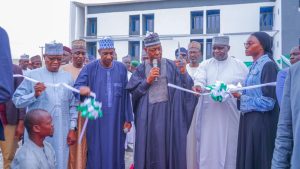
Maigari added that the foundation also implemented community impact projects, including the construction of two hand pumps, an ultra-modern borehole and drainage evacuation projects in both communities.
He said beneficiaries also received livelihood support in areas such as shoe-making, phone charging businesses, petty trading and community savings and loan initiatives.
Speaking on lessons learnt during implementation, Maigari noted that strengthening women mediators had enhanced community peacebuilding, but admitted that the available livelihood support could not meet the needs of every resident.
He added that sustaining local peace structures and community assets would remain critical to preserving the gains recorded under the project.
Several beneficiaries narrated how the intervention had transformed their lives.
One member of the Community Advocates for Transitional Justice (CATJ), who identified himself as a former member of an armed group, said:
“I was a former armed group member, but I surrendered through the support of General Ishaq, and I appreciate Allamin Foundation for the support rendered.”
A female beneficiary recounted surviving a gunshot attack while travelling with her husband.
She thanked the foundation for the livelihood assistance and appealed for educational support for children affected by the insurgency.
An elderly community leader, Baba Modu, also praised the organisation.
He said: “The knowledge of transitional justice gained from the Allamin Foundation has gone a long way in ensuring peace and development. Before the coming of Allamin Foundation, many organisations came to our community without achieving results. It was only when Allamin Foundation came that we began to see real impact.”
He appealed for similar peacebuilding interventions in newly reopened communities recovering from the insurgency.
A representative of beneficiaries from Gwoza assured the foundation that residents would continue to uphold the peace initiatives introduced through the project while appealing for additional support for vulnerable members of the community who were yet to benefit.
The Shehu of Bama, represented by the Secretary of the Emirate Council, Alhaji Makita Usman, described Bama as one of the communities worst affected by the Boko Haram insurgency.
He praised the foundation for establishing the Community Women Mediators Forum and Community Advocates for Transitional Justice, as well as providing livelihood support to displaced families.
According to him, the intervention had contributed to reducing anti-social behaviour, including reckless motorcycle riding and drug abuse among some returnees.
He urged the Borno State Government and development partners to sustain support for the peace structures established under the project.
The Emir of Gwoza, represented by the Marafa of Gwoza, Alhaji Mohammed Lawan, said the foundation had significantly reduced hardship in the community.
He noted that relationships between returnees and host communities had improved, with families now intermarrying as trust continued to grow.
He also appreciated the foundation for donating equipment such as wheelbarrows and shovels to support community development.
UNDP, Military Back Reintegration Efforts
Stakeholders, including representatives of government ministries, local government councils, security agencies and development organisations, commended the Allamin Foundation for complementing government efforts in promoting peace, reconciliation and the rule of law in Borno State.
Representatives of the United Nations Development Programme (UNDP) praised the foundation and traditional institutions for the successful implementation of the SD3R project, which supported more than 500 beneficiaries.
Special Adviser to Governor Babagana Zulum on Security, Brig.-Gen. Abdullahi Sabi (rtd.), said the state government would continue collaborating with the foundation to encourage the successful reintegration of former associates of non-state armed groups.
Also speaking, the Theatre Commander of Operation Hadin Kai, Maj.-Gen. Abdulsalam Abubakar, acknowledged the contributions of the Allamin Foundation to peacebuilding.
He assured participants of the military’s continued support in eliminating the remaining insurgent elements while promoting peace, unity and development across the North-East.
Stakeholders unanimously described the SD3R initiative as one of the most impactful humanitarian and peacebuilding interventions currently complementing government efforts to restore lasting peace in conflict-affected communities of Borno State.