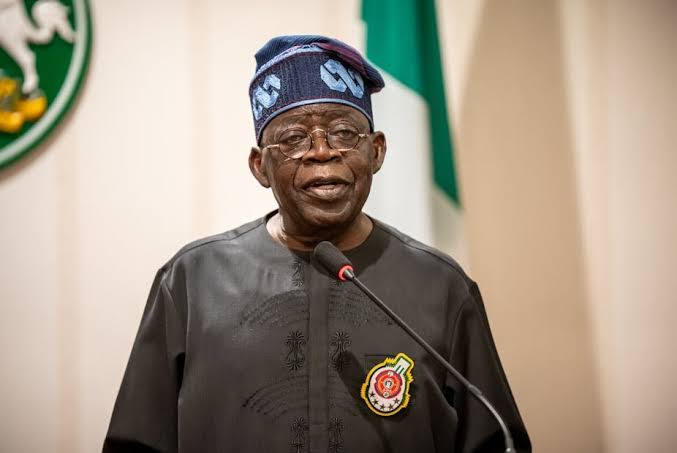
President Bola Tinubu
President Bola Tinubu has said Nigeria will no longer remain an exporter of raw materials and an importer of finished goods, declaring that the country must become Africa’s industrial hub.
Tinubu stated this on Tuesday October 6 in Lagos while addressing the 6th Adeola Odutola Lecture and Presidential Luncheon organised by the Manufacturers Association of Nigeria where he was represented at the event by the Minister of State for Industry, Senator John Enoh.
The event was themed, “Leveraging National Industrial Policy to Position Nigeria as Africa’s Industrial Hub.”
The President said the Federal Government’s industrial policy was aimed at expanding manufacturing, increasing local value addition and strengthening Nigeria’s position in the African market.
“Nigeria will not be Africa’s warehouse, storing what others make. Nigeria will be Africa’s workshop, making what Africa needs, and sending it with pride across the continent and beyond,” he said.
Tinubu expressed concern that manufacturing’s contribution to Nigeria’s Gross Domestic Product had declined from more than 20 per cent in the early 1990s to below 10 per cent in 2024.
He said reversing the decline remained a major priority of his administration, noting that the manufacturing sector grew by 3.29 per cent in the first quarter of 2026 and 3.24 per cent in the second quarter.
However, he acknowledged that manufacturers were still facing major challenges, particularly high financing and operating costs.
The President said the National Industrial Policy, unveiled in February 2026, seeks to raise manufacturing’s contribution to between 20 and 25 per cent of GDP by 2030, with industrial financing of up to five per cent of GDP.
He said the government would prioritise improved electricity supply, affordable long-term financing, fair competition, security along industrial corridors and stronger accountability in implementing industrial policies.
Tinubu also said the Industrial Revolution Work Group would hold quarterly meetings with manufacturers to monitor the implementation of government policies and address emerging challenges.
He identified the African Continental Free Trade Area as a major opportunity for Nigerian manufacturers, noting that it provides access to a continental market of about 1.4 billion people with a combined GDP of approximately $3.4tn.
The President urged manufacturers to increase production, deepen backward integration, meet international export standards and invest in training young Nigerians.
He also called on manufacturers to regard Africa as their home market and move away from a pattern in which Nigeria exports raw cocoa, crude oil and cotton but imports chocolate, refined petroleum products and clothing.
“We are writing a new chapter, and we are writing it in factories,” Tinubu said.
The central message is consistent with the President’s broader industrialisation agenda: Nigeria wants to shift from exporting commodities and importing finished products toward local processing, manufacturing and exports, although achieving that goal will depend heavily on cheaper finance, reliable power and lower operating costs.