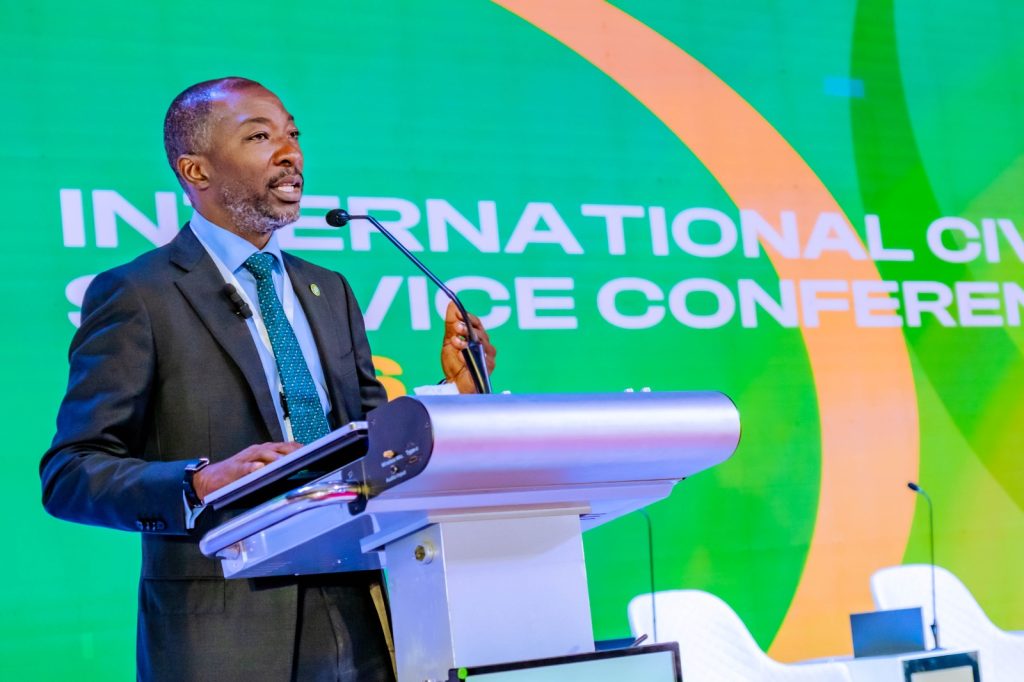
Managing Director of the Fund, Oluwaseun Faleye, speaking on Wednesday during the 2026 International Civil Service Conference in Abuja.
Managing Director of the Nigeria Social Insurance Trust Fund (NSITF), Oluwaseun Faleye, has called for stronger cooperation among government agencies, saying workers’ welfare requires more than paying compensation after workplace injuries or illnesses.
Faleye made the call on Thursday in Abuja at a technical retreat on Presidential Priorities, Ministerial Deliverables and the Performance Management System (PMS), where he urged public institutions to coordinate their efforts to improve workers’ protection and social security.
Represented by his Technical Assistant, Dayo Aloa, the NSITF boss commended the Federal Ministry of Labour and Employment for bringing agencies together to discuss shared responsibilities and improve public service delivery.
He said the success of government institutions depended not only on their individual performance but also on how effectively they worked together to address challenges affecting Nigerians.
Faleye said NSITF and the Ministry shared a responsibility to strengthen institutions and improve the welfare and security of workers.
Explaining the Fund’s mandate, he said NSITF administers the Employees’ Compensation Scheme (ECS), established under the Employees’ Compensation Act 2010, which provides compensation and support for workers and their dependants in cases of work-related injuries, occupational diseases, disability and death.
He said the scheme was founded on the principle that workers and their families should not be left without support when workplace incidents threaten their livelihoods.
However, Faleye stressed that protecting workers went beyond processing claims and paying compensation. He said employers must meet their statutory obligations, workers need greater awareness of the protections available to them, and relevant institutions must work together to improve workplace health and safety.
He linked workers’ welfare to productivity, industrial harmony and sustainable economic development, noting that employees who feel protected are better positioned to contribute meaningfully to their organisations.
Faleye urged government agencies to share information, avoid duplicating responsibilities and develop more coordinated responses to challenges facing workers and employers.
He described the retreat as an opportunity to strengthen working relationships and align institutional programmes with shared national priorities.
Looking ahead to 2027, Faleye reaffirmed NSITF’s commitment to improving the implementation of the Employees’ Compensation Scheme, strengthening service delivery, encouraging employer compliance and promoting safer workplaces.
He said the ultimate measure of public service performance should be the tangible improvements institutions deliver to the people they serve, rather than simply the activities they complete.
Faleye thanked the Permanent Secretary of the Federal Ministry of Labour and Employment and the participating agencies, expressing hope that their deliberations would lead to a more productive and secure Nigeria.