
Everton and Crystal Palace completed a direct exchange of Brennan Johnson and Dwight McNeil on August 11, only 11 days before the clubs meet at Hill Dickinson Stadium. Both players signed four-year contracts running to June 2030. Johnson arrives at Everton after 26 Palace appearances, while McNeil leaves Everton with 128 games behind him. The unusual timing also gives football betting analysis an immediate selection question before the August 22 fixture, although no documented price movement can be attributed to the swap. On the pitch, the exchange is more interesting because the two wingers bring noticeably different attacking qualities rather than filling identical roles.
Johnson gives Everton a more direct route into space
Johnson’s most obvious value comes from acceleration and movement beyond the defensive line. That profile can give Everton another option when possession changes quickly, particularly when space appears behind an opponent’s full-back.
His 26 appearances for Palace provide only a short sample at his previous club. That makes his Everton role less predictable than McNeil’s Palace role based purely on recent totals.
Johnson can play wide or closer to the centre, so his position may depend on the attackers selected around him.
A direct runner can also change the responsibilities of teammates. Central attackers may receive more room if defenders retreat to cover Johnson’s runs. Wide support can work differently as well, because an overlapping player may not need to provide all of the forward movement on that side.
Those are tactical possibilities rather than confirmed instructions. Everton’s early team sheets will show whether Johnson begins as a conventional winger or operates closer to the central forward.
McNeil offers Palace a different type of possession threat
McNeil arrives with a much larger body of Premier League work at his previous club. Across 128 Everton appearances, he recorded 15 goals and 19 assists. His left foot and delivery provide Palace with a different way to progress attacks.
That could mean more service from wider areas. It could also allow McNeil to move inside before playing toward runners ahead of him. Set-piece delivery adds another possible use, although his exact responsibilities will depend on selection.
The contrast between the two incoming players becomes clearer in a direct comparison:
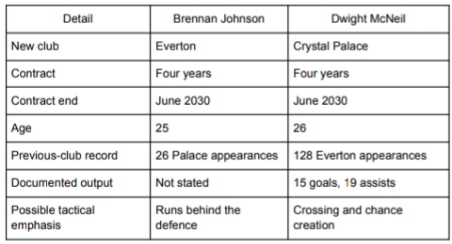
Neither contract reveals how the players were valued inside the exchange. The deal can be described as a direct swap, but that wording does not prove identical accounting values or confirm that no additional financial terms existed.
That distinction matters. Two separately negotiated cash transfers would provide published transfer prices if the clubs disclosed them. A player exchange can leave much more of the internal valuation hidden.
Betting analysis starts with the August 22 team sheets
The swap gives the opening fixture more information to process, but not an automatic betting conclusion. Match-result markets can reflect the complete team picture once availability is clearer. Total-goals analysis also depends on how both sides set up rather than on one transfer in isolation.
Player markets require even more caution before lineups are known. Appearance markets become easier to assess after credible selection information emerges. Shots or assists can then be considered in relation to each winger’s actual position.
Set-piece involvement may be relevant for McNeil if Palace assign him those duties. Johnson-related markets would depend more heavily on whether he starts wide or closer to goal.
No comparable pre-swap and post-swap odds have been documented, so a claim that bookmakers reacted to the exchange would go beyond the evidence. The same principle applies to season forecasts. One attacking change can alter projections, but it does not determine an entire points total.
Betting platforms can present match markets alongside account features such as a first deposit bonus, yet those account terms are separate from the football analysis itself. For the August 22 fixture, squad availability and confirmed roles provide the useful sporting information.
That timing is what makes the exchange unusually easy to evaluate. Everton and Palace do not wait months before facing the player they released. Eleven days after the deal, each club gets an immediate look at how the other side intends to use its new winger.
The longer judgement will take far more than one match. Johnson’s value to Everton depends on whether his direct running changes the team’s attacking routes over time.
McNeil’s Palace spell will be judged through the quality of his service and how consistently he contributes to chance creation. The four-year contracts leave room for both ideas to develop well beyond opening weekend.
Four-year contracts turn the swap into a longer tactical bet
Both agreements run until June 2030, giving Everton and Palace time to evaluate the new roles across several seasons rather than one campaign.
Long contracts can also preserve negotiating control if a player performs well. They do not establish future resale value, because no credible figure can be projected from the information available today.
The immediate sporting question is simpler: who starts on August 22?
Johnson has less than two weeks between completing the move and facing Palace. McNeil works with the same narrow preparation window before returning to face Everton. Neither player has a guaranteed place in the opening lineup.
The match therefore provides an unusually quick test of the swap. If Johnson starts, attention will fall on how often Everton try to release him into space. If McNeil is selected, Palace’s use of his delivery will provide an early clue about whether his role differs from the one he left behind.
Other attacking players could benefit in different ways. Johnson’s forward running may create room for teammates receiving the ball between the lines. McNeil’s passing from wider positions may instead favour attackers who make movements toward the penalty area.
The relevant measures will become clearer once competitive football begins. Crossing volume can help show how Palace use McNeil, while progressive carries can help describe Johnson’s role at Everton. Transition frequency offers another team-level clue, but it cannot be assigned to one winger alone.